







Question: CHAPTER 14: t TEST FOR TWO INDEPENDENT SAMPLES Key Terms Two independent sample Observations in one sample are not paired, on a one~to~one basis, with
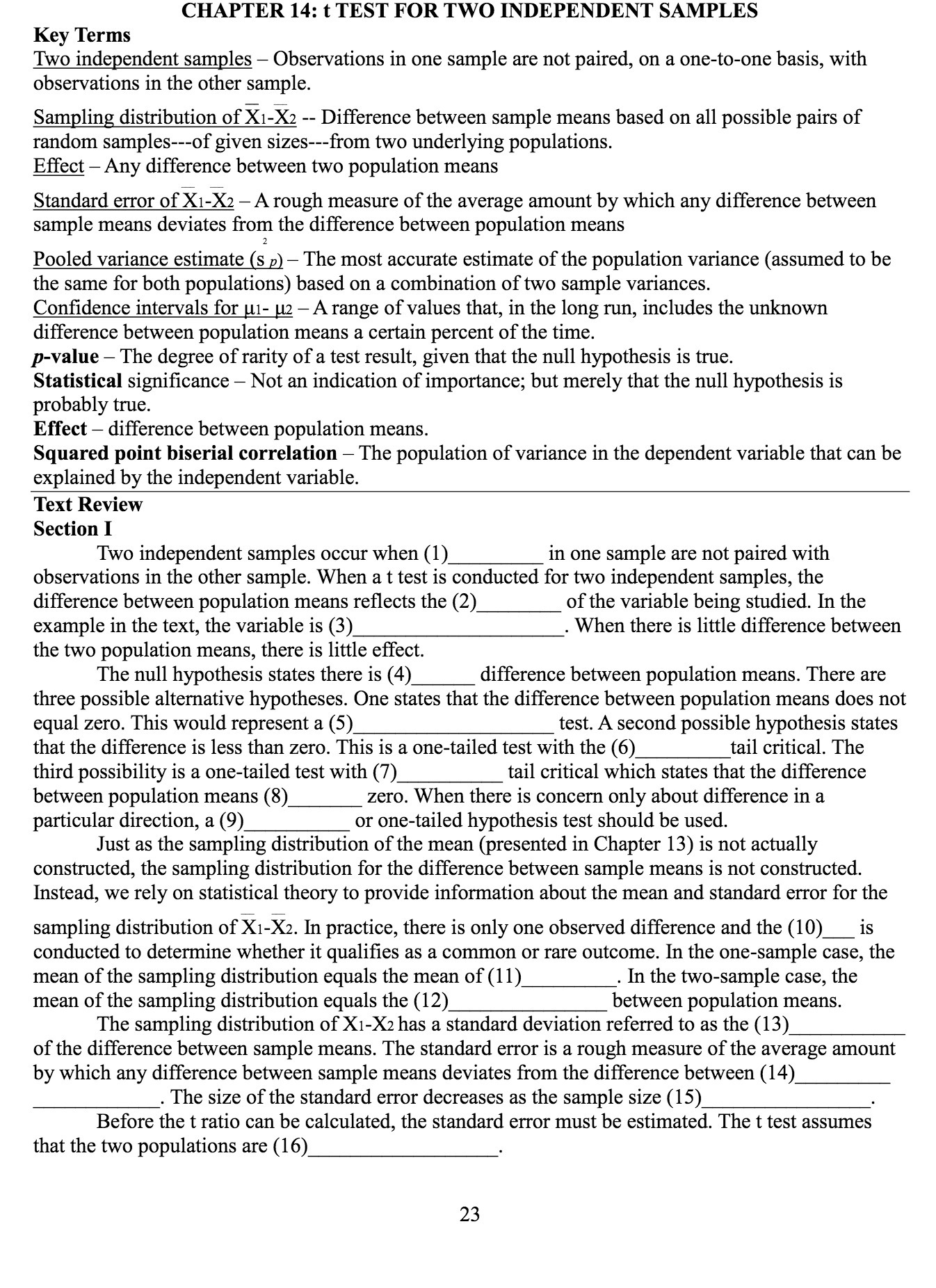
CHAPTER 14: t TEST FOR TWO INDEPENDENT SAMPLES Key Terms Two independent sample Observations in one sample are not paired, on a one~to~one basis, with observations in the other sample. Sampling distribution of ii-Tiz - Difference between sample means based on all possible pairs of random samples---of given sizes---frorn two underlying populations. Effect 7 Any difference between two population means Standard error of iiii2 A rough measure of the average amount by which any difference between sample means deviates from the difference between population means Pooled variance estimate (3 a) The most accurate estimate of the population variance (assumed to be the same for both populations) based on a combination of two sample variances. Condence intervals for gi \"g Arange of values that, in the long run, includes the unknown difference between population means a certain percent of the time. p-value i The degree of rarity of a test result, given that the null hypothesis is true. Statistical signicance Not an indication of importance; but merely that the null hypothesis is probably true. Effect difference between population means. Squared point biserial correlation The population of variance in the dependent variable that can be explained by the independent variable. Text Review Section I Two independent samples occur when (1) in one sample are not paired with observations in the other sample. When a t test is conducted for two independent samples, the difference between population means reflects the (2) of the variable being studied. In the example in the text, the variable is (3) . When there is little difference between the two population means, there is little effect. The null hypothesis states there is (4) difference between population means. There are three possible alternative hypotheses. One states that the difference between population means does not equal zero. This would represent a (5) test. A second possible hypothesis states that the difference is less than zero. This is a one-tailed test with the (6) tail critical. The third possibility is a one~tailed test with (7) tail critical which states that the difference between population means (8) zero. When there is concern only about difference in a particular direction, a (9) or onetailed hypothesis test should be used. Just as the sampling distribution of the mean (presented in Chapter 13) is not actually constructed, the sampling distribution for the difference between sample means is not constructed. Instead, we rely on statistical theory to provide information about the mean and standard error for the sampling distribution of Fir-i2. In practice, there is only one observed difference and the (10)_ is conducted to determine whether it qualies as a common or rare outcome. In the one-sample case, the mean of the sampling distribution equals the mean of (11) . In the two-sample case, the mean of the sampling distribution equals the (12) between population means. The sampling distribution of Xl-XZ has a standard deviation referred to as the (13) of the difference between sample means. The standard error is a rough measure of the average amount by which any difference between sample means deviates from the difference between (14) . The size of the standard error decreases as the sample size (15) . Before the t ratio can be calculated, the standard error must be estimated. The t test assumes that the two populations are (16) 23
Step by Step Solution
There are 3 Steps involved in it

Get step-by-step solutions from verified subject matter experts
 Study Help