







Question: CHAPTER 15: t TEST FOR TWO RELATED SAMPLES (Repeated Measures) Key Terms Two Related/Matched samples-Each observation in one sample is paired, on a one-to-one basis,
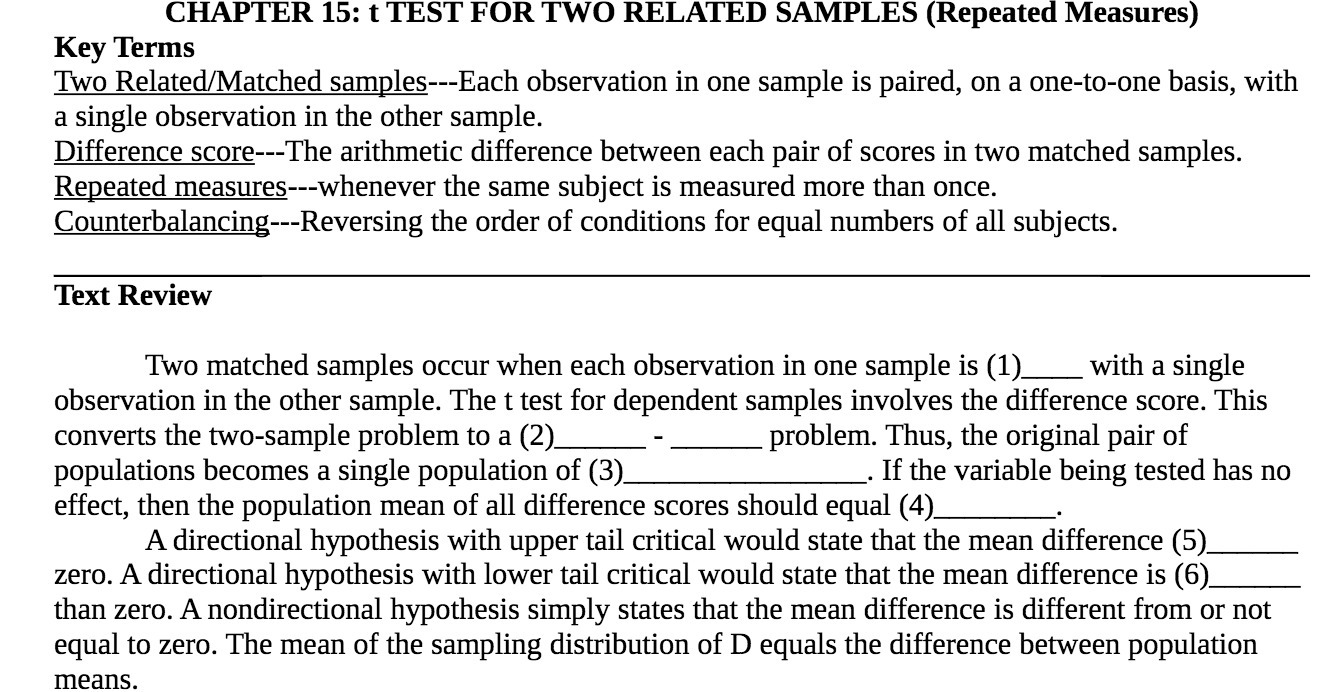
CHAPTER 15: t TEST FOR TWO RELATED SAMPLES (Repeated Measures) Key Terms Two Related/Matched samples-"Each observation in one sample is paired, on a one-to-one basis, with a single observation in the other sample. Difference score---The arithmetic difference between each pair of scores in two matched samples. Repeated measures---whenever the same subject is measured more than once. Counterbalancing---Reversing the order of conditions for equal numbers of all subjects. 'bet Review Two matched samples occur when each observation in one sample is (1) with a single observation in the other sample. The t test for dependent samples involves the difference score. This converts the two-sample problem to a (2) - problem. Thus, the original pair of populations becomes a single population of (3) .If the variable being tested has no effect, then the population mean of all difference scores should equal (4) A directional hypothesis with upper tail critical would state that the mean difference (5) zero. A directional hypothesis with lower tail critical would state that the mean difference IS (6) than zero. A nondirectional hypothesis simply states that the mean difference is different from or not equal to zero. The mean of the sampling distribution of D equals the difference between population means
Step by Step Solution
There are 3 Steps involved in it

Get step-by-step solutions from verified subject matter experts
 Study Help