







Question: Chapter 14 The demand for subassembly S is 140 units in week 7. Each unit of S requires 2 units of T and 2 units
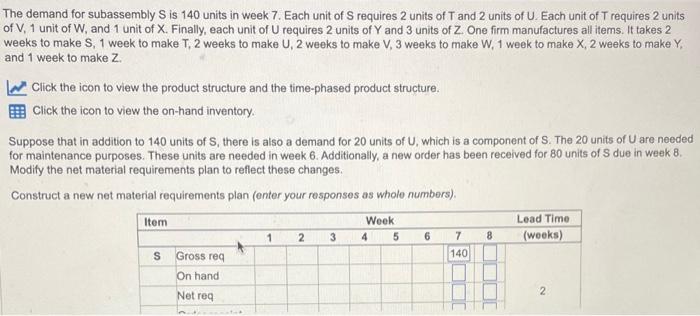
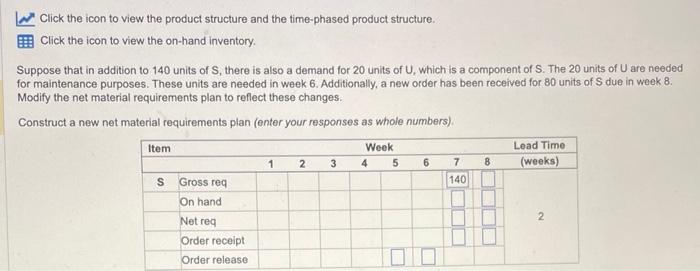
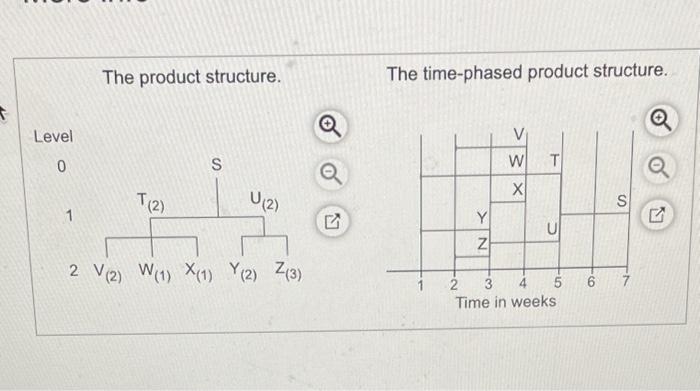
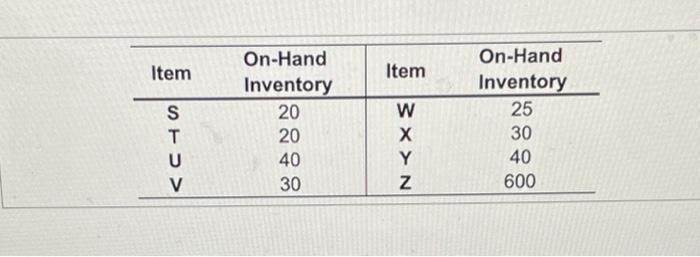
The demand for subassembly S is 140 units in week 7. Each unit of S requires 2 units of T and 2 units of U. Each unit of T requires 2 units of V,1 unit of W, and 1 unit of X. Finally, each unit of U requires 2 units of Y and 3 units of Z. One firm manufactures all iterns. It takes 2 weeks to make S,1 week to make T, 2 weeks to make U,2 weeks to make V,3 weeks to make W, 1 week to make X,2 weeks to make Y, and 1 week to make Z. Click the icon to view the product structure and the time-phased product structure. Click the icon to view the on-hand inventory. Suppose that in addition to 140 units of S, there is also a demand for 20 units of U, which is a component of S. The 20 units of U are needed for maintenance purposes. These units are needed in week 6 . Additionally, a new order has been received for 80 units of S due in week 8 . Modify the net material requirements plan to reflect these changes. Construct a new net material requirements plan (enter your responses as whole numbers). Click the icon to view the product structure and the time-phased product structure. Click the icon to view the on-hand inventory. Suppose that in addition to 140 units of S, there is also a demand for 20 units of U, which is a component of S. The 20 units of U are needed for maintenance purposes. These units are needed in week 6 . Additionally, a new order has been received for 80 units of S due in week 8 . Modify the net material requirements plan to reflect these changes. Construct a new net material requirements plan (enter your responses as whole numbers) The time-phased product structure. \begin{tabular}{cc|cc} \hline Item & On-HandInventory & Item & On-HandInventory \\ \hline S & 20 & W & 25 \\ T & 20 & X & 30 \\ U & 40 & Y & 40 \\ V & 30 & Z & 600 \\ \hline \end{tabular} The demand for subassembly S is 140 units in week 7. Each unit of S requires 2 units of T and 2 units of U. Each unit of T requires 2 units of V,1 unit of W, and 1 unit of X. Finally, each unit of U requires 2 units of Y and 3 units of Z. One firm manufactures all iterns. It takes 2 weeks to make S,1 week to make T, 2 weeks to make U,2 weeks to make V,3 weeks to make W, 1 week to make X,2 weeks to make Y, and 1 week to make Z. Click the icon to view the product structure and the time-phased product structure. Click the icon to view the on-hand inventory. Suppose that in addition to 140 units of S, there is also a demand for 20 units of U, which is a component of S. The 20 units of U are needed for maintenance purposes. These units are needed in week 6 . Additionally, a new order has been received for 80 units of S due in week 8 . Modify the net material requirements plan to reflect these changes. Construct a new net material requirements plan (enter your responses as whole numbers). Click the icon to view the product structure and the time-phased product structure. Click the icon to view the on-hand inventory. Suppose that in addition to 140 units of S, there is also a demand for 20 units of U, which is a component of S. The 20 units of U are needed for maintenance purposes. These units are needed in week 6 . Additionally, a new order has been received for 80 units of S due in week 8 . Modify the net material requirements plan to reflect these changes. Construct a new net material requirements plan (enter your responses as whole numbers) The time-phased product structure. \begin{tabular}{cc|cc} \hline Item & On-HandInventory & Item & On-HandInventory \\ \hline S & 20 & W & 25 \\ T & 20 & X & 30 \\ U & 40 & Y & 40 \\ V & 30 & Z & 600 \\ \hline \end{tabular}
Step by Step Solution
There are 3 Steps involved in it

Get step-by-step solutions from verified subject matter experts
 Study Help