







Question: Chapter 2: Application Layer 4. Describe the four basic functions of an application software package. Using these differences, explain the differences between a host-based architecture
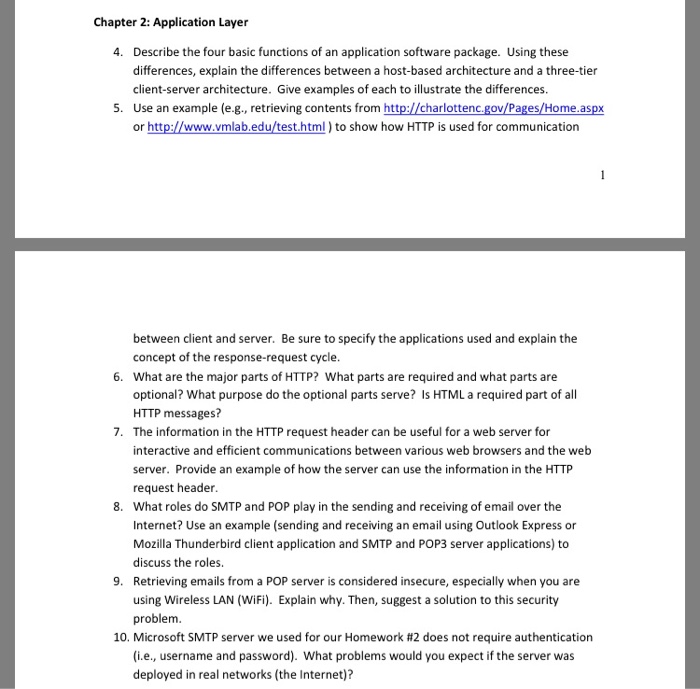
Chapter 2: Application Layer 4. Describe the four basic functions of an application software package. Using these differences, explain the differences between a host-based architecture and a three-tier client-server architecture. Give examples of each to illustrate the differences. Use an example (e.g., retrieving contents from http://charlottenc.gov/Pages/Home.aspx or http://www.vmlab.edu/test.html) to show how HTTP is used for communication 5. between client and server. Be sure to specify the applications used and explain the concept of the response-request cycle. What are the major parts of HTTP? What parts are required and what parts are optional? What purpose do the optional parts serve? Is HTML a required part of all HTTP messages? The information in the HTTP request header can be useful for a web server for interactive and efficient communications between various web browsers and the web server. Provide an example of how the server can use the information in the HTTP request header. What roles do SMTP and POP play in the sending and receiving of email over the Internet? Use an example (sending and receiving an email using Outlook Express or Mozilla Thunderbird client application and SMTP and POP3 server applications) to discuss the roles. Retrieving emails from a POP server is considered insecure, especially when you are using Wireless LAN (WiFi). Explain why. Then, suggest a solution to this security problem 6. 7. 8. 9. 10, Microsoft SMTP server we used for our Homework #2 does not require authentication (i.e., username and password). What problems would you expect if the server was deployed in real networks (the Internet)
Step by Step Solution
There are 3 Steps involved in it

Get step-by-step solutions from verified subject matter experts
 Study Help