Question: Chapter 2 Formulating and clarifying the research topic Case 2 'Helpful but not required': A student research proposal Lian was a student from China. Lian
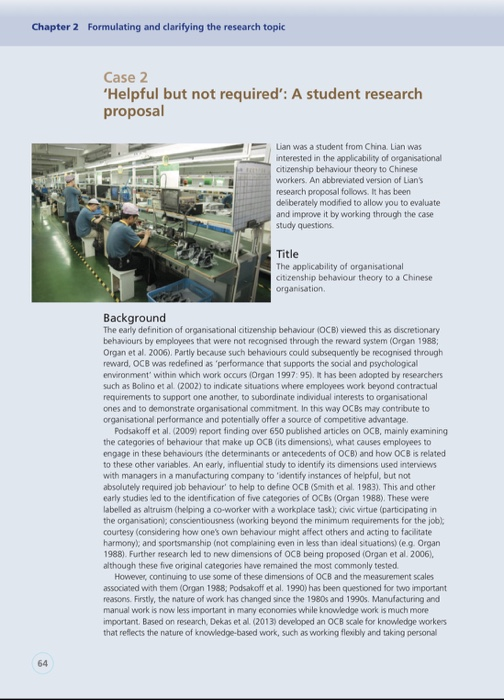
Chapter 2 Formulating and clarifying the research topic Case 2 'Helpful but not required': A student research proposal Lian was a student from China. Lian was interested in the applicability of organisational citizenship behaviour theory to Chinese workers. An abbreviated version of Lian's research proposal follows. It has been deiberately modified to allow you to evaluate and improve it by working through the case study questions Title The applicability of organisational citizenship behaviour theory to a Chinese organisation Background The early definition of organisational citizenship behaviour (OCB) viewed this as discretionary behaviours by employees that were not recognised through the reward system (Organ 1988; Organ et al. 2006). Partly because such behaviours could subsequently be recognised through reward, OCB was redefined as 'performance that supports the social and psychological environment within which work occurs (Organ 1997: 95). It has been adopted by researchers such as Bolino et al. (2002) to indicate situations where employees work beyond contractual requirements to support one another, to subordinate individual interests to organisational ones and to demonstrate organisational commitment. In this way OCBs may contribute to organisational performance and potentially offer a source of competitive advantage Podsakoff et al. (2009) report finding over 650 published articles on OCB, mainly examining the categories of behaviour that make up OCB (its dimensions, what causes employees to engage in these behaviours (the determinants or antecedents of OCB) and how OCB is related to these other variables. An early, influential study to identify its dimensions used interviews with managers in a manufacturing company to identify instances of helpful, but not absolutely required job behaviour' to help to define OCB (Smith et al. 1983). This and other early studies led to the identification of five categories of OCBs (Organ 1988). These were labelled as altruism (helping a co-worker with a workplace task); civic virtue (participating in the organisation conscientiousness (working beyond the minimum requirements for the job! courtesy (considering how one's own behaviour might affect others and acting to facilitate harmony and sportsmanship (not complaining even in less than ideal situations) (e.g. Organ 1988). Further research led to new dimensions of OCB being proposed (Organ et al. 2006). although these five original categories have remained the most commonly tested However, continuing to use some of these dimensions of OCB and the measurement scales associated with them (Organ 1988; Podsakoff et al. 1990) has been questioned for two important reasons. Firstly, the nature of work has changed since the 1980s and 1990s. Manufacturing and manual work is now less important in many economies while knowledge work is much more important. Based on research, Dekas et al. (2013) developed an OCB scale for knowledge workers that reflects the nature of knowledge-based work, such as working flexibly and taking personal 64 Case 2: 'Helpful but not required': A student research proposal initiative. This new scale overlaps with some earlier OCB dimensions but replaces or eliminates outdated items related to willingly obeying rules or regimented working practices. Secondly, questions have been asked about the transferability of OCB scales to other cultures. OCB studies may apply only to the cultural context within which they are conducted (Choi 2009). The applicability of OCB to other cultural settings therefore requires further research. Hui et al. (2004) examined the relationships between psychological contract constructs and OCBs in China. They adopted the OCB scale developed by Podsakoff et al. (1990) (see earlier) and, in part, found that that more research is required to understand how culture affects the applicability of OCB. Farh et al. (1997) examined the relationships between organisational justice theory and OCBs in China, using a Chinese OCB scale they developed. They found that the relationships between organisational justice and OCB were moderated by cultural (attitudes about either modernity or tradition) and gender factors. Some behaviour of Chinese employees may be due to socialisation or broader cultural norms and be more personally focused than organisationally related (Farh et al. 1997; Hui et al. 2004). This raises questions about the applicability of OCB in China and whether organisational justice and psychology contract constructs may be determinants or antecedents of OCB. In addition, Hui et al. (2004) point out that organisational type may affect OCB; for example, they cite research saying that Chinese employees may prefer working for a foreign-owned company rather than a state-owned enterprise. Research question and research objectives The research question is: To what extent are organisational citizenship behaviour, organisational justice and psy. chological contract theories applicable to Chinese organisations and why? The research objectives are: 1. To identify suitable measurement scales for each theory, to use in the case study Chinese organisation 2. To examine the relationship in the case study organisation between findings from the organisational justice scale and findings from the organisational citizenship behaviour scale. 3. To examine the relationship in the case study organisation between findings from the psychological contract scale and findings from the organisational citizenship behaviour scale. 4. To examine the relationship between findings in the case study organisation from the organisational citizenship behaviour scale and findings in other national contexts from organisational citizenship behaviour research. 5. To draw conclusions from the relationships observed in objectives 2, 3 and 4, to evaluate the applicability of these concepts in a Chinese organisation









 Study Help