







Question: CHAPTER 2. The Financial Mini Case This Mini Case is available in MyFinanceLab. On the first day of your summer internship, vou've been assigned to
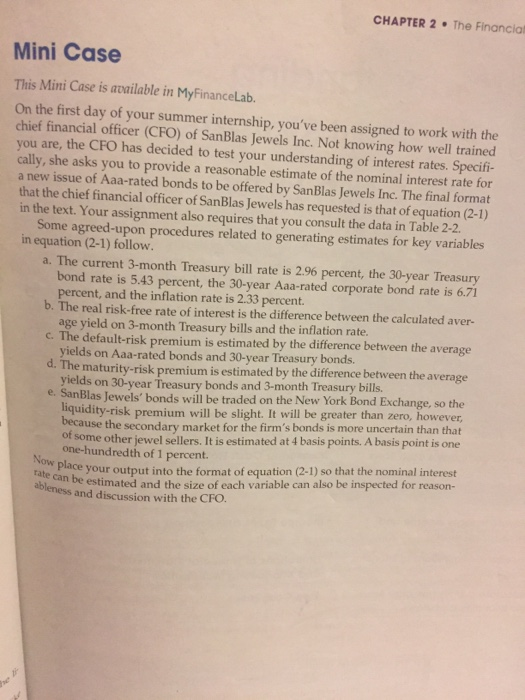
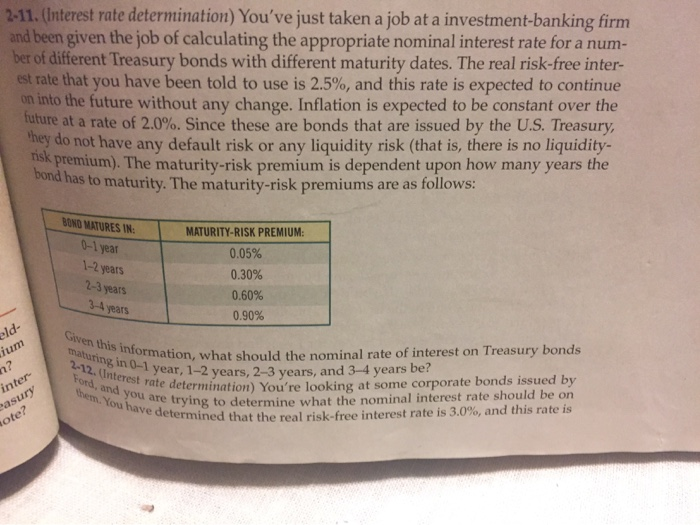
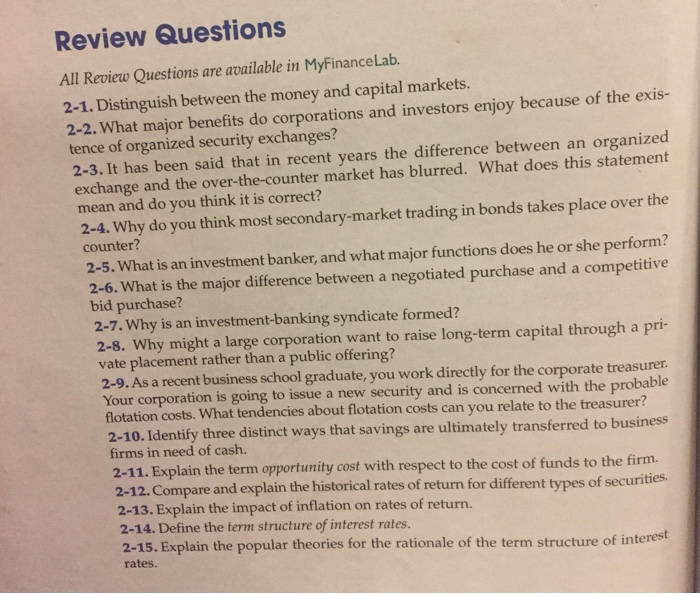
CHAPTER 2. The Financial Mini Case This Mini Case is available in MyFinanceLab. On the first day of your summer internship, vou've been assigned to work with the chief financial officer (CFO) of San Blas Jewels Inc. Not knowing how well trained you are, the CFO has decided to test your understanding of interest rates. Specifi- cally, she asks you to provide a reasonable estimate of the nominal interest rate for a new issue of Aaa-rated bonds to be offered by San Blas Jewels Inc. The final format that the chief financial officer of San Blas Jewels has requested is that of equation (2-1) in the text. Your assignment also requires that you consult the data in Table 2-2. Some agreed-upon procedures related to generating estimates for key variables in equation (2-1) follow. a. The current 3-month Treasury bill rate is 2.96 percent, the 30-year Treasury bond rate is 5.43 percent, the 30-year Aaa-rated corporate bond rate is 6.71 percent, and the inflation rate is 2.33 percent. b. The real risk-free rate of interest is the difference between the calculated aver- age yield on 3-month Treasury bills and the inflation rate. c. The default-risk premium is estimated by the difference between the average yields on Aaa-rated bonds and 30-year Treasury bonds. d. The maturity-risk premium is estimated by the difference between the average yields on 30-year Treasury bonds and 3-month Treasury bills. e San Blas Jewels' bonds will be traded on the New York Bond Exchange, so the liquidity-risk premium will be slight. It will be greater than zero, however, because the secondary market for the firm's bonds is more uncertain than that of some other jewel sellers. It is estimated at 4 basis points. A basis point is one one-hundredth of 1 percent place your output into the format of equation (2-1) so that the nominal interest in be estimated and the size of each variable can also be inspected for reason- eness and discussion with the CFO. Now place rate can be estimated 2-11. (Interest rate determination) You've just taken a job at a investment-banking firm and been given the job of calculating the appropriate nominal interest rate for a num- ber of different Treasury bonds with different maturity dates. The real risk-free inter- est rate that you have been told to use is 2.5%, and this rate is expected to continue on into the future without any change. Inflation is expected to be constant over the tuture at a rate of 2.0%. Since these are bonds that are issued by the U.S. Treasury, hey do not have any default risk or any liquidity risk (that is, there is no liquidity- premium). The maturity-risk premium is dependent upon how many years the u nas to maturity. The maturity-risk premiums are as follows: BOND MATURES IN: 0-1 year 1-2 years 2-3 years MATURITY-RISK PREMIUM: 0.05% 0.30% 0.60% 0.90% ium Given this information matuting in 0-1 year, 2-12. Interest rate deter Ford, and you are trying Whem. You have determ inter ormation, what should the nominal rate of interest on Treasury bonds year, 1-2 years, 2-3 years, and 3-4 years be? e determination) You're looking at some corporate bonds issued by We trying to determine what the nominal interest rate should be on etermined that the real risk-free interest rate is 3.0%, and this rate is easury Note? Review Questions All Review Questions are available in MyFinance Lab. 2-1. Distinguish between the money and capital markets. 2-2. What major benefits do corporations and investors enjoy because of the exis- tence of organized security exchanges? 2-3. It has been said that in recent years the difference between an organized exchange and the over-the-counter market has blurred. What does this statement mean and do you think it is correct? 2-4. Why do you think most secondary-market trading in bonds takes place over the counter? 2-5. What is an investment banker, and what major functions does he or she perform? 2-6. What is the major difference between a negotiated purchase and a competitive bid purchase? 2-7. Why is an investment-banking syndicate formed? 2-8. Why might a large corporation want to raise long-term capital through a pri- vate placement rather than a public offering? 2-9. As a recent business school graduate, you work directly for the corporate treasurer. Your corporation is going to issue a new security and is concerned with the probable flotation costs. What tendencies about flotation costs can you relate to the treasurer? 2-10. Identify three distinct ways that savings are ultimately transferred to business firms in need of cash. 2-11. Explain the term opportunity cost with respect to the cost of funds to the firm. 2-12. Compare and explain the historical rates of return for different types of securities. 2-13. Explain the impact of inflation on rates of return. 2-14. Define the term structure of interest rates. 2-15. Explain the popular theories for the rationale of the term structure of interest rates. CHAPTER 2. The Financial Mini Case This Mini Case is available in MyFinanceLab. On the first day of your summer internship, vou've been assigned to work with the chief financial officer (CFO) of San Blas Jewels Inc. Not knowing how well trained you are, the CFO has decided to test your understanding of interest rates. Specifi- cally, she asks you to provide a reasonable estimate of the nominal interest rate for a new issue of Aaa-rated bonds to be offered by San Blas Jewels Inc. The final format that the chief financial officer of San Blas Jewels has requested is that of equation (2-1) in the text. Your assignment also requires that you consult the data in Table 2-2. Some agreed-upon procedures related to generating estimates for key variables in equation (2-1) follow. a. The current 3-month Treasury bill rate is 2.96 percent, the 30-year Treasury bond rate is 5.43 percent, the 30-year Aaa-rated corporate bond rate is 6.71 percent, and the inflation rate is 2.33 percent. b. The real risk-free rate of interest is the difference between the calculated aver- age yield on 3-month Treasury bills and the inflation rate. c. The default-risk premium is estimated by the difference between the average yields on Aaa-rated bonds and 30-year Treasury bonds. d. The maturity-risk premium is estimated by the difference between the average yields on 30-year Treasury bonds and 3-month Treasury bills. e San Blas Jewels' bonds will be traded on the New York Bond Exchange, so the liquidity-risk premium will be slight. It will be greater than zero, however, because the secondary market for the firm's bonds is more uncertain than that of some other jewel sellers. It is estimated at 4 basis points. A basis point is one one-hundredth of 1 percent place your output into the format of equation (2-1) so that the nominal interest in be estimated and the size of each variable can also be inspected for reason- eness and discussion with the CFO. Now place rate can be estimated 2-11. (Interest rate determination) You've just taken a job at a investment-banking firm and been given the job of calculating the appropriate nominal interest rate for a num- ber of different Treasury bonds with different maturity dates. The real risk-free inter- est rate that you have been told to use is 2.5%, and this rate is expected to continue on into the future without any change. Inflation is expected to be constant over the tuture at a rate of 2.0%. Since these are bonds that are issued by the U.S. Treasury, hey do not have any default risk or any liquidity risk (that is, there is no liquidity- premium). The maturity-risk premium is dependent upon how many years the u nas to maturity. The maturity-risk premiums are as follows: BOND MATURES IN: 0-1 year 1-2 years 2-3 years MATURITY-RISK PREMIUM: 0.05% 0.30% 0.60% 0.90% ium Given this information matuting in 0-1 year, 2-12. Interest rate deter Ford, and you are trying Whem. You have determ inter ormation, what should the nominal rate of interest on Treasury bonds year, 1-2 years, 2-3 years, and 3-4 years be? e determination) You're looking at some corporate bonds issued by We trying to determine what the nominal interest rate should be on etermined that the real risk-free interest rate is 3.0%, and this rate is easury Note? Review Questions All Review Questions are available in MyFinance Lab. 2-1. Distinguish between the money and capital markets. 2-2. What major benefits do corporations and investors enjoy because of the exis- tence of organized security exchanges? 2-3. It has been said that in recent years the difference between an organized exchange and the over-the-counter market has blurred. What does this statement mean and do you think it is correct? 2-4. Why do you think most secondary-market trading in bonds takes place over the counter? 2-5. What is an investment banker, and what major functions does he or she perform? 2-6. What is the major difference between a negotiated purchase and a competitive bid purchase? 2-7. Why is an investment-banking syndicate formed? 2-8. Why might a large corporation want to raise long-term capital through a pri- vate placement rather than a public offering? 2-9. As a recent business school graduate, you work directly for the corporate treasurer. Your corporation is going to issue a new security and is concerned with the probable flotation costs. What tendencies about flotation costs can you relate to the treasurer? 2-10. Identify three distinct ways that savings are ultimately transferred to business firms in need of cash. 2-11. Explain the term opportunity cost with respect to the cost of funds to the firm. 2-12. Compare and explain the historical rates of return for different types of securities. 2-13. Explain the impact of inflation on rates of return. 2-14. Define the term structure of interest rates. 2-15. Explain the popular theories for the rationale of the term structure of interest rates
Step by Step Solution
There are 3 Steps involved in it

Get step-by-step solutions from verified subject matter experts
 Study Help