







Question: Chapter 3 Cloud 9. Using Excel to Perform Materiality Planning PROBLEM W&S Partners has just won the January 31, 2026, audit for Cloud 9. As
Chapter 3 Cloud 9. Using Excel to Perform Materiality Planning PROBLEM W&S Partners has just won the January 31, 2026, audit for Cloud 9. As a part of the risk assessment phase for the new audit, the audit team needs to gain an understanding of Cloud 9s structure and its business environment, determine materiality, and assess the risk of material misstatement. This will assist the team in developing an audit strategy and designing the nature, extent, and timing of audit procedures. The trial balance at October 31, 2025 is provided here. Cloud 9 Trial Balance as of October 31, 2025 Debit Credit Cash and cash equivalents $13,446,154 Accounts receivable 70,485,625 Allowance for doubtful accounts $704,856 Inventory 55,100,000 Investments (derivatives) 13,419,231 Deferred income taxes (current) 2,857,692 Prepaid expenses and other current assets 9,265,385 Property, plant, and equipment 103,803,846 Accumulated depreciation 39,761,538 Identifiable intangible assets and goodwill 3,723,007 Accumulated amortization Deferred income taxes and other assets (noncurrent) 9,557,692 Current portion of long-term debt 2,115,385 Notes payable 21,376,923 Accounts payable 14,986,457 Accrued liabilities 25,803,846 Income taxes payable 2,211,539 Long-term debt 23,661,538 Deferred income taxes and other liabilities (noncurrent) 4,915,384 Common stock at par value 111,538 Capital stock in excess of par value 19,415,385 Unearned stock compensation 253,846 Accumulated other comprehensive income 5,011,538 Beginning retained earnings 122,857,692 Dividends 3,866,838 Repurchases of common stock 4,627,381 Revenue 277,338,461 Cost of sales 169,346,154 Selling and administrative 79,092,308 Interest expenses 1,438,461 Other expense 453,846 Income tax expense 9,511,538 Totals $555,260,542 $555,260,542 One task during the planning phase is to consider the concept of materiality as it applies to the client. Auditors will design procedures to identify and correct errors or irregularities that would have a material effect on the financial statements and affect the decision-making of the users of the financial statements. Materiality is used in determining audit procedures and sample selections, and evaluating differences from client records to audit results. Materiality is the maximum amount of misstatement, individually or in aggregate, that can be accepted in the financial statements. In selecting the benchmark to be used to calculate materiality, the auditors should consider the key drivers of the business. They should ask, What are the end users (that is, stockholders, banks, etc.) of the accounts going to be looking at? For example, will stockholders be interested in profit figures that can be used to pay dividends and increase share price? W&S Partners audit methodology dictates that one planning materiality (PM) amount is to be used for the financial statements as a whole. The benchmark selected for determining materiality is the one determined to be the key driver of the business. W&S Partners uses the following percentages as starting points for the various benchmarks: Benchmark Threshold (%) Income before tax 5.0% Total revenue 0.5% Gross profit 2.0% Total assets 0.5% Equity 1.0% These starting points can be increased or decreased by taking into account qualitative client factors, which could be: "The nature of the clients business and industry (for example, rapidly changing, either through growth or downsizing, or an unstable environment). " Whether the client is a public company (or a subsidiary of a public company) subject to regulations. The knowledge of or high risk of fraud. "Typically, income before tax is used; however, it cannot be used if reporting a loss for the year or if profitability is not consistent. When calculating PM based on interim figures, it may be necessary to annualize the results. This allows the auditors to plan the audit properly based on an approximate projected year-end balance. Then, at year-end, the figure is adjusted, if necessary, to reflect the actual results. "
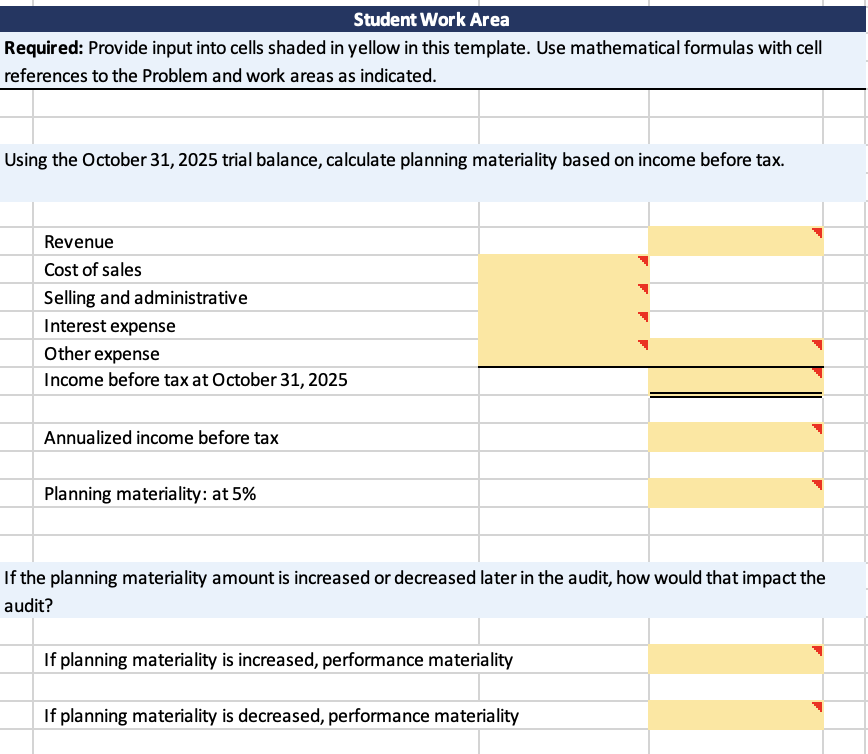
Student Work Area Required: Provide input into cells shaded in yellow in this template. Use mathematical formulas with cell references to the Problem and work areas as indicated. Using the October 31, 2025 trial balance, calculate planning materiality based on income before tax. Revenue Cost of sales Selling and administrative Interest expense Other expense Income before tax at October 31, 2025 Annualized income before tax Planning materiality: at 5% If the planning materiality amount is increased or decreased later in the audit, how would that impact the audit? If planning materiality is increased, performance materiality If planning materiality is decreased, performance materiality
Step by Step Solution
There are 3 Steps involved in it

Get step-by-step solutions from verified subject matter experts
 Study Help