







Question: Chapter #4, Pg 168 Apple's Design Team Write a summary of the case, answer the case questions and elaborate on two (2) KEY LEARNING'S from
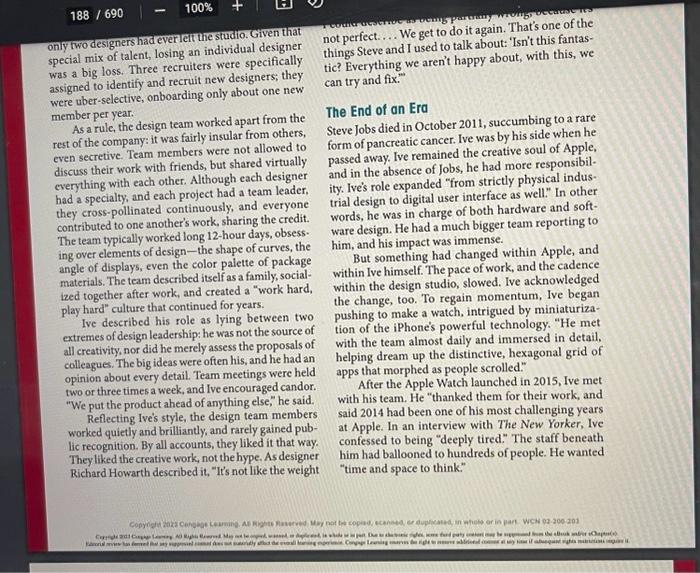
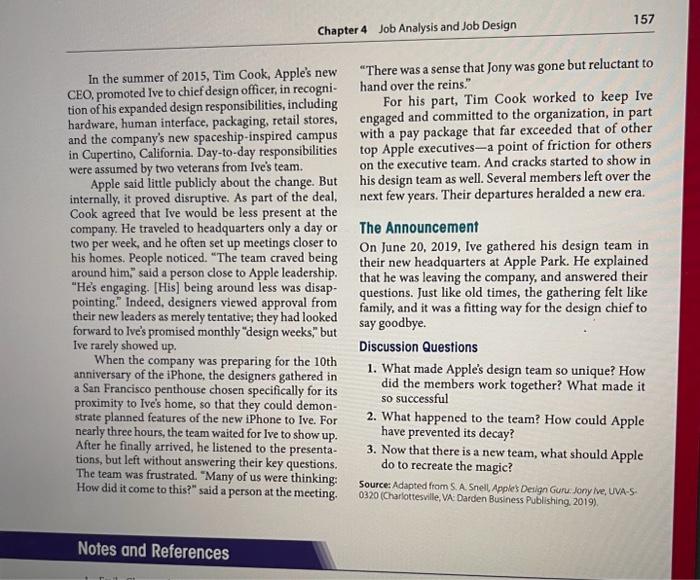
Chapter \#4, Pg 168 Apple's Design Team Write a summary of the case, answer the case questions and elaborate on two (2) KEY LEARNING'S from the case. Using section headings and number your case questions/answers. Be certain to CLEARLY STATE you Key Learning's and then defend them. A KEY LEARNING is defined as something you learned from the case. Then explain things like, why it is a key learning, how can it be applied to a real-world application, personal insight (has something similar happen to you or someone you know), your thoughts and opinions about what was stated, how is it handled at your company and so on. Two (2) Key Learning's are required. I suggest that you state the first one and defend it, then state you second one and defend it. Remember you must clearly state two (2) KEY LEARNING'S and cite your work. Case studies should be three pages, minimum, in length and formatted to APA 7th Edition. Utilize the APA template provided .. Click to Download. What is a Key Learning (KL)? *.A Key Learning is defined as something you learned from the case. Then explain to me, why it is a key learning, how it can be applied to a real-world application, personal insight (has something similar happen to you or someone you know), your thoughts and opinions about what was stated, how it is handled at your company and so on. Two (2) Key Learning's are required. I suggest that you state the first KL and defend it, then state your second KL and defend it. Below is a sample of a good quality Key Learning from a previous case. Key Learning \#1: Reciprocity goes a long way. (Note that it is clearly stated.) Defended: Employees are more willing to compromise when management and executives are willing to give some positive incentives. Many employers are working to improve their employeesi quality of life, not just being a source of finances. Reciprocity is an especially What is a Key Learning ( KL) ? * - A Key Learning is defined as something you learned from the case. Then explain to me, why it is a key learning, how it can be applied to a real-world application, personal insight (has something similar happen to you or someone you know), your thoughts and opinions about what was stated, how it is handled at your company and so on. Two (2) Key Learning's are required. I suggest that you state the first KL and defend it, then state your second KL and defend it. Below is a sample of a good quality Key Learning from a previous case. Key Learning \#1: Reciprocity goes a long way. (Note that it is clearly stated.) Defended: Employees are more willing to compromise when management and executives are willing to give some positive incentives. Many employers are working to improve their employeesii quality of life, not just being a source of finances. Reciprocity is an especially important aspect of my life as I practice it in everything that I do, and the outcome is almost always favorable. A big problem that many employees have is that they feel as though management does not envision their struggles, or at least does not want to help deal with them. Many employees need to feel as though their concerns are important throughout the organization, and often seek change or other employment. Employee needs are always changing and are most often never parallel, which is something that must always be taken into consideration among management when employee incentives are being reviewed or sought after. Surveying the employees is almost always the best way to get honest feedback from employees. Include references and follow APA 7th Edition style. In a surprise notice issued late on Thursday, June 20, The iMac was Jobs's and Ive's first big hit in 1998. 2019, Apple announced that its chief design officer, Both men knew they were redesigning not just Apple's Jonathan "Jony" Ive, would be leaving the company flagship computer, but the company itself. As Steven later in the year. Ive was the man behind the design Levy put it, the iMac "was the beginning of a succesteam that created Apple's most iconic products-the sion of products that changed the expectations not just iMac, the MacBook, the iPod, the iPhone, the iPad, of technology design but the role of design in conand the Apple Watch. Working side by side with sumer products." Apple's founder, Steve Jobs, Ive led what was arguably Jobs and Ive had complementary styles and comthe most successful design team in the history of busi- plementary strengths. "Ive could translate futuristic ness, and the inspiration for a whole new generation concepts into physical objects with simplicity and of consumer electronics. It was not an exaggeration sophistication. ... Jobs was the inspiration and the to say that the work of his design team had rescued editor needed to bring these ideas to life." Ive was genApple from the edge of the abyss, and made it one of erally reserved, while Jobs was famously charismatic. the most highly valued companies in the world. And His reputation was "one of almost maniacal micronow lve was moving on. management when it came to creating a new product Apple's Renaissance and of almost Barnum-like mastery of hoopla and Apple's storied history is fairly well known. Steve Jobs razzmatazz when it came to selling "- But Jobs and Ive were alike in their design phiand Steve Wozniak founded Apple Computer in 1976. Losophies: both put beauty before everything else. After disrupting the industry and setting a new course As Ive described it, "We think alike about how prodfor personal computing, the company struggled, and ucts should be made to look pure and seamless." For Jobs and Wozniak left the company in 1985. Jobs both, less was more. "In so many ways, we're trying returned to Apple in 1997 and put the company on to get the object out of the way," Ive said. Both Jobs a different trajectory, increasing Apple's emphasis on and Ive were equally passionate about big ideas and innovation and design. small details. They didn't just care about how a prodJobs began searching for talent, and he wanted At uct looked from the outside; they were focused on the players he could use to build his design team. Up until complete picture, inside and out. that time, the company had partnered with firms out-_ Their offices were right next to each other, and side of Apple to design its products. But Jobs wanted they often ate lunch and took walks together, discussto bring the work in-house. Jobs and Ive had a remark- ing new projects and plans. Ive recalled, "Steve used to able first meeting, the two jusl clicked. "I can't really say to me-and he used to say this a lot-'Hey, Jony, remember that happening really ever before," Ive said. here's a dopey idea:' And sometimes they were: really "It was the most bizarre thing, where we were both dopey. Sometimes they were truly dreadful. But someperhaps a little - a little bit odd. We weren't used to times they took the air from the room, and they left us clicking." both completely silent. Bold, crazy, magnificent ideas. Or quiet, simple ones which, in their subtlety, their of the world's on our shoulders. Jony set it up so that detail, they were utterly profound." Matt Rogers, who it's a little-it's freer than you might imagine." developed software for the iPhone and iPad between However, the design team enjoyed a level of influ2007 and 2010, said, "Most of the greatest debates at ence at Apple unimaginable at other firms. At most Apple happened between those two as they walked tech companies, engineering dictates product development. At Apple, it was the other way around. "Ive often gave concepts to Apple's engineering department, telling them to make the product design posIve's 20-person design team was the epicenter of sible." Designers reigned supreme. Apple's great run of iconic products. An eclectic Ive also changed the process by which design was group, the team members included Eugene Whang, created. As Brunner put it, design had been "a vertiwho moonlighted as a DJ; Julian Hnig, who previ-_ cal stripe in the [value] chain of events" in a prodously had designed Lamborghinis; Jody Akana, who uct's creation. But at Apple, Ive shaped it to become "a specialized in color; and Bart Andr, who had more long horizontal stripe, where design is part of every design patents than any other Apple employee. conversation." Although the group expanded somewhat over the The the obsessed over the designs, understandyears, it remained very loyal. In almost two decades, ing the importance of iteration. "Everything we make only two designers had ever left the studio. Given that I could describe as being partially wrong, because it's special mix of talent, losing an individual designer not perfect.... We get to do it again. That's one of the was a big loss. Three recruiters were specifically things Steve and I used to talk about: 'Isn't this fantasassigned to identify and recruit new designers; they tic? Everything we aren't happy about, with this, we were uber-selective, onboarding only about one new can try and fix." member per year. As a rule, the design team worked apart from the The End of an Era rest of the company: it was fairly insular from others, Steve Jobs died in October 2011, succumbing to a rare even secretive. Team members were not allowed to form of pancreatic cancer. Ive was by his side when he discuss their work with friends, but shared virtually passed away. Ive remained the creative soul of Apple, everything with cach other. Although each designer and in the absence of Jobs, he had more responsibilhad a specialty, and eachrproject had a team leader, ity. Ive's role expanded "from strictly physical industhey cross-pollinated continuously, and everyone trial design to digital user interface as well." In other contributed to one another's work, sharing the credit. words, he was in charge of both hardware and softThe team typically worked long 12 hour days, obsess- ware design. He had a much bigger team reporting to ing over elements of design-the shape of curves, the him, and his impact was immense. angle of displays, even the color palette of package But something had changed within Apple, and materials. The team described itself as a family, social- within Ive himself. The pace of work, and the cadence ized together after work, and created a "work hard, within the design studio, slowed. Ive acknowledged play hard" culture that continued for years. the change, too. To regain momentum, Ive began Ive described his role as lying between two pushing to make a watch. intrigued by miniaturiza- ony two designers had ever ert the studio. Given that not perfect.... We get to do it again. That's one of the special mix of talent, losing an individual designer things Steve and I used to talk about: 'Isn't this fantaswas a big loss. Three recruiters were specifically tic? Everything we aren't happy about, with this, we assigned to identify and recruit new designers; they can try and fix." were uber-selective, onboarding only about one new member per year. As a rule, the design team worked apart from the The End of an Erc rest of the company: it was fairly insular from others, Steve Jobs died in October 2011, succumbing to a rare even secretive. Team members were not allowed to form of pancreatic cancer. Ive was by his side when he discuss their work with friends, but shared virtually passed away. Ive remained the creative soul of Apple, everything with each other. Although each designer and in the absence of Jobs, he had more responsibilhad a specialty, and each project had a team leader, ity. Ive's role expanded "from strictly physical industhey cross-pollinated continuously, and everyone trial design to digital user interface as well." In other contributed to one another's work, sharing the credit. words, he was in charge of both hardware and softThe team typically worked long 12-hour days, obsess-. ware design. He had a much bigger team reporting to ing over elements of design - the shape of curves, the him, and his impact was immense. angle of displays, even the color palette of package But something had changed within Apple, and materials. The team described itself as a family, social- within Ive himself. The pace of work, and the cadence ized together after work, and created a "work hard, within the design studio, slowed. Ive acknowledged play hard" culture that continued for years. the change, too. To regain momentum, Ive began Ive described his role as lying between two pushing to make a watch, intrigued by miniaturizaextremes of design leadership: he was not the source of tion of the iPhone's powerful technology. "He met all creativity, nor did he merely assess the proposals of with the team almost daily and immersed in detail. colleagues. The big ideas were often his, and he had an helping dream up the distinctive, hexagonal grid of opinion about every detail. Team meetings were held apps that morphed as people scrolled." two or three times a week, and Ive encouraged candor. After the Apple Watch launched in 2015, Ive met "We put the product ahead of anything else," he said. with his team. He "thanked them for their work, and Reflecting Ive's style, the design team members said 2014 had been one of his most challenging years worked quietly and brilliantly, and rarely gained pub- at Apple. In an interview with The New Yorker, Ive lic recognition. By all accounts, they liked it that way. confessed to being "deeply tired." The staff beneath They liked the creative work, not the hype. As designer him had ballooned to hundreds of people. He wanted Richard Howarth described it, "I's not like the weight "time and space to think." In the summer of 2015, Tim Cook, Apple's new "There was a sense that Jony was gone but reluctant to CEO, promoted Ive to chief design officer, in recogni- hand over the reins." tion of his expanded design responsibilities, including For his part, Tim Cook worked to keep Ive hardware, human interface, packaging, retail stores, engaged and committed to the organization, in part and the company's new spaceship-inspired campus with a pay package that far exceeded that of other in Cupertino, California. Day-to-day responsibilities top Apple executives-a point of friction for others were assumed by two veterans from Ive's team. on the executive team. And cracks started to show in Apple said little publicly about the change. But his design team as well. Several members left over the internally, it proved disruptive. As part of the deal, next few years. Their departures heralded a new era. Cook agreed that Ive would be less present at the company. He traveled to headquarters only a day or The Announcement two per week, and he often set up meetings closer to On June 20, 2019, Ive gathered his design team in his homes. People noticed. "The team craved being their new headquarters at Apple Park. He explained around him," said a person close to Apple leadership. that he was leaving the company, and answered their "He's engaging. [His] being around less was disap- questions. Just like old times, the gathering felt like pointing." Indeed, designers viewed approval from family, and it was a fitting way for the design chief to their new leaders as merely tentative; they had looked say goodbye. forward to lve's promised monthly "design weeks," but Ive rarely showed up. When the company was preparing for the 10 th anniversary of the iPhone, the designers gathered in Discussion Questions a San Francisco penthouse chosen specifically for its 1. What made Apple's design team so unique? How proximity to Ive's home, so that they could demondid the members work together? What made it strate planned features of the new iPhone to Ive. For so successful nearly three hours, the team waited for Ive to show up. 2. What happened to the team? How could Apple After he finally arrived, he listened to the presentahave prevented its decay? tions, but left without answering their key questions. 3. Now that there is a new team, what should Apple The team was frustrated. "Many of us were thinking: do to recreate the magic? How did it come to this?" said a person at the meeting. Source: Adapted from S. A Snell, Apples Deiling Gunu-fony ive, UVA-S
Step by Step Solution
There are 3 Steps involved in it

Get step-by-step solutions from verified subject matter experts
 Study Help