







Question: Chapter 4: Student Version Chapter 4: Understanding Contracts True or False 1. A contract is an agreement between two or more parties and must be
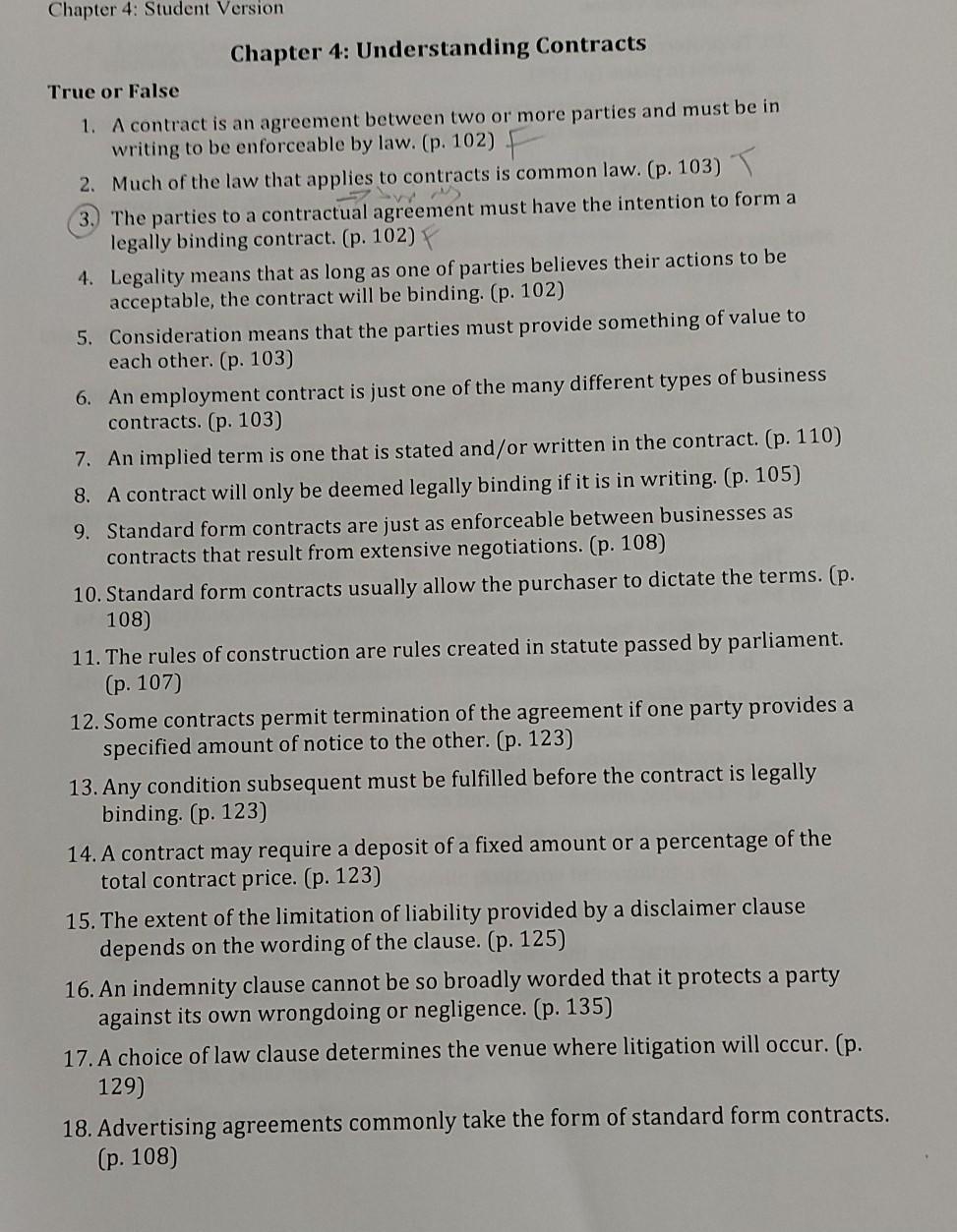
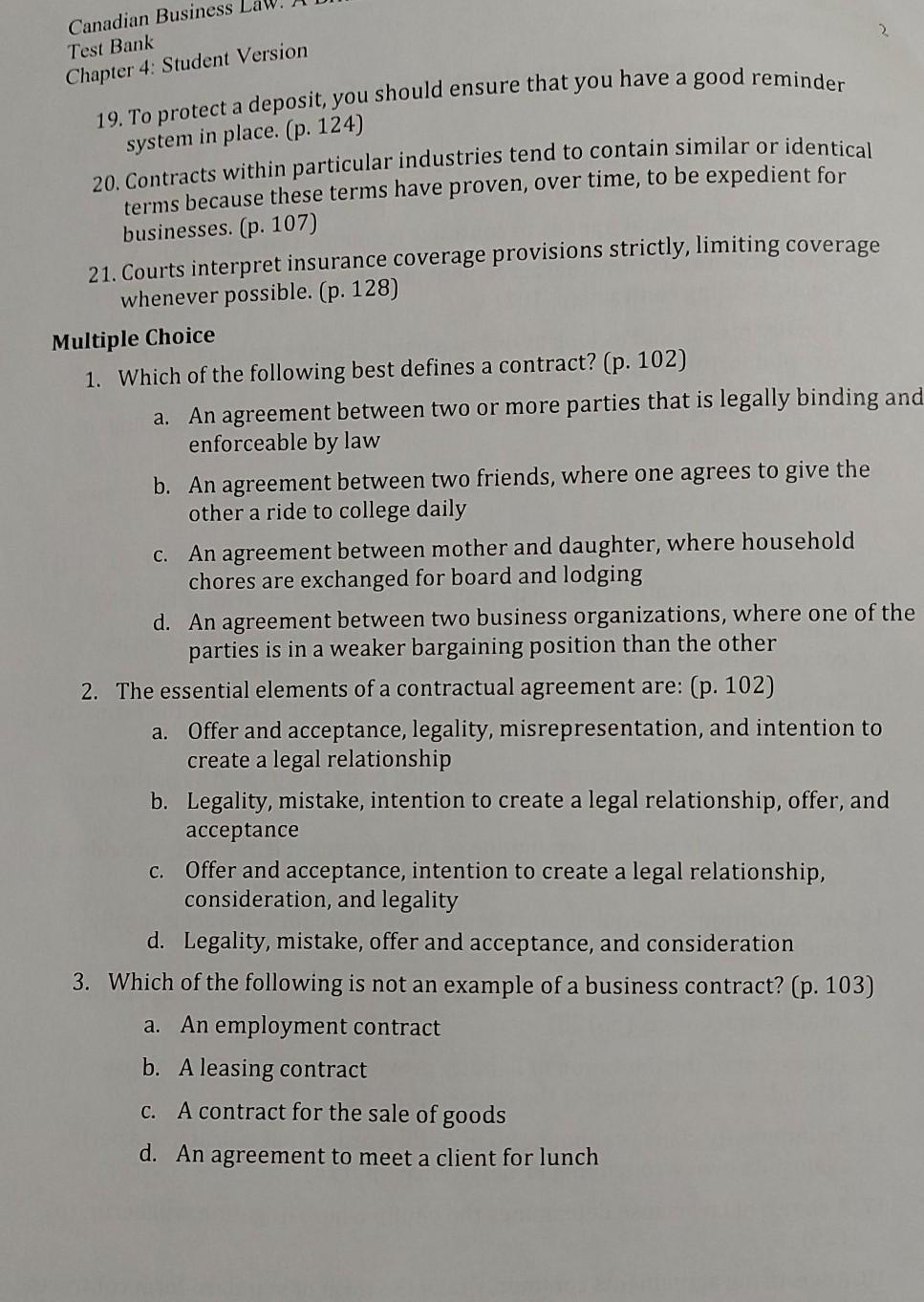
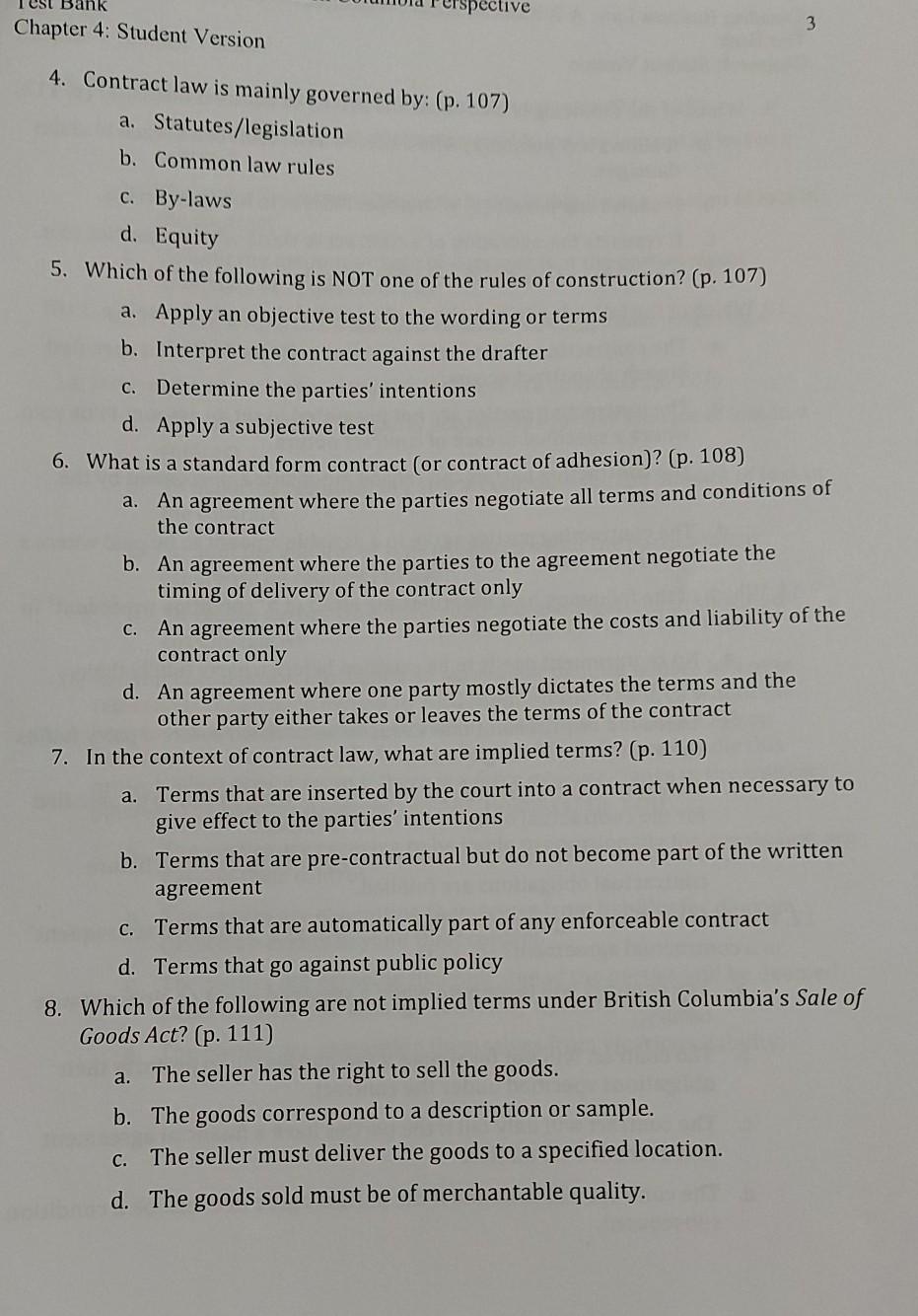
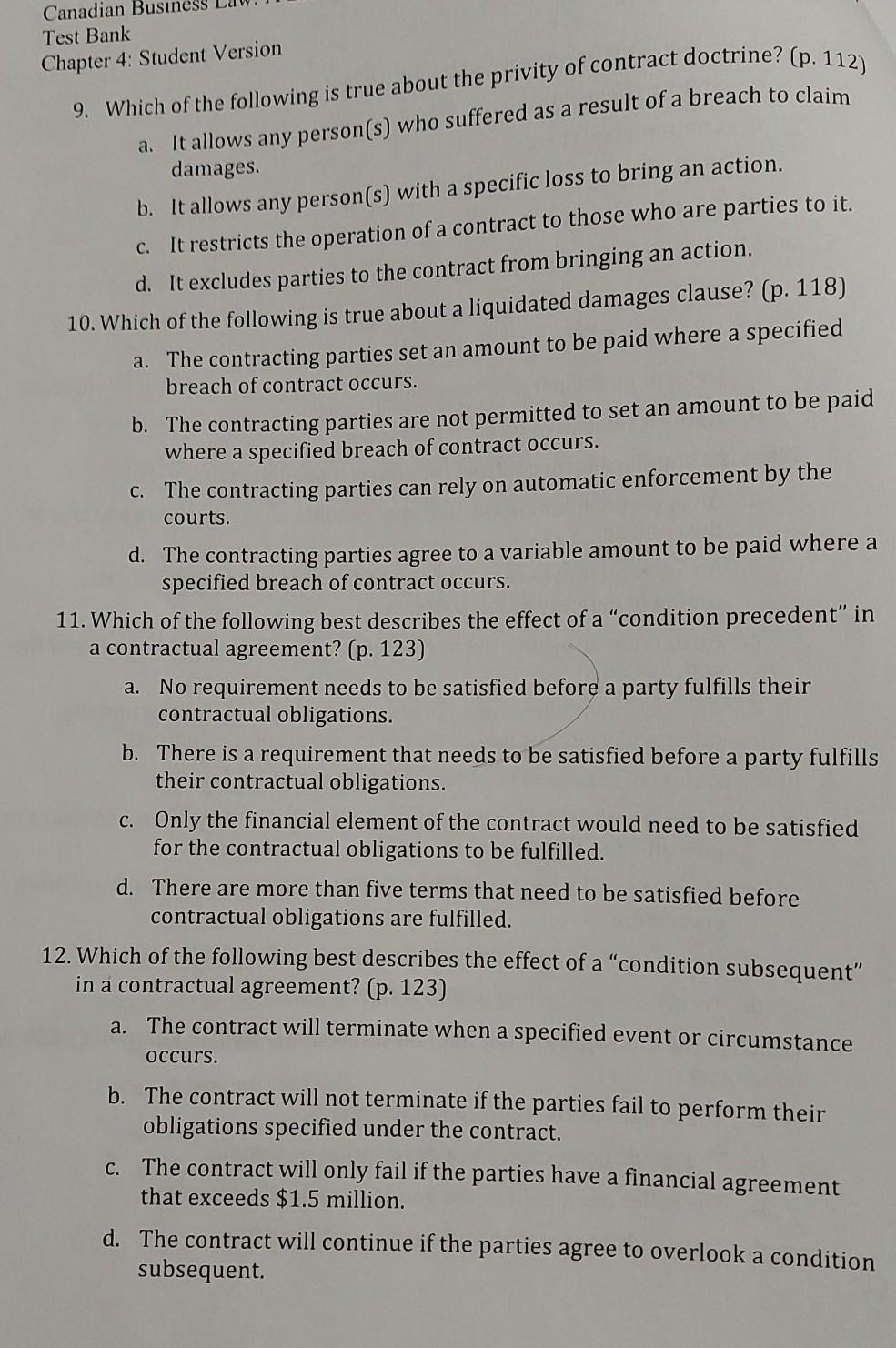
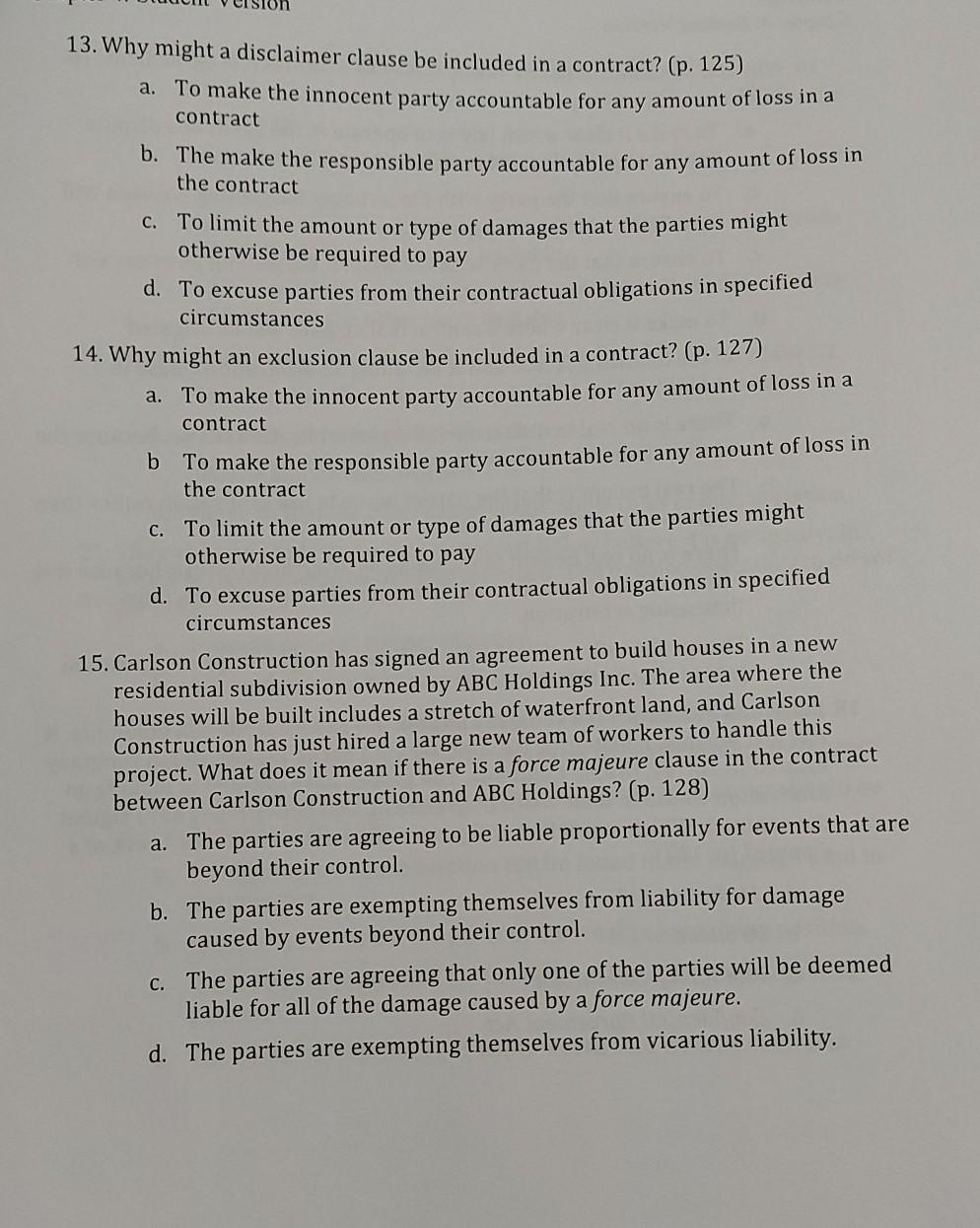
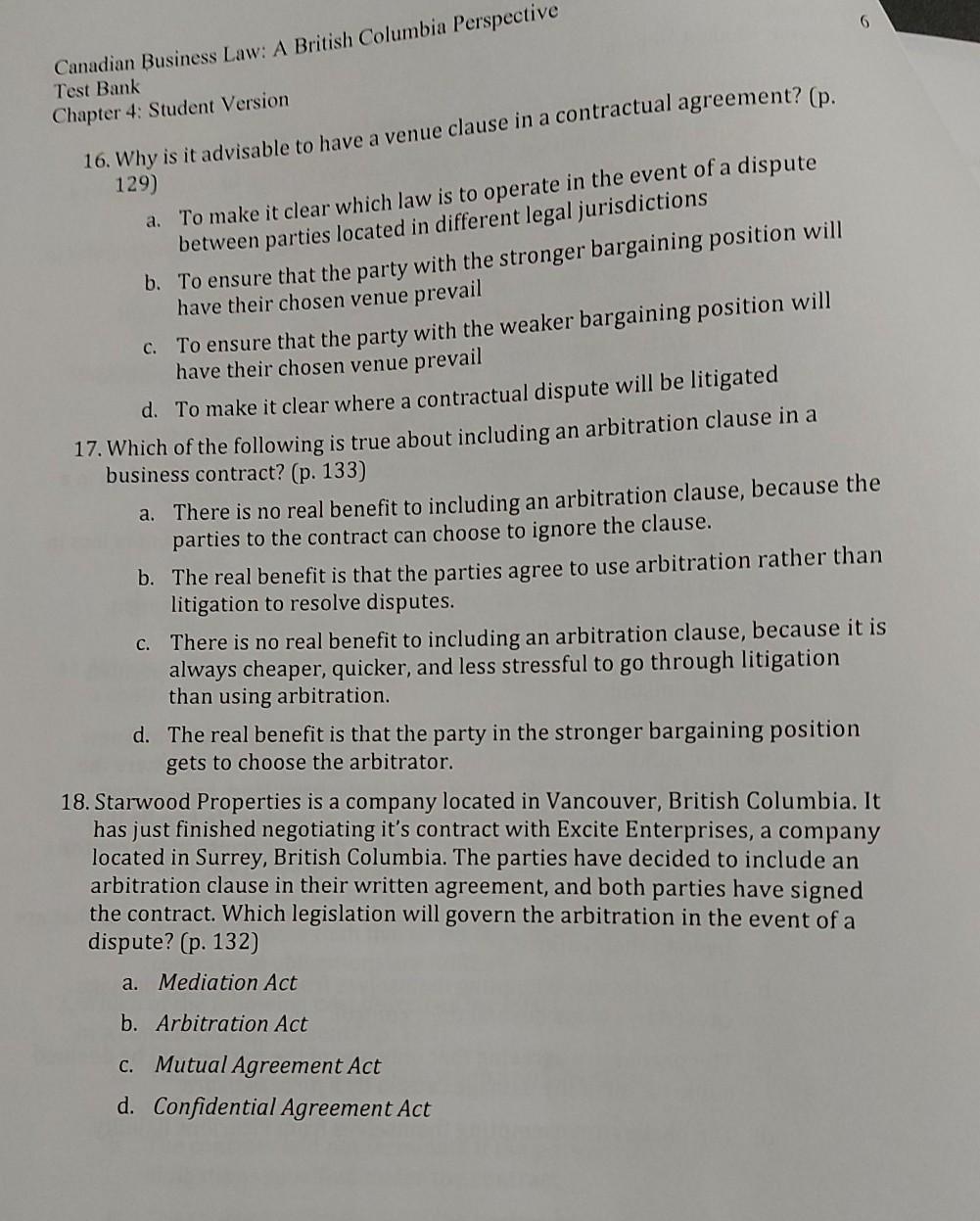
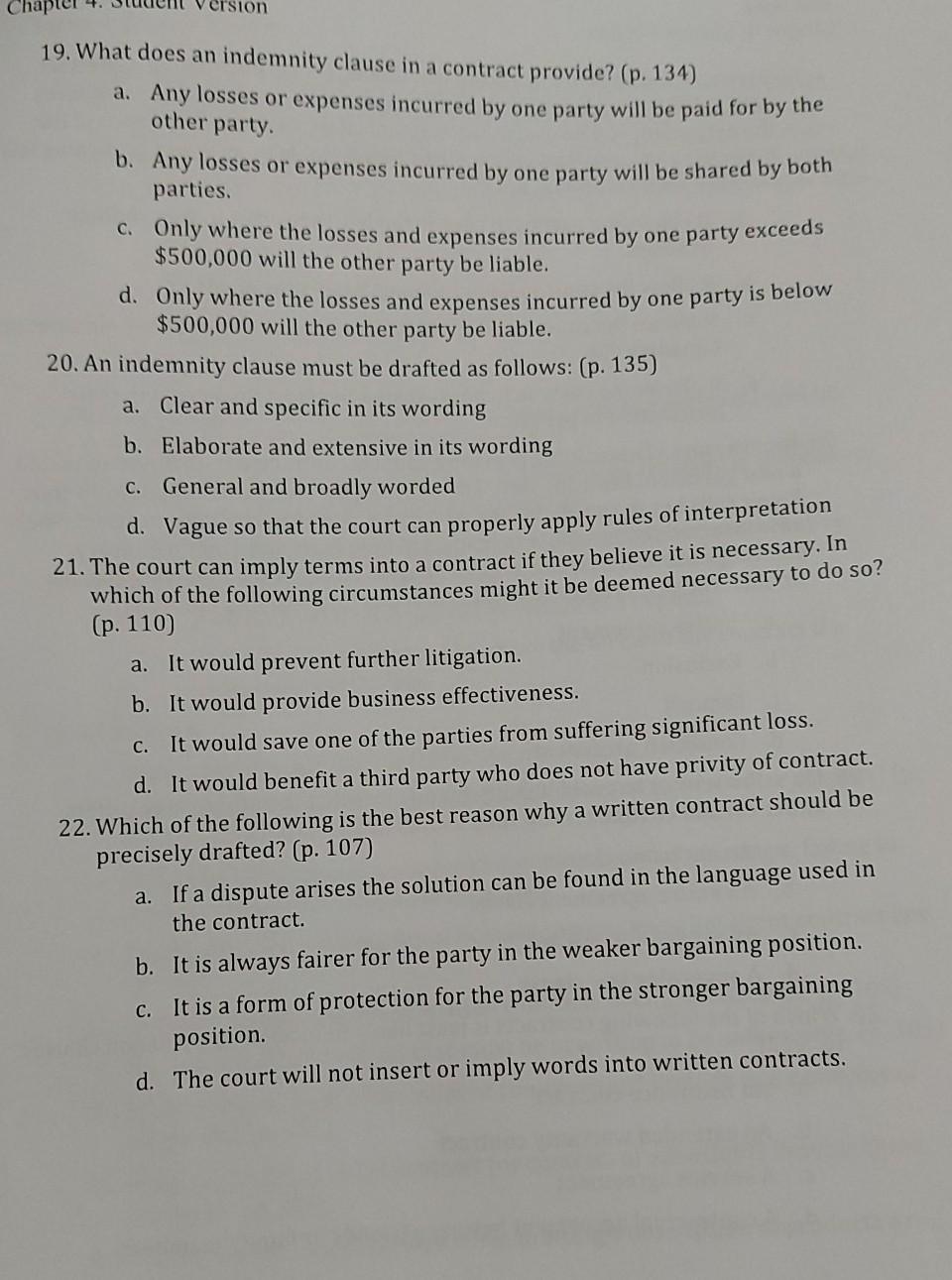
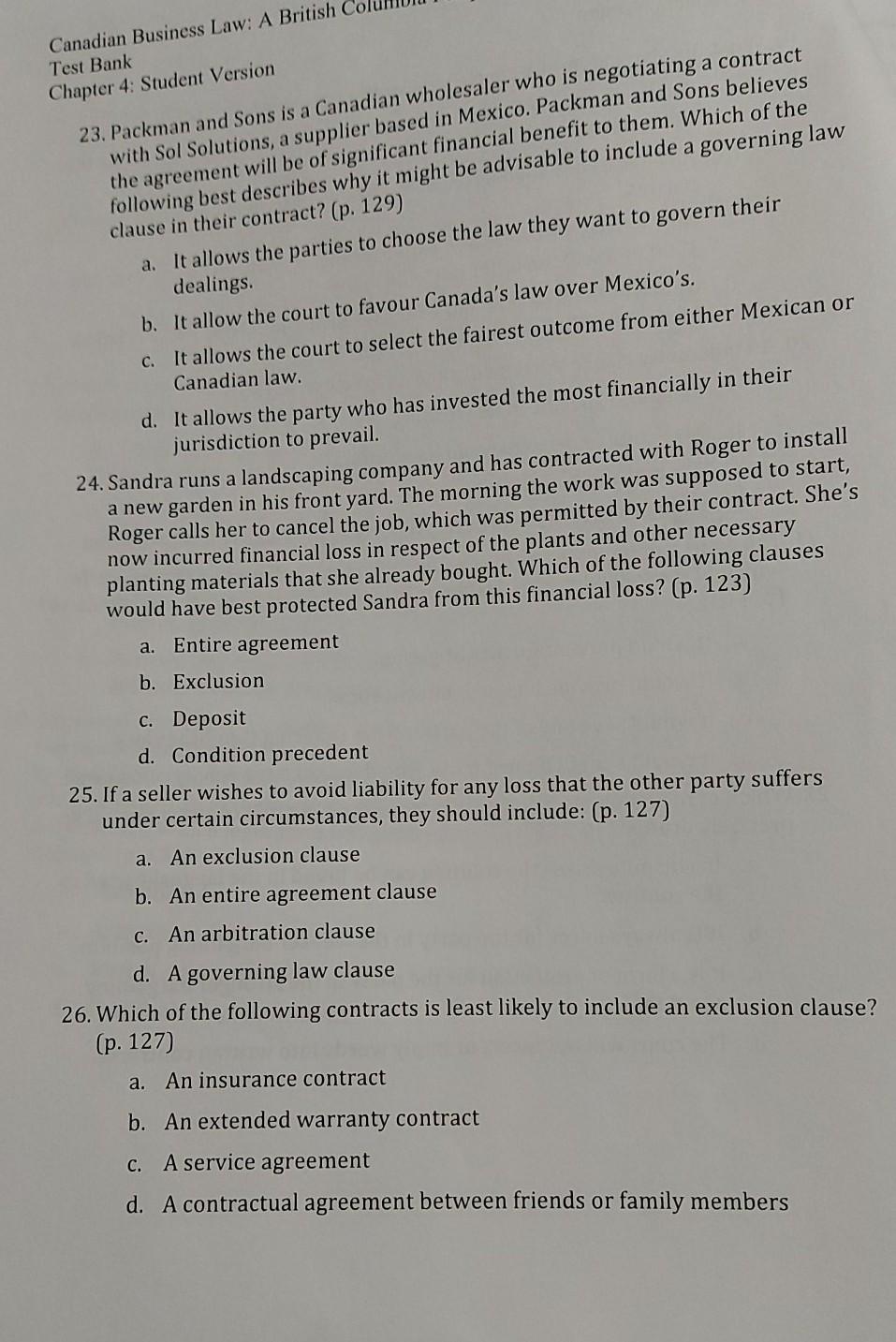
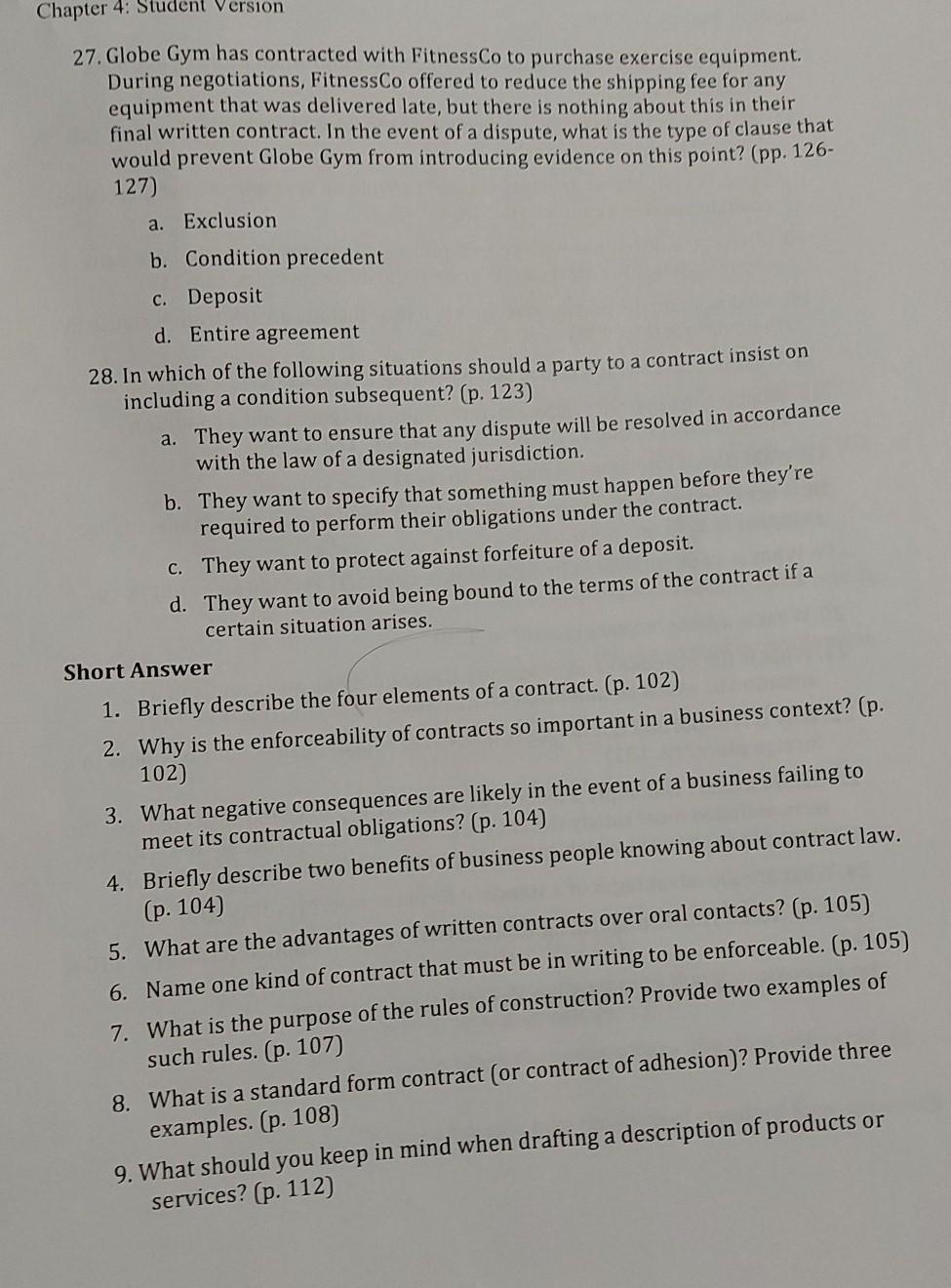
Chapter 4: Student Version Chapter 4: Understanding Contracts True or False 1. A contract is an agreement between two or more parties and must be in writing to be enforceable by law. (p. 102) 2. Much of the law that applies to contracts is common law. (p. 103) 3. The parties to a contractual agreement must have the intention to form a legally binding contract. (p. 102) 4. Legality means that as long as one of parties believes their actions to be acceptable, the contract will be binding. (p. 102) 5. Consideration means that the parties must provide something of value to each other. (p. 103) 6. An employment contract is just one of the many different types of business contracts. (p. 103) 7. An implied term one that is stated and/or written in the contract. (p. 110) 8. A contract will only be deemed legally binding if it is in writing. (p. 105) 9. Standard form contracts are just as enforceable between businesses as contracts that result from extensive negotiations. (p. 108) 10. Standard form contracts usually allow the purchaser to dictate the terms. (p. 108) 11. The rules of construction are rules created in statute passed by parliament. (p. 107) 12. Some contracts permit termination of the agreement if one party provides a specified amount of notice to the other. (p. 123) 13. Any condition subsequent must be fulfilled before the contract is legally binding. (p. 123) 14. A contract may require a deposit of a fixed amount or a percentage of the total contract price. (p. 123) 15. The extent of the limitation of liability provided by a disclaimer clause depends on the wording of the clause. (p. 125) 16. An indemnity clause cannot be so broadly worded that it protects a party against its own wrongdoing or negligence. (p. 135) 17. A choice of law clause determines the venue where litigation will occur. (p. 129) 18. Advertising agreements commonly take the form of standard form contracts. (p. 108) Canadian Business Test Bank Chapter 4: Student Version 19. To protect a deposit, you should ensure that you have a good reminder system in place. (p. 124) 20. Contracts within particular industries tend to contain similar or identical terms because these terms have proven, over time, to be expedient for businesses. (p. 107) 21. Courts interpret insurance coverage provisions strictly, limiting coverage whenever possible. (p. 128) Multiple Choice 1. Which of the following best defines a contract? (p. 102) a. An agreement between two or more parties that is legally binding and enforceable by law b. An agreement between two friends, where one agrees to give the other a ride to college daily C. An agreement between mother and daughter, where household chores are exchanged for board and lodging d. An agreement between two business organizations, where one of the parties is in a weaker bargaining position than the other 2. The essential elements of a contractual agreement are: (p. 102) a. Offer and acceptance, legality, misrepresentation, and intention to create a legal relationship b. Legality, mistake, intention to create a legal relationship, offer, and acceptance c. Offer and acceptance, intention to create a legal relationship, consideration, and legality d. Legality, mistake, offer and acceptance, and consideration 3. Which of the following is not an example of a business contract? (p. 103) a. An employment contract b. A leasing contract c. A contract for the sale of goods d. An agreement to meet a client for lunch Bank Tspective Chapter 4: Student Version 3 4. Contract law is mainly governed by: (p. 107) a. Statutes/legislation b. Common law rules c. By-laws d. Equity 5. Which of the following is NOT one of the rules of construction? (p. 107) a. Apply an objective test to the wording or terms b. Interpret the contract against the drafter c. Determine the parties' intentions d. Apply a subjective test 6. What is a standard form contract (or contract of adhesion)? (p. 108) a. An agreement where the parties negotiate all terms and conditions of the contract b. An agreement where the parties to the agreement negotiate the timing of delivery of the contract only C. An agreement where the parties negotiate the costs and liability of the contract only d. An agreement where one party mostly dictates the terms and the other party either takes or leaves the terms of the contract 7. In the context of contract law, what are implied terms? (p. 110) a. Terms that are inserted by the court into a contract when necessary to give effect to the parties' intentions b. Terms that are pre-contractual but do not become part of the written agreement C. Terms that are automatically part of any enforceable contract d. Terms that go against public policy 8. Which of the following are not implied terms under British Columbia's Sale of Goods Act? (p. 111) a. The seller has the right to sell the goods. b. The goods correspond to a description or sample. C. The seller must deliver the goods to a specified location. d. The goods sold must be of merchantable quality. Canadian siness Test Bank Chapter 4: Student Version 9. Which of the following is true about the privity of contract doctrine? (p. 112) a. It allows any person(s) who suffered as a result of a breach to claim damages. b. It allows any person(s) with a specific loss to bring an action. c. It restricts the operation of a contract to those who are parties to it. d. It excludes parties to the contract from bringing an action. 10. Which of the following is true about a liquidated damages clause? (p. 118) a. The contracting parties set an amount to be paid where a specified breach of contract occurs. b. The contracting parties are not permitted to set an amount to be paid where a specified breach of contract occurs. C. The contracting parties can rely on automatic enforcement by the courts. d. The contracting parties agree to a variable amount to be paid where a specified breach of contract occurs. 11. Which of the following best describes the effect of a "condition precedent" in a contractual agreement? (p. 123) a. No requirement needs to be satisfied before a party fulfills their contractual obligations. b. There is a requirement that needs to be satisfied before a party fulfills their contractual obligations. c. Only the financial element of the contract would need to be satisfied for the contractual obligations to be fulfilled. d. There are more than five terms that need to be satisfied before contractual obligations are fulfilled. 12. Which of the following best describes the effect of a "condition subsequent" in a contractual agreement? (p. 123) a. The contract will terminate when a specified event or circumstance occurs. b. The contract will not terminate if the parties fail to perform their obligations specified under the contract. C. The contract will only fail if the parties have a financial agreement that exceeds $1.5 million. d. The contract will continue if the parties agree to overlook a condition subsequent 13. Why might a disclaimer clause be included in a contract? (p. 125) a. To make the innocent party accountable for any amount of loss in a contract b. The make the responsible party accountable for any amount of loss in the contract C. To limit the amount or type of damages that the parties might otherwise be required to pay d. To excuse parties from their contractual obligations in specified circumstances 14. Why might an exclusion clause be included in a contract? (p. 127) a. To make the innocent party accountable for any amount of loss in a contract b To make the responsible party accountable for any amount of loss in the contract C. To limit the amount or type of damages that the parties might otherwise be required to pay d. To excuse parties from their contractual obligations in specified circumstances 15. Carlson Construction has signed an agreement to build houses in a new residential subdivision owned by ABC Holdings Inc. The area where the houses will be built includes a stretch of waterfront land, and Carlson Construction has just hired a large new team of workers to handle this project. What does it mean if there is a force majeure clause in the contract between Carlson Construction and ABC Holdings? (p. 128) a. The parties are agreeing to be liable proportionally for events that are beyond their control. b. The parties are exempting themselves from liability for damage caused by events beyond their control. C. The parties are agreeing that only one of the parties will be deemed liable for all of the damage caused by a force majeure. d. The parties are exempting themselves from vicarious liability. Canadian Business Law: A British Columbia Perspective Test Bank Chapter 4: Student Version 16. Why is it advisable to have a venue clause in a contractual agreement? (p. 129) a. To make it clear which law is to operate in the event of a dispute between parties located in different legal jurisdictions b. To ensure that the party with the stronger bargaining position will have their chosen venue prevail c. To ensure that the party with the weaker bargaining position will have their chosen venue prevail d. To make it clear where a contractual dispute will be litigated 17. Which of the following is true about including an arbitration clause in a business contract? (p. 133) a. There is no real benefit to including an arbitration clause, because the parties to the contract can choose to ignore the clause. b. The real benefit is that the parties agree to use arbitration rather than litigation to resolve disputes. c. There is no real benefit to including an arbitration clause, because it is always cheaper, quicker, and less stressful to go through litigation than using arbitration. d. The real benefit is that the party in the stronger bargaining position gets to choose the arbitrator. 18. Starwood Properties is a company located in Vancouver, British Columbia. It has just finished negotiating it's contract with Excite Enterprises, a company located in Surrey, Brit Columbia. The parties have decided to include an arbitration clause in their written agreement, and both parties have signed the contract. Which legislation will govern the arbitration in the event of a dispute? (p. 132) a. Mediation Act b. Arbitration Act C. Mutual Agreement Act d. Confidential Agreement Act ersion 19. What does an indemnity clause in a contract provide? (p. 134) a. Any losses or expenses incurred by one party will be paid for by the other party. b. Any losses or expenses incurred by one party will be shared by both parties. c. Only where the losses and expenses incurred by one party exceeds $500,000 will the other party be liable. d. Only where the losses and expenses incurred by one party is below $500,000 will the other party be liable. 20. An indemnity clause must be drafted as follows: (p. 135) a. Clear and specific in its wording b. Elaborate and extensive in its wording c. General and broadly worded d. Vague so that the court can properly apply rules of interpretation 21. The court can imply terms into a contract if they believe it is necessary. In which of the following circumstances might it be deemed necessary to do so? (p. 110) a. It would prevent further litigation. b. It would provide business effectiveness. C. It would save one of the parties from suffering significant loss. d. It would benefit a third party who does not have privity of contract. 22. Which of the following is the best reason why a written contract should be precisely drafted? (p. 107) a. If a dispute arises the solution can be found in the language used in the contract. b. It is always fairer for the party in the weaker bargaining position. c. It is a form of protection for the party in the stronger bargaining position. d. The court will not insert or imply words into written contracts. Canadian Business Law: A British Test Bank Chapter 4: Student Version 23. Packman and Sons is a Canadian wholesaler who is negotiating a contract with Sol Solutions, a supplier based in Mexico. Packman and Sons believes the agreement will be of significant financial benefit to them. Which of the following best describes why it might be advisable to include a governing law clause in their contract? (p. 129) a. It allows the parties to choose the law they want to govern their dealings. b. It allow the court to favour Canada's law over Mexico's. c. It allows the court to select the fairest outcome from either Mexican or Canadian law. d. It allows the party who has invested the most financially in their jurisdiction to prevail. 24. Sandra runs a landscaping company and has contracted with Roger to install a new garden in his front yard. The morning the work was supposed to start, Roger calls her to cancel the job, which was permitted by their contract. She's now incurred financial loss in respect of the plants and other necessary planting materials that she already bought. Which of the following clauses would have best protected Sandra from this financial loss? (p. 123) a. Entire agreement b. Exclusion c. Deposit d. Condition precedent 25. If a seller wishes to avoid liability for any loss that the other party suffers under certain circumstances, they should include: (p. 127) a. An exclusion clause b. An entire agreement clause C. An arbitration clause d. A governing law clause 26. Which of the following contracts is least likely to include an exclusion clause? (p. 127) a. An insurance contract b. An extended warranty contract C. A service agreement d. A contractual agreement between friends or family members Chapter 4: Student Version 27. Globe Gym has contracted with FitnessCo to purchase exercise equipment. During negotiations, FitnessCo offered to reduce the shipping fee for any equipment that was delivered late, but there is nothing about this in their final written contract. In the event of a dispute, what is the type of clause that would prevent Globe Gym from introducing evidence on this point? (pp. 126- 127) a. Exclusion b. Condition precedent c. Deposit d. Entire agreement 28. In which of the following situations should a party to a contract insist on including a condition subsequent? (p. 123) a. They want to ensure that any dispute will be resolved in accordance with the law of a designated jurisdiction. b. They want to specify that something must happen before they're required to perform their obligations under the contract. C. They want to protect against forfeiture of a deposit. d. They want to avoid being bound to the terms of the contract if a certain situation arises. Short Answer 1. Briefly describe the four elements of a contract. (p. 102) 2. Why is the enforceability of contracts so important in a business context? (p. 102) 3. What negative consequences are likely in the event of a business failing to meet its contractual obligations? (p. 104) 4. Briefly describe two benefits of business people knowing about contract law. (p. 104) 5. What are the advantages of written contracts over oral contacts? (p. 105) 6. Name one kind of contract that must be in writing to be enforceable. (p. 105) 7. What is the purpose of the rules of construction? Provide two examples of such rules. (p. 107) 8. What is a standard form contract (or contract of adhesion)? Provide three examples. (p. 108) 9. What should you keep in mind when drafting a description of products or services? (p. 112)
Step by Step Solution
There are 3 Steps involved in it
1 Expert Approved Answer
Step: 1 Unlock

Question Has Been Solved by an Expert!
Get step-by-step solutions from verified subject matter experts
Step: 2 Unlock
Step: 3 Unlock
 Study Help