







Question: Chapter 4 - Work Set True - False Questions q , 1 . A federal form of government is one in which a central authority
Chapter Work Set
TrueFalse Questions
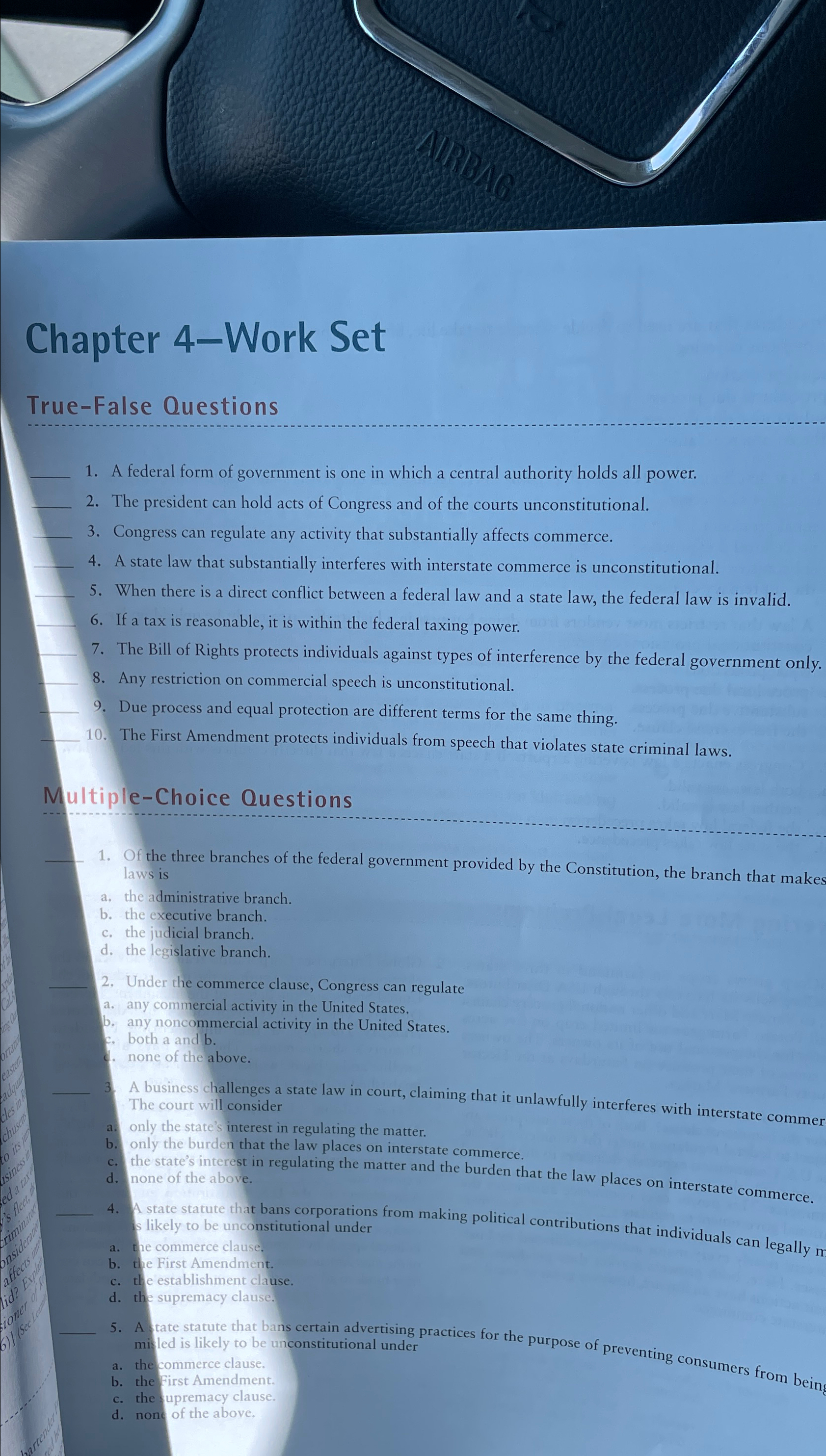
A federal form of government is one in which a central authority holds all power.
The president can hold acts of Congress and of the courts unconstitutional.
Congress can regulate any activity that substantially affects commerce.
A state law that substantially interferes with interstate commerce is unconstitutional.
When there is a direct conflict between a federal law and a state law, the federal law is invalid.
If a tax is reasonable, it is within the federal taxing power.
The Bill of Rights protects individuals against types of interference by the federal government only.
Any restriction on commercial speech is unconstitutional.
Due process and equal protection are different terms for the same thing.
The First Amendment protects individuals from speech that violates state criminal laws.
MultipleChoice Questions
Of the three branches of the federal government provided by the Constitution, the branch that makes laws is
a the administrative branch.
b the executive branch.
c the judicial branch.
d the legislative branch.
Under the commerce clause, Congress can regulate
a any commercial activity in the United States.
b any noncommercial activity in the United States.
c both a and
none of the above.
A business challenges a state law in court, claiming that it unlawfully interferes with interstate commer The court will consider
a only the state's interest in regulating the matter.
b only the burden that the law places on interstate commerce.
c the state's interest in regulating the matter and the burden that the law places on interstate commerce.
d none of the above.
A state statute that bans corporations from making political contributions that individuals can legally likely to be unconstitutional under
a the commerce clause.
b the First Amendment.
c the establishment clause.
d the supremacy clause.
A tate statute that bans certain adver mi led is likely to be unconstitutional under
a the commerce clause.
b the First Amendment.
c the upremacy clause.
d non of the above.
Step by Step Solution
There are 3 Steps involved in it
1 Expert Approved Answer
Step: 1 Unlock

Question Has Been Solved by an Expert!
Get step-by-step solutions from verified subject matter experts
Step: 2 Unlock
Step: 3 Unlock
 Study Help