Question: Chapter 6 Extra Credit Assignment . . Read the SAP and the American CEO Critical Thinking Case on pages 204-205 of the textbook. Review the
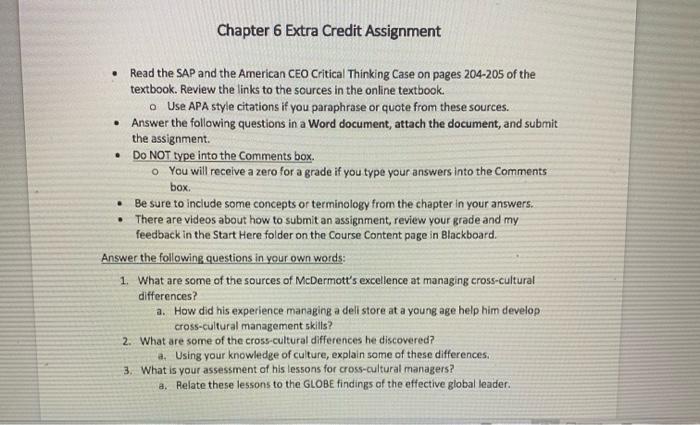
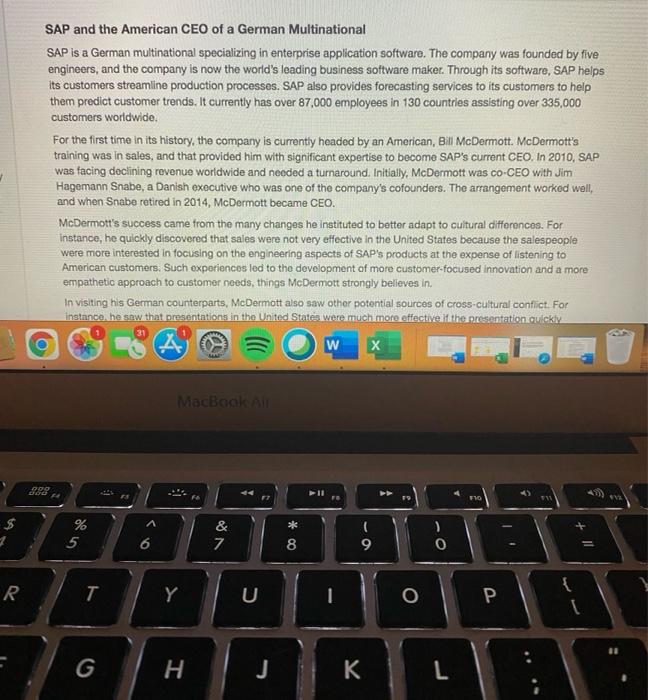
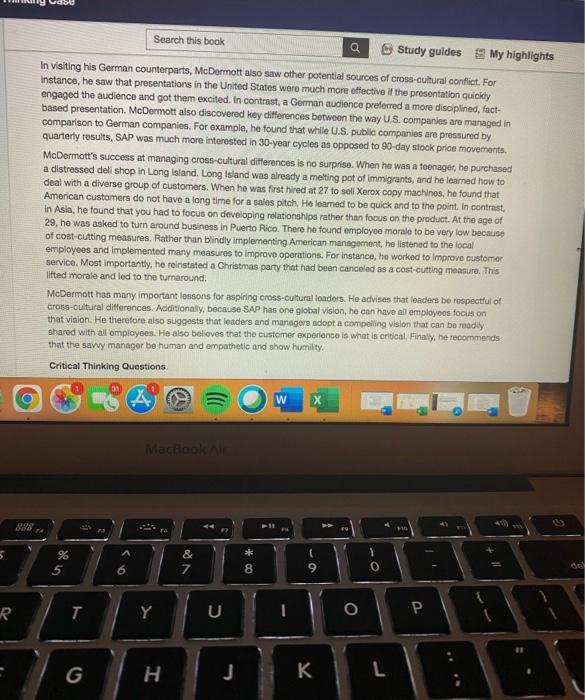
Chapter 6 Extra Credit Assignment . . Read the SAP and the American CEO Critical Thinking Case on pages 204-205 of the textbook. Review the links to the sources in the online textbook . Use APA style citations if you paraphrase or quote from these sources. Answer the following questions in a Word document, attach the document, and submit the assignment. Do NOT type into the Comments box. You will receive a zero for a grade if you type your answers into the Comments box Be sure to include some concepts or terminology from the chapter in your answers. There are videos about how to submit an assignment, review your grade and my feedback in the Start Here folder on the Course Content page in Blackboard. Answer the following questions in your own words: 1. What are some of the sources of McDermott's excellence at managing cross-cultural differences? a. How did his experience managing a deli store at a young age help him develop cross-cultural management skills? 2. What are some of the cross-cultural differences he discovered? a. Using your knowledge of culture, explain some of these differences 3. What is your assessment of his lessons for cross-cultural managers? a. Relate these lessons to the GLOBE findings of the effective global leader. SAP and the American CEO of a German Multinational SAP is a German multinational specializing in enterprise application software. The company was founded by five engineers, and the company is now the world's leading business software maker. Through its software, SAP helps its customers streamline production processes. SAP also provides forecasting services to its customers to help them predict customer trends. It currently has over 87,000 employees in 130 countries assisting over 335,000 customers worldwide For the first time in its history, the company is currently headed by an American, Bill McDermott. McDermott's training was in sales, and that provided him with significant expertise to become SAP's current CEO. In 2010, SAP was facing declining revenue worldwide and needed a turnaround. Initially, McDermott was co-CEO with Jim Hagemann Snabe, a Danish executive who was one of the company's cofounders. The arrangement worked well, and when Snabe retired in 2014, McDermott became CEO. McDermott's success came from the many changes he Instituted to better adapt to cultural differences. For Instance, he quickly discovered that sales were not very effective in the United States because the salespeople were more interested in focusing on the engineering aspects of SAP's products at the expense of listening to American customers. Such experiences led to the development of more customer focused innovation and a more empathetic approach to customer needs, things McDermott strongly believes in In visiting his German counterparts, McDermott also saw other potential sources of cross-cultural conflict. For instance, he saw that presentations in the United States were much more effective the presentation quickly w O A MacBook Air 000 DO FY $ A % 5 & 7 00* 6 9 O R. T Y U O P. I G H K L Search this book a Study guides My highlights In visiting his German counterparts, McDermott also saw other potential sources of cross-cultural conflict. For Instance, he saw that presentations in the United States were much more effective if the presentation quickly engaged the audience and got them excited. In contrast, a Gorman audience preferred a more disciplined, fact- based presentation. McDermott also discovered key differences between the way U.S. companies are managed in comparison to German companies. For example, he found that while U.S. public companies are pressured by quarterly results, SAP was much more interested in 30-year cycles as opposed to 90-day stock price movements, McDermott's success at managing cross-cultural differences is no surprise. When he was a teenager, he purchased a distressed deli shop in Long Island, Long Island was already a melting pot of immigrants, and he learned how to deal with a diverse group of customers. When he was first hired at 27 to sell Xerox copy machines, he found that American customers do not have a long time for a sales pitch. He learned to be quick and to the point. In contrast in Asia, he found that you had to focus on developing relationships rather than focus on the product. At the age of 29, he was asked to turn around business in Puerto Rico. There he found employee morale to be very low because of cost-cutting measures. Rather than blindly implementing American management, he listened to the local employees and implemented many measures to improve operations. For instance, he worked to improve customer service. Most importantly, he reinstated a Christmas party that had been canceled as a cost-cutting measure. This lifted morale and led to the turnaround. McDermott has many important lessons for aspiring cross-cultural fonders. He advises that leaders be respectful of cross-cultural differences. Additionally, because SAP has one global vision, he can have all employoos focus on that vision. He therefore also suggests that leaders and managers adopt a compelling vision that can be madly shared with all employees. He also believes that the customer experience is what is critical. Finally, he recommends that the savvy manager be human and empathetic and show humility Critical Thinking Questions A W MacBook 828 10 5 6 . & 7 * 00 9 0 R. T Y U O P G H j L









 Study Help