







Question: Chapter 6 Lab 6 Saved 2 Problem 6-7A Gross profit comparisons and cost flow assumptions-perpetual LO2, 3 Ontario Skateboard Company has the following inventory and
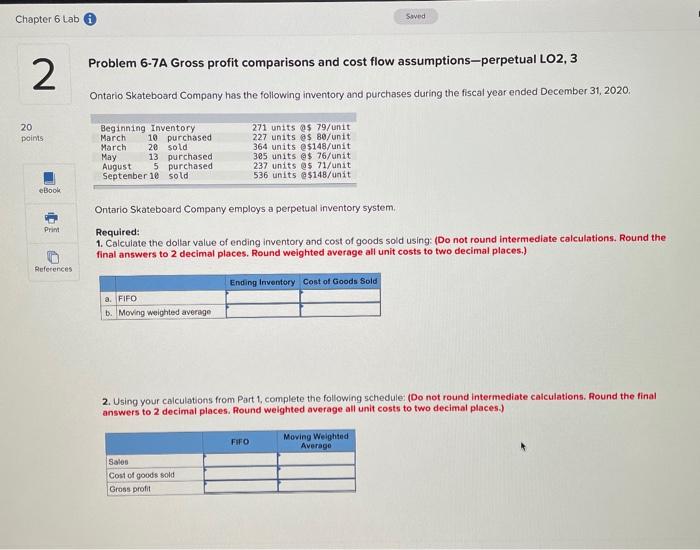
Chapter 6 Lab 6 Saved 2 Problem 6-7A Gross profit comparisons and cost flow assumptions-perpetual LO2, 3 Ontario Skateboard Company has the following inventory and purchases during the fiscal year ended December 31, 2020, 20 points Beginning Inventory March 10 purchased March 20 sold May 13 purchased August 5 purchased Septenber 10 sold 271 units $ 79/unit 227 units $ 80/unit 364 units $148/unit 305 units @$ 76/unit 237 units @ 71/unit 536 units $148/unit eBook Print Ontario Skateboard Company employs a perpetual inventory system Required: 1. Calculate the dollar value of ending inventory and cost of goods sold using: (Do not round intermediate calculations. Round the final answers to 2 decimal places. Round weighted average all unit costs to two decimal places.) References Ending Inventory Cost of Goods Sold a FIFO B. Moving weighted average 2. Using your calculations from Part 1, complete the following schedule: (Do not found intermediate calculations. Round the final answers to 2 decimal places. Round weighted average all unit costs to two decimal places.) FIFO Moving Weighted Average Sales Cost of goods sold Gross profit
Step by Step Solution
There are 3 Steps involved in it

Get step-by-step solutions from verified subject matter experts
 Study Help