







Question: Chapter 6 Stacks, Queues, and Deques On Page 227, Section 6.1.1, implement the Stack Abstract Data Type. That means implementing all the 5 functions and
Chapter 6 Stacks, Queues, and Deques On Page 227, Section 6.1.1, implement the Stack Abstract Data Type. That means implementing all the 5 functions and run your codes on Example 6.3. Your program should print out that table in Example 6.3.
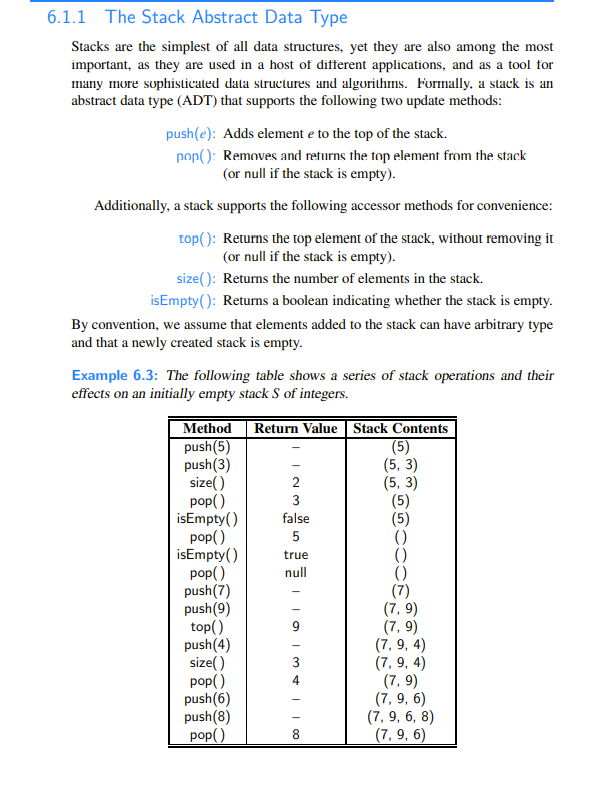
Stacks are the simplest of all data structures, yet they are also among the most important, as they are used in a host of different applications, and as a tool for many more sophisticated data structures and algorithms. Formally. a stack is an abstract data type (ADT) that supports the following two update methods: push(e): Adds element e to the top of the stack. pop( ): Removes and returns the top element from the stack (or null if the stack is empty). Additionally, a stack supports the following accessor methods for convenience: top( ): Returns the top element of the stack, without removing it (or null if the stack is empty). size( ): Returns the number of elements in the stack. is Empty ( ): Returns a boolean indicating whether the stack is empty. By convention, we assume that elements added to the stack can have arbitrary type and that a newly created stack is empty. Example 6.3: The following table shows a series of stack operations and their effects on an initially empty stack S of integers
Step by Step Solution
There are 3 Steps involved in it

Get step-by-step solutions from verified subject matter experts
 Study Help