







Question: On Page 239, Section 6.2.1, implement the Queue Abstract Data Type. That means implementing all the 5 functions and run your codes on Example 6.4
On Page 239, Section 6.2.1, implement the Queue Abstract Data Type. That means implementing all the 5 functions and run your codes on Example 6.4 on Page 240. Your program should print out that table in Example 6.4. (Java)
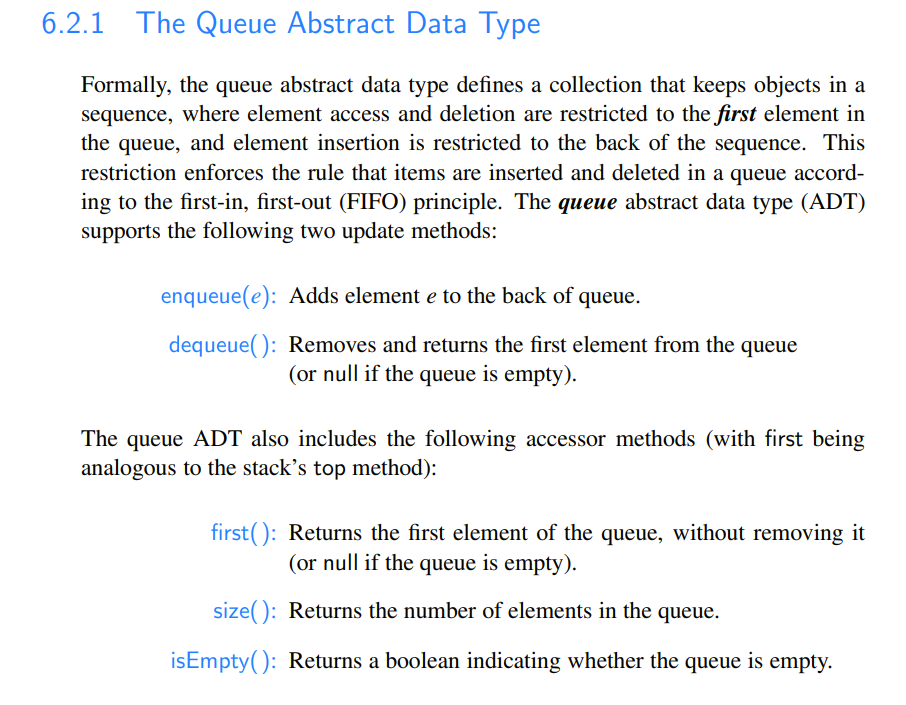
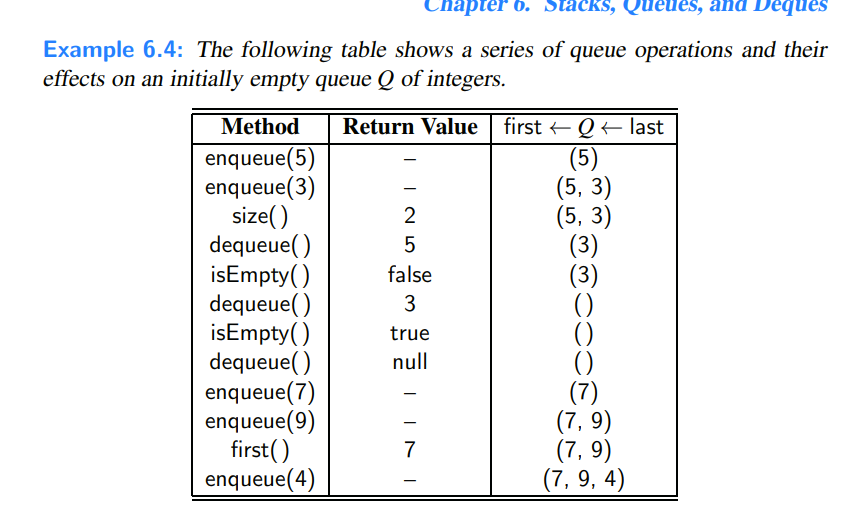
2.1 The Queue Abstract Data Iype Formally, the queue abstract data type defines a collection that keeps objects in a sequence, where element access and deletion are restricted to the first element in the queue, and element insertion is restricted to the back of the sequence. This restriction enforces the rule that items are inserted and deleted in a queue according to the first-in, first-out (FIFO) principle. The queu abstract data type (ADT) supports the following two update methods: enqueue (e): Adds element e to the back of queue. dequeue(): Removes and returns the first element from the queue (or null if the queue is empty). The queue ADT also includes the following accessor methods (with first being analogous to the stack's top method): first(): Returns the first element of the queue, without removing it (or null if the queue is empty). size( ): Returns the number of elements in the queue. isEmpty ( ): Returns a boolean indicating whether the queue is empty. Example 6.4: The following table shows a series of queue operations and their effects on an initially empty queue Q of integers
Step by Step Solution
There are 3 Steps involved in it

Get step-by-step solutions from verified subject matter experts
 Study Help