







Question: Chapter 7: 1. (8 Points) Write the chemical reaction for the combustion of hydrogen, H, and air then, calculate the stoichiometric fuel-to-air ratio, fstoich
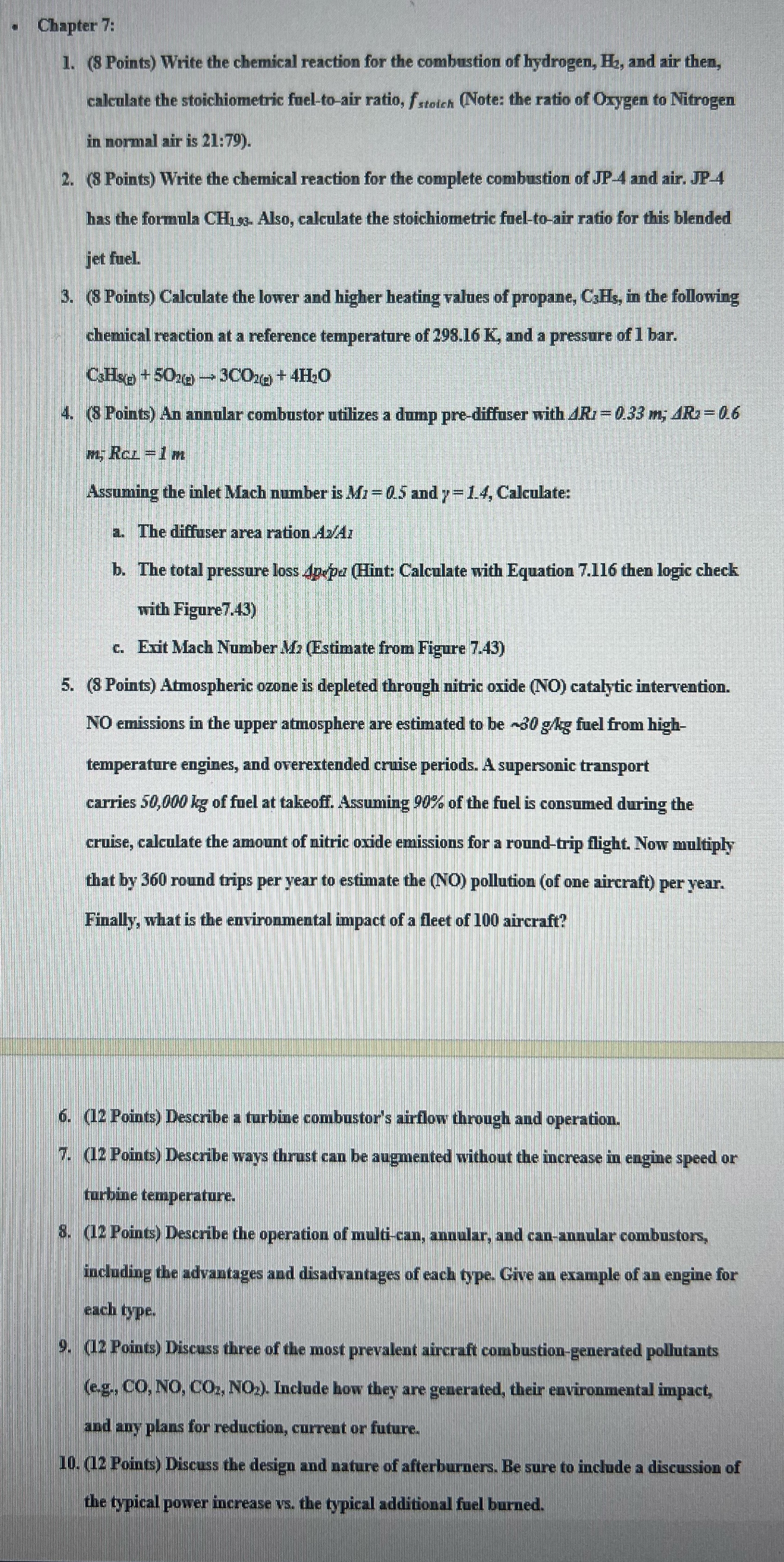
Chapter 7: 1. (8 Points) Write the chemical reaction for the combustion of hydrogen, H, and air then, calculate the stoichiometric fuel-to-air ratio, fstoich (Note: the ratio of Oxygen to Nitrogen in normal air is 21:79). 2. (8 Points) Write the chemical reaction for the complete combustion of JP-4 and air. JP-4 has the formula CH. Also, calculate the stoichiometric fuel-to-air ratio for this blended jet fuel. 3. (8 Points) Calculate the lower and higher heating values of propane, CaHs, in the following chemical reaction at a reference temperature of 298.16 K, and a pressure of 1 bar. CsHse +503CO2) + 4HO 4. (8 Points) An annular combustor utilizes a dump pre-diffuser with R=0.33 m; AR=06 my Ra=1 m Assuming the inlet Mach number is Mr-05 and y=1.4, Calculate: a. The diffuser area ration 4x4 b. The total pressure loss Appa (Hint: Calculate with Equation 7.116 then logic check with Figure 7.43) c. Exit Mach Number M (Estimate from Figure 7.43) 5. (8 Points) Atmospheric ozone is depleted through nitric oxide (NO) catalytic intervention. NO emissions in the upper atmosphere are estimated to be 30 g/kg fuel from high- temperature engines, and overextended cruise periods. A supersonic transport carries 50,000 kg of fuel at takeoff. Assuming 90% of the fuel is consumed during the cruise, calculate the amount of nitric oxide emissions for a round-trip flight. Now multiply that by 360 round trips per year to estimate the (NO) pollution (of one aircraft) per year. Finally, what is the environmental impact of a fleet of 100 aircraft? 6. (12 Points) Describe a turbine combustor's airflow through and operation. 7. (12 Points) Describe ways thrust can be augmented without the increase in engine speed or turbine temperature. 8. (12 Points) Describe the operation of multi-can, annular, and can-annular combustors, including the advantages and disadvantages of each type. Give an example of an engine for each type. 9. (12 Points) Discuss three of the most prevalent aircraft combustion-generated pollutants (e.g., CO, NO, CO, NO2). Include how they are generated, their environmental impact, and any plans for reduction, current or future. 10. (12 Points) Discuss the design and nature of afterburners. Be sure to include a discussion of the typical power increase vs. the typical additional fuel burned.
Step by Step Solution
There are 3 Steps involved in it

Get step-by-step solutions from verified subject matter experts
 Study Help