







Question: Chapter 9:pls help :) Question 1 (1 point) Suppose the coonomy is initialy in a long -run macroeconomic equilibrium. A shock then hits the poor
Chapter 9:pls help :)
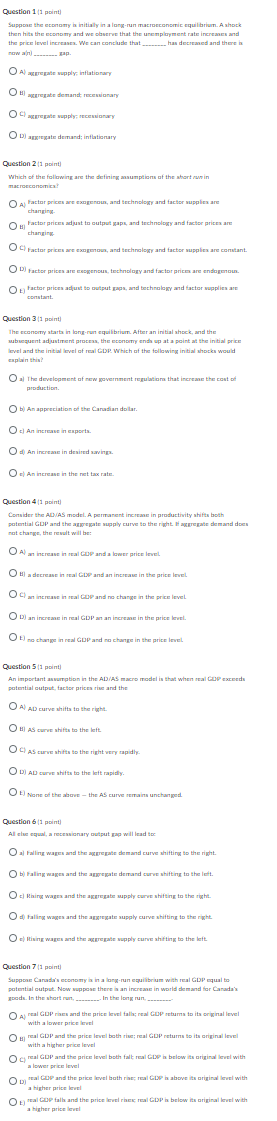
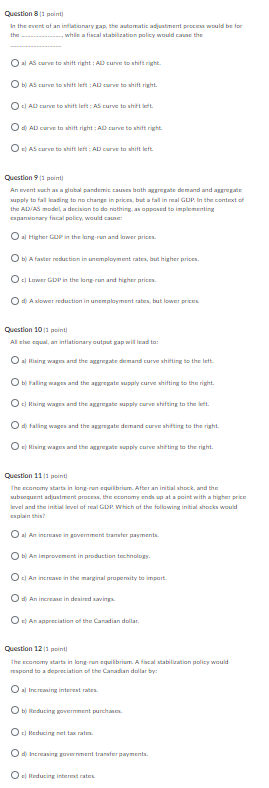
Question 1 (1 point) Suppose the coonomy is initialy in a long -run macroeconomic equilibrium. A shock then hits the poor the price level increases. We can conclude that -. has decreased and there is now an) _.. Al aggregate supply; inflationary OHI aggregate demand recessionary 4 aggregate supply; recessionary O D) aggregate demand; inflationary Question 2 (1 point) Which of the following are the defining assumptions of the shari wwwin macroeconomics! O A Factor prices are exogenous, and technology and factor supplies are changing. Op Factor prices adjust to output gaps, and technology and factor prices are changing. 4Factor prices are exogenous, and technology and factor supplies are constant. O ") Factor prices a chnology and factor Op factor prices adjust to output gaps, and technology and factor supplies are constant. Question 3 (1 point) The economy starts in long-run equilibrium. After an initial shock, and the a point at the initial price level and the initial level of real GDP. Which of the following initial shocks would caplain this! al The development of new government regulation that increase the cost of production. ) b) An appreciation of the Canadian dollar. O :] An increase in maports. O ) An ircream in desired savings. O ) An increase in the net tax rate. Question 4 (1 point) Consider the ADMVAS model. A permanent increase in productivity shifts both potential GUP and the aggregate supply curve to the right. If aggregate demand does not change, the result will be: A an increase in real CUP and a lower price level OHJ a decrease in real GDP and an increase in the price level 4 an increase in real COP and no change in the price level DJ an increase in real GDP an an increase in the price level. OH no change in real GUP and no change in the price level Question 5 (1 point) An important assumption in the ALIAS macro model is that when real CUP exceeds potential output, factor prices rise and the A AD curve shifts to the right. (OH) AS curve shifts to the left O CI AS curve shifts to the right very rapidly. O () AD curve shifts to the left rapidly. OF None of the showe - the AS curve remains unchanged. Question 6 (1 point) All che equal, a recessionary output gap will lead to al Falling wages and the aggregate demand curve shifting to the right. () b) Falling wages and the appegate demand curve shifting in the left. : Khing wages and the aggregate supply curve shifting to the right. 0 4) falling wages and the aggregate supply curve shifting to the right. O ) Rising wages and the aggregate supply curve shifting to the left. Question 7 (1 point) Suppos Canada's economy in in a long -run equilibrium with real GDP equal to potential output. Now sup here is an increasing world demand for Canada's Foods. In the short ru . In the long run. .. A real GOP rises and the price level fall; real GUP returns to its original level with a lower price level Om real GDP and the price level both rise; real GUP returns to its original level with a higher price level real GUP and the price level both fall real GDP is below its original level with lower price level "al GOP and the price level both rise; real GDP is above its original level with higher price level Op cal GOP falk and the price level ries, real GDP is below its original level with a higher price levelQuestion 8 |1 pointl In the ment of an inflationary gap, the automatic adjustment process would be for the .while a fiscal stabilization policy would cause the al AS cures to shift right ; All curve to shift right. O b) As curve to shift left ; All curse to shift right. () : ADD curve to shift left ; AS curve to shift left. d AD curve to shift right ; ADD curve to shift right. O c AS curve to shift left ; All curve to shift left. Question 9 (1 point) An event such as a plobal pandernic causes both aggregain demand and aggregate supply to fall leading to no change in prices, but a fall in real GUP. In the context of the AWAS model, a decision to do nothing, as opposed to implementing expansionary focal policy, would cris: al Higher COP in the long-run and lower prices. O b) A faster reduction in unemployment rates, but higher prices. a Lower GDP in the long-run and higher prices. O) ) A slower reduction in unemployment rates, but lower prices. Question 10 |1 point) All che equal, an inflationary output gap will lead to: al Rising wages and the aggregate demand curve shifting to the left. b) Falling wages and the aggregate supply curve shifting to the right. a Rising wages and the aggregate supply cures shifting in the left. O d falling wages and the aggregate demand curve shifting to the right. 0 4 Rising wages and the aggregate supply curve shifting to the right. Question 11 (1 point) The economy starts in long-run equilibrium. After an initial shock, and the subsequent adjustment process, the economy ends up at a point with a higher price level and the initial level of real GDP. Which of the following initial shocks would caplain Whist al An increase in government transfer payments. by An improvement in production technology. ( c An increase in the marginal propernity to import. O ) An increase in desired savings. Of An appreciation of the Canadian dollar. Question 12 (1 point) The economy starts in long-run equilibrium. A fiscal stabilisation policy would respond to a depreciation of the Canadian dollar by: al Incmeaning interest rates. b) Reducing government purchases. Of Reducing net tax rates. d Increasing government transfer payments. Reducing interest rates
Step by Step Solution
There are 3 Steps involved in it

Get step-by-step solutions from verified subject matter experts
 Study Help