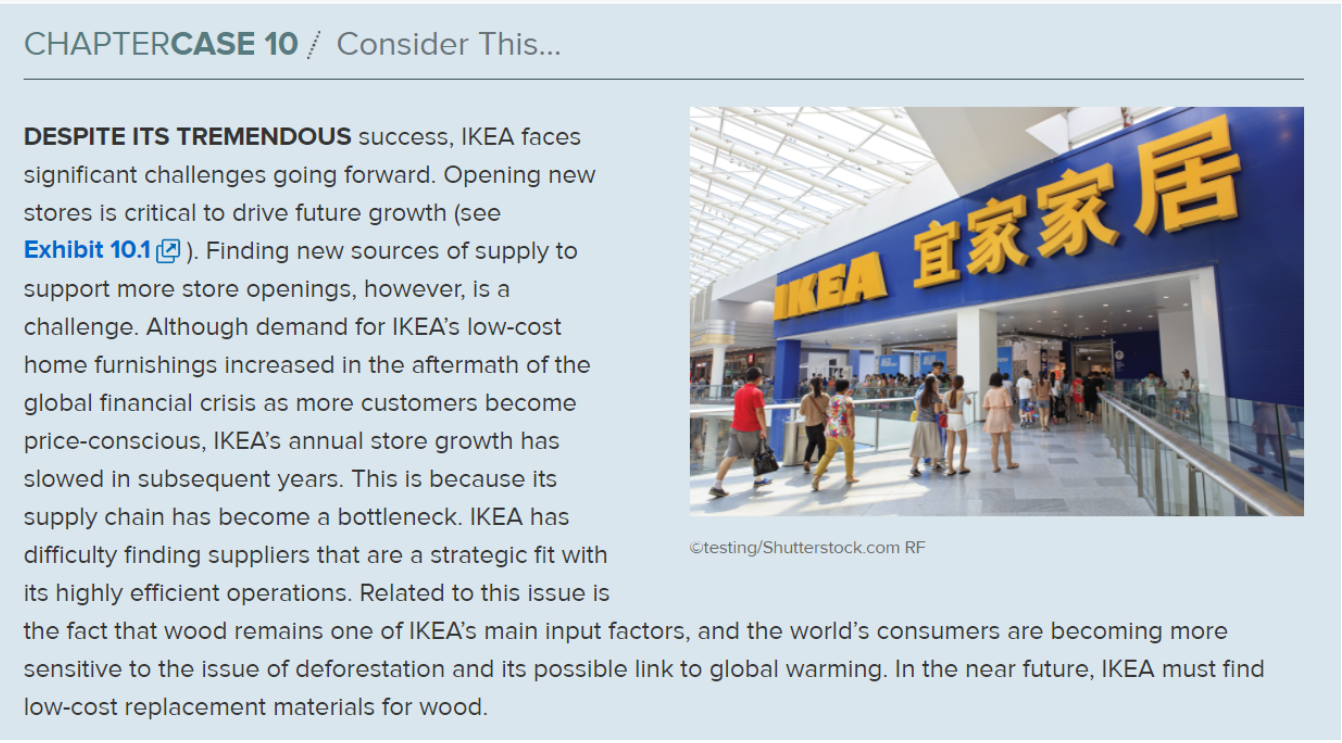

CHAPTERCASE 10. Consider This... TEA IRRE DESPITE ITS TREMENDOUS success, IKEA faces significant challenges going forward. Opening new stores is critical to drive future growth (see Exhibit 10.10 ). Finding new sources of supply to support more store openings, however, is a challenge. Although demand for IKEA's low-cost home furnishings increased in the aftermath of the global financial crisis as more customers become price-conscious, IKEA's annual store growth has slowed in subsequent years. This is because its supply chain has become a bottleneck. IKEA has difficulty finding suppliers that are a strategic fit with Otesting/Shutterstock.com RF its highly efficient operations. Related to this issue is the fact that wood remains one of IKEA's main input factors, and the world's consumers are becoming more sensitive to the issue of deforestation and its possible link to global warming. In the near future, IKEA must find low-cost replacement materials for wood. Powerful competitors, moreover, have also taken notice of IKEA's success. Although IKEA is growing in North America, it holds less than 5 percent of the home-furnishings market. To keep IKEA at bay in the United States, Target has recently recruited top designers and launched a wide range of low-priced furnishings. In some European markets, IKEA holds 30 percent market share. IKEA has also been facing issues on the safety front and taken a hit to its corporate reputation. In 2016, IKEA was forced to recall 35 million chests and dressers in the United States and Canada, because they were implicated in the death of several toddlers. Covered widely in the media, the dressers tipped over easily and were not designed to be anchored in a wall. IKEA agreed to a $50 million settlement. Besides these external challenges, IKEA also faces significant internal ones. Since the company's founding in 1943, no strategic decisions have been made without Ingvar Kamprad's involvement and explicit approval. Kamprad (now in his 90s) in 2013 stepped down from chairing Inter IKEA, the foundation that owns the company. Many observers compare Kamprad's influence on IKEA's culture and organization to that of the legendary Sam Walton at Walmart. Kamprad's three sons are taking on stronger leadership roles at IKEA, including chairing the foundation that controls IKEA. In 2017, IKEA appointed Jesper Brodin, a former assistant to Ingvar Kamprad, as the new CEO. With new leadership, IKEA is making a major push into online sales. Unlike its competition, IKEA had been slow to compete online, with its chief executive openly accepting that IKEA failed to realize that the internet was not just another fad, but rather a significant disruptor for retailing. IKEA's store traffic and website visits are indicative of this strategic shift. While IKEA's website visits more than doubled within a five-year period (to over 2 billion a year), in-person visits to IKEA stores increased a mere 3 percent a year (to about 1 billion in 2017). IKEA also faces some limitations due to its complicated ownership structure. IKEA is privately held through a complex network of foundations and holding companies in the Netherlands, Liechtenstein, and Luxembourg. This arrangement provides benefits in terms of reducing tax exposure, but also creates significant constraints in accessing large sums of capital needed for rapid global expansion. In addition, many EU countries as well as the United States have become increasingly more sensitive to the issue of tax-avoidance schemes by large multinational enterprises. IKEA will need to address the slew of internal and external challenges to achieve its strategic intent of doubling its number of yearly openings in an attempt to capture a larger slice of fast-growing markets, such as the United States, and to make stronger in-roads in newer markets like China and India. As more and more people are buying furniture online, IKEA now also has to contend with the likes of Amazon, Alibaba, and other online retailers specializing in home furnishings. List IKEA's external and internal challenges. Looking at IKEA's challenges, which ones do you think pose the greatest threat? Why? How would you address the challenges




