Question: CHAPTERCASE 2 / PepsiCo's Indra Nooyi: Performance with a Purpose INSTA AS CHIEF EXECUTIVE Officer (CEO) of PepsiCo. Indra Nooys is one of the world's
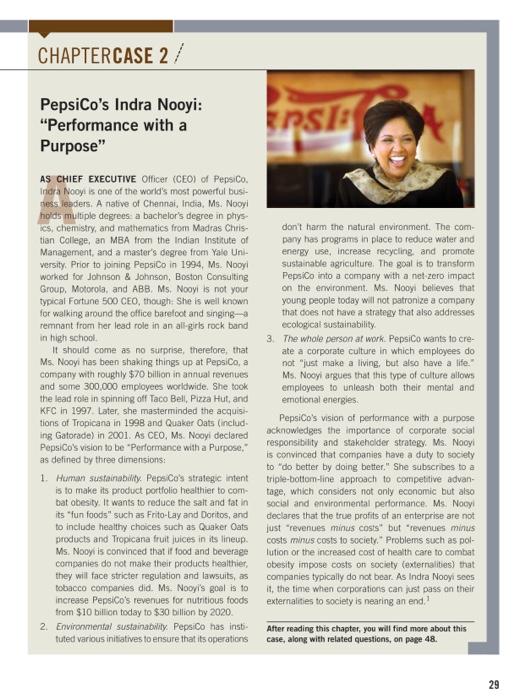
CHAPTERCASE 2 / PepsiCo's Indra Nooyi: "Performance with a Purpose" INSTA AS CHIEF EXECUTIVE Officer (CEO) of PepsiCo. Indra Nooys is one of the world's most powerful busi- ness leaders. A native of Chennai, India, Ms. Nooyi holds multiple degrees a bachelor's degree in phys ics, chemistry, and mathematics from Madras Chris tian College, an MBA from the Indian Institute of Management, and a master's degree from Yale Uni- versity. Prior to joining PepsiCo in 1994, Ms. Nooyi worked for Johnson & Johnson, Boston Consulting Group, Motorola, and ABB. Ms. Nooyi is not your typical Fortune 500 CEO, though. She is well known for walking around the office barefoot and singing-a remnant from her lead role in an all-girls rock band in high school It should come as no surprise, therefore, that Ms. Nooyi has been shaking things up at PepsiCo, a company with roughly $70 billion in annual revenues and some 300,000 employees worldwide. She took the lead role in spinning off Taco Bell, Pizza Hut, and KFC in 1997 Later, she masterminded the acquisi- tions of Tropicana in 1998 and Quaker Oats (includ: ing Gatorade) in 2001. As CEO, Ms. Nooyi declared PepsiCo's vision to be "Performance with a Purpose." as defined by three dimensions: 1. Human Sustainability. PepsiCo's strategic intent is to make its product portfolio healthier to com- bat obesity. It wants to reduce the salt and fat in its "fun foods" such as Frito-Lay and Doritos, and to include healthy choices such as Quaker Oats products and Tropicana fruit juices in its lineup. Ms. Nooy is convinced that if food and beverage companies do not make their products healthier, they will face stricter regulation and lawsuits, as tobacco companies did. Ms. Nooyi's goal is to increase PepsiCo's revenues for nutritious foods from $10 billion today to $30 billion by 2020 2. Environmental sustainability. PepsiCo has insti. tuted various initiatives to ensure that its operations don't harm the natural environment. The com- pany has programs in place to reduce water and energy use, increase recycling and promote sustainable agriculture. The goal is to transform PepsiCo into a company with a net-zero impact on the environment. Ms. Nooyi believes that young people today will not patronize a company that does not have a strategy that also addresses ecological sustainability 3. The whole person at work. PepsiCo wants to cre- ate a corporate culture in which employees do not just make a living, but also have a life." Ms. Nooyi argues that this type of culture allows employees to unleash both their mental and emotional energies PepsiCo's vision of performance with a purpose acknowledges the importance of corporate social responsibility and stakeholder strategy Ms. Nooyi is convinced that companies have a duty to society to do better by doing better." She subscribes to a triple-bottom-line approach to competitive advan- tage, which considers not only economic but also social and environmental performance. Ms. Nocy declares that the true profits of an enterprise are not just revenues minus costs but revenues minus costs minus costs to society. Problems such as pol- lution or the increased cost of health care to combat obesity impose costs on society (externalities that companies typically do not bear. As Indra Nooyi sees it, the time when corporations can just pass on their externalities to society is nearing an end. After reading this chapter, you will find more about this case, along with related questions, on page 48. 29 48 CHAPTER 2 Svategic Leadership Managing the Strategy Process 2.4 Implications for the Strategist Two ingredients are needed to create a powerful foundation upon which to formulate and implement a strategy in order to gain and sustain a competitive advantage: First, the firm needs an inspiring vision and mission backed up by ethical values. Second, the firm needs an effective strategic management process Each of the three strategy processes introduced in this chapter has its strengths and weaknesses. The effectiveness of the chosen strategy process is contingent upon the rate of change in the internal and external environments of the firm. In a slow-moving enviro- ment, top down strategic planning might be the most effective approach. Besides the rate of change, a second dimension is fimm size. Larger firms tend to use either a top-down stra tegic planning process or scenario planning. For a nuclear power provider such as Areva in France that provides over 75 percent of the country's energy and has the long-term backing of the state, for instance, using a top-down strategy approach might work well. Given that nuclear accidents are rare, but when they occur they have a tremendous impact (such >> in Chernobyl, Russia, and Fukushima, Japan). Areva might use scenario planning to pre- pare for black swan events. In fast-moving environments, in contrast, Internet companies such as Alibaba, eBay, Facebook, Google, Dropbox. Pinterest, or Twitter tend to use the strategy-as-planned emergence process. Another important implication of our discussion is that all employees should be involved in setting an inspiring vision and mission to create more meaningful work. Belief in a company's vision and mission motivates its employees. Moreover, every employee plays strategic role. Lower level employees focus mainly on strategy implementation when a firm is using top-down or scenario planning. As the examples, however, have shown any employee (even at the entry level) can have great ideas that might become strategic initio tives with the potential to transform companies Here we conclude our discussion of the strategic management process, which marks the end of the getting started portion of the AFI framework. The next chapter moves us into the analysis part of the framework, where we begin by studying external and internal analyses CHAPTERCASE 2 / Consider This ... MANY OBSERVERS APPLAUD Indra Nooyi for taking a stakeholder strategy approach by making PepsiCo's strategic vision Performance with a purpose. Although Ms. Nooyi has defined an inspiring vision for Peps.Co, financial performance seems to be aggine especially in comparison with archival Coca-Cola, which has done well by continuing to concentrate on its core business in soda and other non-alcoholic beverages In particular, critics allege that Ms. Nooyi has not paid enough attention to the company's flagship beverage business: Pepsi-Cola fel to No. 3 in U.S. soda sales, behind Coke and Diet Coke. As a result, PepsiCo's stock has underperformed archival inst Coca-Cola in recent years Some critics even 50 far as to call for the replace ment of Ms. Nooy. They also propose splitting PepsiCo into two standalone companies. One would focus on beverages (Pepsi. Gatorade. Tropicana): the other would focus on snack foods (Frito Lay. Doritos) This move would unlock additional profit potential, the argument goes, because well performing snack foods would no longer need to subsidie underperforming beverages CHAPTER 2 Stargic Londonship Managing the Sprategy Process : 49 Questions Thinking about ChaperCase 2 answer the following questions 1. What grade would you give Ms. Nooyi for het job performance as a strategic leader? What are her strengths and weaknesses? Where would you place Ms. Nooyi on the level-5 pyramid of strate Bic leadership son Exhibit 2.4), and why? Support your answers 2. What should a strategic leader like Ms. Nooyi do if his or her vision does not seem to lead to an immediate financial competitive advantage? What would be your top-threo recommendations? Support your arguments 3. you were a member of PepsiCo's board of direc tors, would you be concerned with Ms. Nooy's and/or PepsiCo's performance? If you were con cerned, what course of action would you recom- mend? Would you go so far as to endorse Ms. Nooyi's replacement with a new CEO who would focus more on PepsiCo's stock market perfor mance? Why or why not? 4. Do you agree with Ms. Nooy's cntics that Pep siCo should be split up into two companies one focusing on beverages, and one focusing on snack foods? What would be the advantages and disadvantages of such a move? TAKE-AWAY CONCEPTS This chapter explained the role of vision, mission, and values in the strategic management process. It provided an overview of strategic leadership and explained dif- ferent processes to create strategy, as summarized by the following learning objectives and related take away concepts , LO 2-1 / Describe the roles of vision, mission, and values in the strategic management process. A vision captures an organization's aspirations An effective vision inspires and motivates mem- bers of the organization A mission statement describes what an organiza tion actually does-what its business is and why and how it does it Values define the ethical standards and norms that should govern the behavior of individuals within the firm. LO 2-2 Evaluate the strategic implications of product-oriented and customer-oriented vision statements. Product-oriented vision statements define a busi ness in terms of a good or service provided Customer-oriented vision statements define business in terms of providing solutions to customer needs. Customer-oriented vision statements provide managers with more strategic flexibility than product-oriented missions To be effective, visions and missions need to be backed up by hard-to-reverse strategic commitments LO 2-3 Explain why anchoring a firm in ethical values is essential for long-term success. . Employees tend to follow values practiced by strategic leaders. Without commitment from top managers, statements of values remain merely public relations exercises Ethical values are the guardrails that help keep the company on track when pursuing its mission and its quest for competitive advantage. LO 2-4 Outline how managers become strategic leaders. - To become an effective strategic leader a man ager needs to develop skills to move sequentially through five different leadership levels: highly capablc individual, contributing team mem- ber, competent manager. cffective leader, and executive









 Study Help