







Question: How do you categorize the Performance with Purpose strategy across the different levels of strategy (Corporate or Business or Functional) and different approaches to strategy
How do you categorize the "Performance with Purpose" strategy across the different levels of strategy (Corporate or Business or Functional) and different approaches to strategy (Planing, Scenario Planing, or Planned Emergent)? Explain using the minicase down below to answer the question briefly. 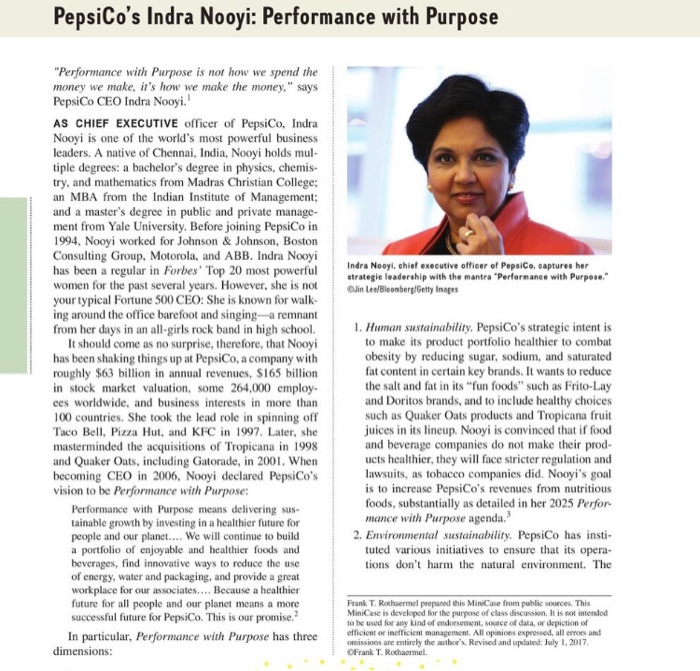
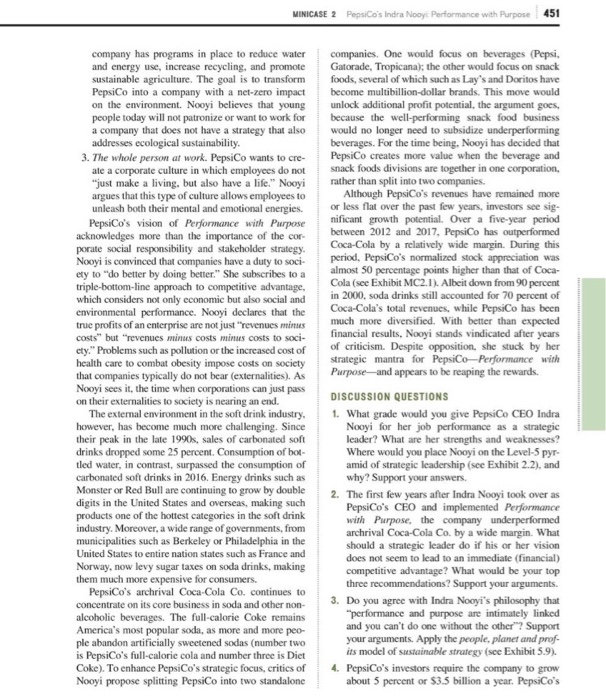
PepsiCo's Indra Nooyi: Performance with Purpose Indra Nooyi, chief executive officer of PepsiCo, captures her strategic leadership with the mantra "Performance with Purpose." Olin Led/Bloomberg/Getty Images "Performance with Purpose is not how we spend the money we make it's how we make the money," says PepsiCo CEO Indra Nooyi.! AS CHIEF EXECUTIVE officer of PepsiCo, Indra Nooyi is one of the world's most powerful business leaders. A native of Chennai, India, Nooyi holds mul- tiple degrees: a bachelor's degree in physics, chemis- try, and mathematics from Madras Christian College; an MBA from the Indian Institute of Management; and a master's degree in public and private manage- ment from Yale University. Before joining PepsiCo in 1994, Nooyi worked for Johnson & Johnson, Boston Consulting Group, Motorola, and ABB. Indra Nooyi has been a regular in Forbes' Top 20 most powerful women for the past several years. However, she is not your typical Fortune 500 CEO: She is known for walk- ing around the office barefoot and singing a remnant from her days in an all-girls rock band in high school. It should come as no surprise, therefore, that Nooyi has been shaking things up at PepsiCo, a company with roughly $63 billion in annual revenues, S165 billion in stock market valuation, some 264,000 employ. ees worldwide, and business interests in more than 100 countries. She took the lead role in spinning off Taco Bell, Pizza Hut, and KFC in 1997. Later, she masterminded the acquisitions of Tropicana in 1998 and Quaker Oats, including Gatorade, in 2001. When becoming CEO in 2006, Nooyi declared PepsiCo's vision to be Performance with Purpose: Performance with Purpose means delivering sus- tainable growth by investing in a healthier future for people and our planet.... We will continue to build a portfolio of enjoyable and healthier foods and beverages, find innovative ways to reduce the use of energy, water and packaging, and provide a great workplace for our associates.... Because a healthier future for all people and our planet means a more successful future for PepsiCo. This is our promise.? In particular, Performance with Purpose has three dimensions: 1. Human sustainability. PepsiCo's strategic intent is to make its product portfolio healthier to combat obesity by reducing sugar, sodium, and saturated fat content in certain key brands. It wants to reduce the salt and fat in its "fun foods" such as Frito Lay and Doritos brands, and to include healthy choices such as Quaker Oats products and Tropicana fruit juices in its lineup. Nooyi is convinced that if food and beverage companies do not make their prod- ucts healthier, they will face stricter regulation and lawsuits, as tobacco companies did. Nooyi's goal is to increase PepsiCo's revenues from nutritious foods, substantially as detailed in her 2025 Perfor mance with Purpose agenda. 2. Environmental sustainability, PepsiCo has insti- tuted various initiatives to ensure that its opera- tions don't harm the natural environment. The Frank T. Rotherme prepared this MiniCase from public sources. This MiniCase is developed for the purpose of class discussion. It is not intended to be used for any kind of endorsement source of data, or depiction of efficient or inefficient management. All opinions expressed, all errors and omissions are entirely the author's Revised and updated: July 1, 2017 OFrank T. Rothaermel. MINICASE 2 PepsiCo's Indra Nooy: Performance with Purpose 451 company has programs in place to reduce water and energy use, increase recycling, and promote sustainable agriculture. The goal is to transform PepsiCo into a company with a net-zero impact on the environment. Nooyi believes that young people today will not patronize or want to work for a company that does not have a strategy that also addresses ecological sustainability. 3. The whole person at work. PepsiCo wants to cre- ate a corporate culture in which employees do not "just make a living, but also have a life." Nooyi argues that this type of culture allows employees to unleash both their mental and emotional energies. PepsiCo's vision of Performance with Purpose acknowledges more than the importance of the cor- porate social responsibility and stakeholder strategy. Nooyi is convinced that companies have a duty to soci- ety to "do better by doing better." She subscribes to a triple-bottom-line approach to competitive advantage, which considers not only economic but also social and environmental performance. Nooyi declares that the true profits of an enterprise are not just "revenues minus costs" but "revenues minus costs minus costs to soci- ety." Problems such as pollution or the increased cost of health care to combat obesity impose costs on society that companies typically do not bear (externalities). As Nooyi sees it, the time when corporations can just pass on their externalities to society is nearing an end. The external environment in the soft drink industry, however, has become much more challenging. Since their peak in the late 1990s, sales of carbonated soft drinks dropped some 25 percent. Consumption of bot- tled water, in contrast, surpassed the consumption of carbonated soft drinks in 2016. Energy drinks such as Monster or Red Bull are continuing to grow by double digits in the United States and overseas, making such products one of the hottest categories in the soft drink industry. Moreover, a wide range of governments, from municipalities such as Berkeley or Philadelphia in the United States to entire nation states such as France and Norway, now levy sugar taxes on soda drinks, making them much more expensive for consumers. PepsiCo's archival Coca-Cola Co. continues to concentrate on its core business in soda and other non- alcoholic beverages. The full-calorie Coke remains America's most popular soda, as more and more peo- ple abandon artificially sweetened sodas (number two is PepsiCo's full-calorie cola and number three is Diet Coke). To enhance PepsiCo's strategic focus, critics of Nooyi propose splitting PepsiCo into two standalone companies. One would focus on beverages (Pepsi, Gatorade, Tropicana); the other would focus on snack foods, several of which such as Lay's and Doritos have become multibillion-dollar brands. This move would unlock additional profit potential, the argument goes, because the well-performing snack food business would no longer need to subsidize underperforming beverages. For the time being, Nooyi has decided that PepsiCo creates more value when the beverage and snack foods divisions are together in one corporation, rather than split into two companies. Although PepsiCo's revenues have remained more or less flat over the past few years, investors see sig- nificant growth potential. Over a five-year period between 2012 and 2017, PepsiCo has outperformed Coca-Cola by a relatively wide margin. During this period, PepsiCo's normalized stock appreciation was almost 50 percentage points higher than that of Coca- Cola (see Exhibit MC2.1). Albeit down from 90 percent in 2000, soda drinks still accounted for 70 percent of Coca-Cola's total revenues, while PepsiCo has been much more diversified. With better than expected financial results. Nooyi stands vindicated after years of criticism. Despite opposition, she stuck by her strategic mantra for PepsiCo-Performance with Purpose and appears to be reaping the rewards. DISCUSSION QUESTIONS 1. What grade would you give PepsiCo CEO Indra Nooyi for her job performance as a strategic leader? What are her strengths and weaknesses? Where would you place Nooyi on the Level-5 pyr- amid of strategic leadership (see Exhibit 2.2), and why? Support your answers. 2. The first few years after Indra Nooyi took over as PepsiCo's CEO and implemented Performance with Purpose, the company underperformed archrival Coca-Cola Co. by a wide margin. What should a strategic leader do if his or her vision does not seem to lead to an immediate (financial) competitive advantage? What would be your top three recommendations? Support your arguments. 3. Do you agree with Indra Nooyi's philosophy that "performance and purpose are intimately linked and you can't do one without the other"? Support your arguments. Apply the people, planet and prof. its model of sustainable strategy (see Exhibit 5.9). 4. PepsiCo's investors require the company to grow about 5 percent or $3.5 billion a year. PepsiCo's Step by Step Solution
There are 3 Steps involved in it
1 Expert Approved Answer
Step: 1 Unlock

Question Has Been Solved by an Expert!
Get step-by-step solutions from verified subject matter experts
Step: 2 Unlock
Step: 3 Unlock
 Study Help