







Question: ChE 383 Matlab - Math Problem 1 Consider these two differentials: df = y(3x + y)dx + x(x + 2y)dy df = y(3x + y)dx
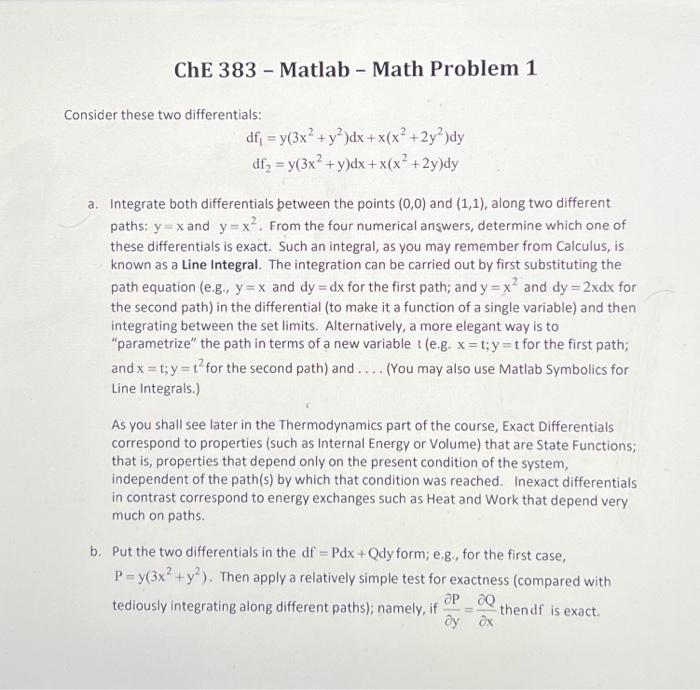
ChE 383 - Matlab - Math Problem 1 Consider these two differentials: df1=y(3x2+y2)dx+x(x2+2y2)dydf2=y(3x2+y)dx+x(x2+2y)dy a. Integrate both differentials between the points (0,0) and (1,1), along two different paths: y=x and y=x2. From the four numerical answers, determine which one of these differentials is exact. Such an integral, as you may remember from Calculus, is known as a Line Integral. The integration can be carried out by first substituting the path equation (e.g., y=x and dy=dx for the first path; and y=x2 and dy=2xdx for the second path) in the differential (to make it a function of a single variable) and then integrating between the set limits. Alternatively, a more elegant way is to "parametrize" the path in terms of a new variable t (e.g. x=t;y=t for the first path; and x=t;y=t2 for the second path) and .... (You may also use Matlab Symbolics for Line Integrals.) As you shall see later in the Thermodynamics part of the course, Exact Differentials correspond to properties (such as Internal Energy or Volume) that are State Functions; that is, properties that depend only on the present condition of the system, independent of the path(s) by which that condition was reached. Inexact differentials in contrast correspond to energy exchanges such as Heat and Work that depend very much on paths. b. Put the two differentials in the df =Pdx+Qdy form; e.g., for the first case, P=y(3x2+y2). Then apply a relatively simple test for exactness (compared with tediously integrating along different paths); namely, if yP=xQ then df is exact
Step by Step Solution
There are 3 Steps involved in it

Get step-by-step solutions from verified subject matter experts
 Study Help