Question: che case below, the original source material is given along with a sample of student work. Cermine the type of plagiarism by clicking the appropriate
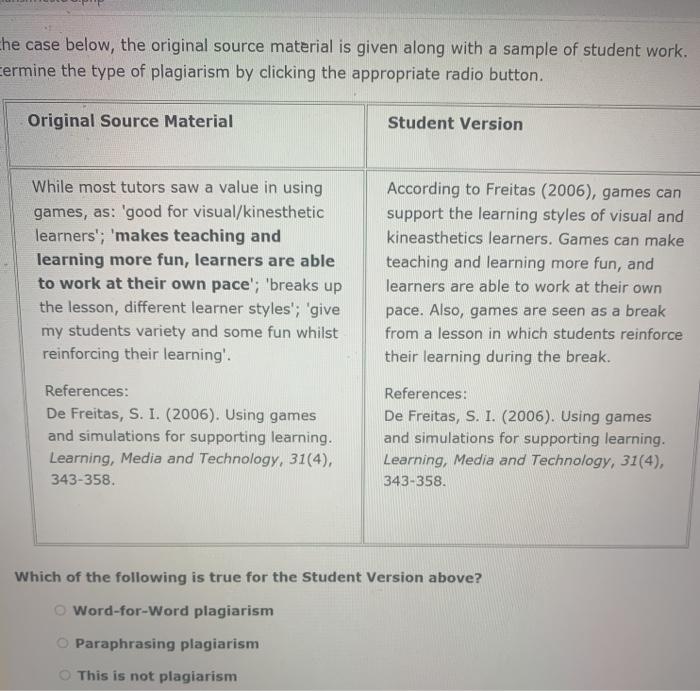
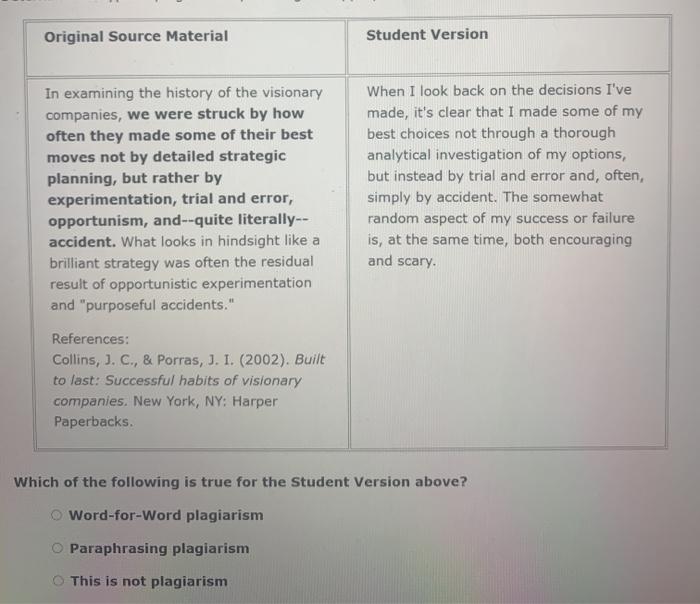
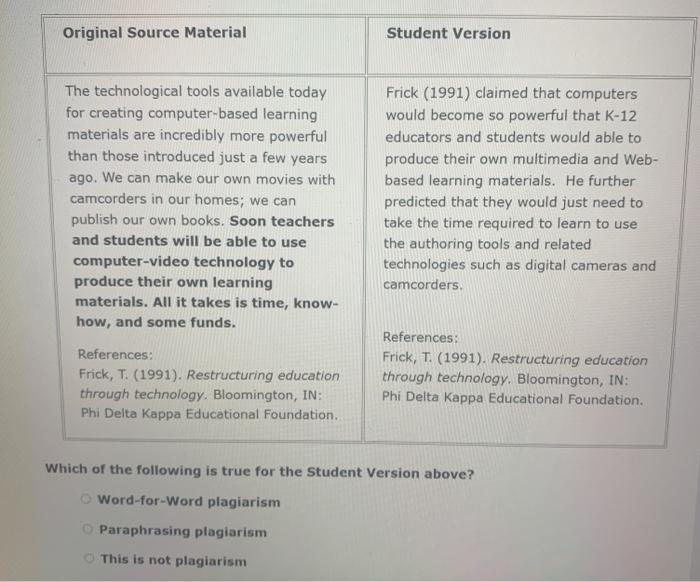
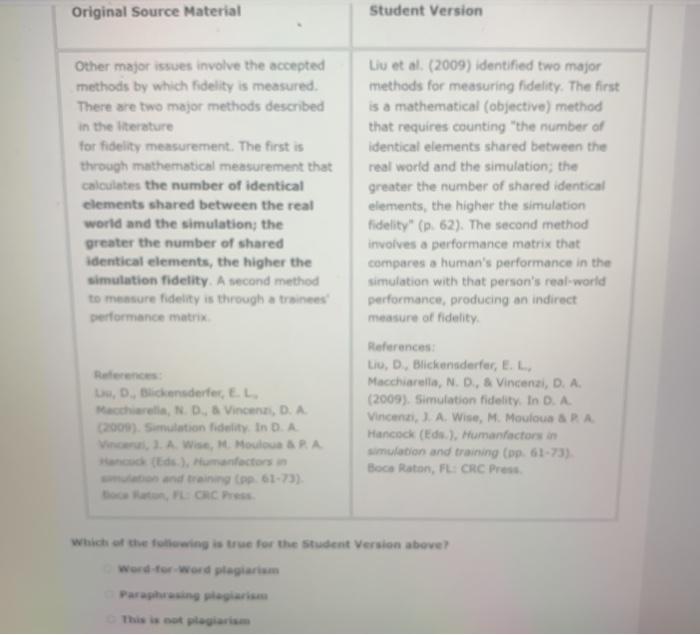
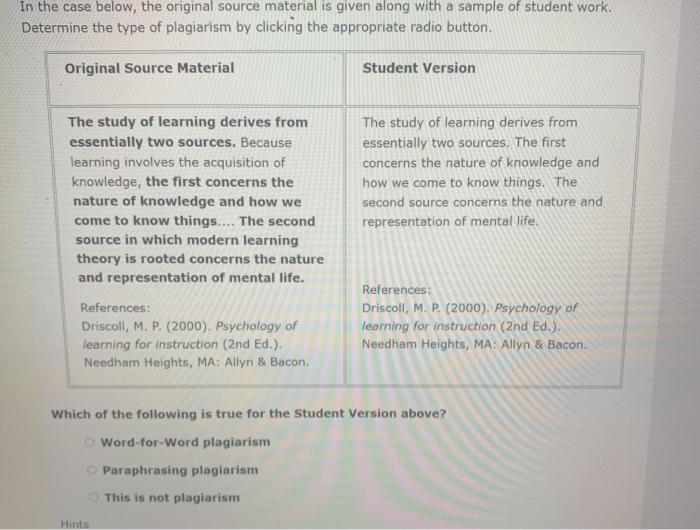
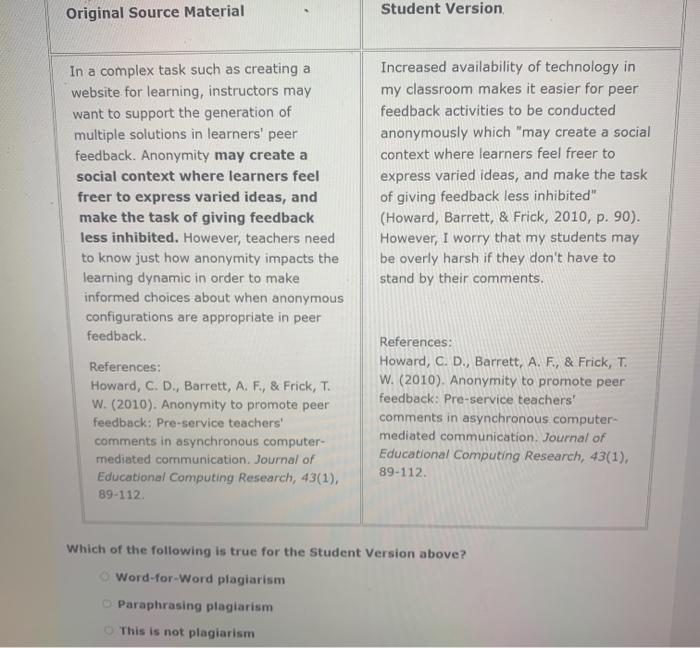
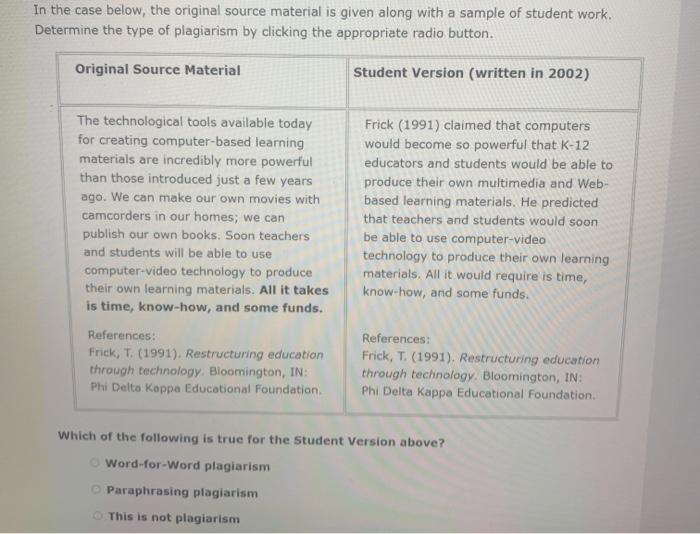
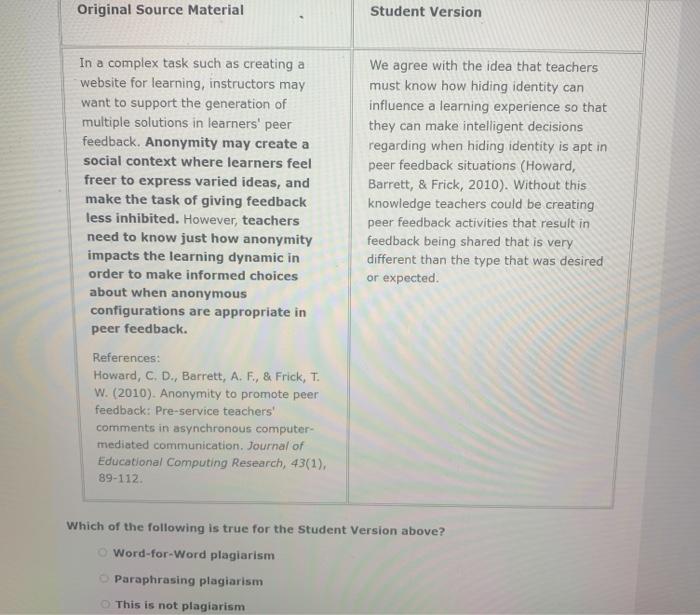
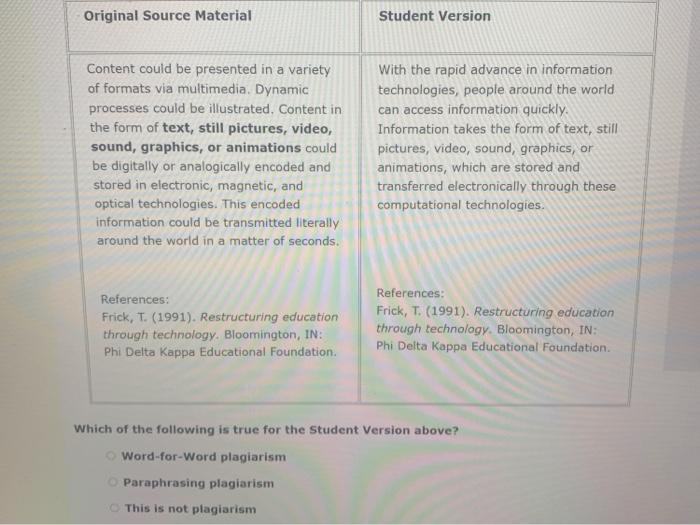
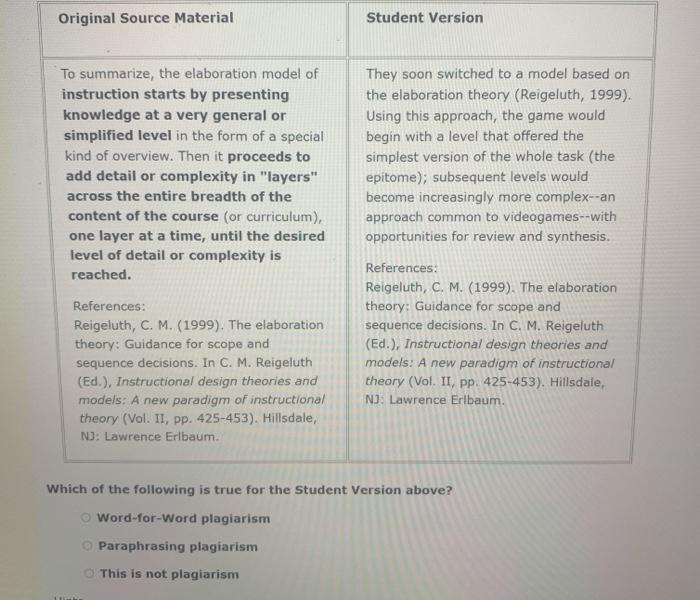
che case below, the original source material is given along with a sample of student work. Cermine the type of plagiarism by clicking the appropriate radio button. Original Source Material Student Version While most tutors saw a value in using games, as: 'good for visual/kinesthetic learners'; 'makes teaching and learning more fun, learners are able to work at their own pace'; 'breaks up the lesson, different learner styles'; 'give my students variety and some fun whilst reinforcing their learning'. According to Freitas (2006), games can support the learning styles of visual and kineasthetics learners. Games can make teaching and learning more fun, and learners are able to work at their own pace. Also, games are seen as a break from a lesson in which students reinforce their learning during the break. References: De Freitas, S. I. (2006). Using games and simulations for supporting learning. Learning, Media and Technology, 31(4), 343-358. References: De Freitas, S. I. (2006). Using games and simulations for supporting learning. Learning, Media and Technology, 31(4), 343-358. Which of the following is true for the Student Version above? Word-for-Word plagiarism Paraphrasing plagiarism This is not plagiarism Original Source Material Student Version In examining the history of the visionary companies, we were struck by how often they made some of their best moves not by detailed strategic planning, but rather by experimentation, trial and error, opportunism, and--quite literally-- accident. What looks in hindsight like a brilliant strategy was often the residual result of opportunistic experimentation and "purposeful accidents." When I look back on the decisions I've made, it's clear that I made some of my best choices not through a thorough analytical investigation of my options, but instead by trial and error and, often, simply by accident. The somewhat random aspect of my success or failure is, at the same time, both encouraging and scary. References: Collins, J. C., & Porras, J. I. (2002). Built to last: Successful habits of visionary companies. New York, NY: Harper Paperbacks. Which of the following is true for the Student Version above? Word-for-Word plagiarism Paraphrasing plagiarism This is not plagiarism Original Source Material Student Version The technological tools available today for creating computer-based learning materials are incredibly more powerful than those introduced just a few years ago. We can make our own movies with camcorders in our homes; we can publish our own books. Soon teachers and students will be able to use computer-video technology to produce their own learning materials. All it takes is time, know- how, and some funds. Frick (1991) claimed that computers would become so powerful that K-12 educators and students would able to produce their own multimedia and Web- based learning materials. He further predicted that they would just need to take the time required to learn to use the authoring tools and related technologies such as digital cameras and camcorders. References: Frick, T. (1991). Restructuring education through technology. Bloomington, IN: Phi Delta Kappa Educational Foundation, References: Frick, T. (1991). Restructuring education through technology. Bloomington, IN: Phi Delta Kappa Educational Foundation Which of the following is true for the Student Version above? Word-for-Word plagiarism Paraphrasing plagiarism This is not plagiarism Original Source Material Student Version Other major issues involve the accepted methods by which fidelity is measured There are two major methods described in the literature for fidelity measurement. The first is through mathematical measurement that calculates the number of identical clements shared between the real world and the simulation, the greater the number of shared identical elements, the higher the simulation fidelity. A second method to measure fidelity is through a trainees performance matrix Liu et al. (2009) identified two major methods for measuring fidelity. The first is a mathematical (objective) method that requires counting the number of identical elements shared between the real world and the simulation; the greater the number of shared identical elements, the higher the simulation fidelity" (. 62). The second method involves a performance matrix that compares a human's performance in the simulation with that person's real-world performance, producing an indirect measure of fidelity UND, Blickensderfer, EL. Macchiare, ND & Vincen, DA 2009). Sinulation fidelity in DA LAW, M. Moi RA References Lo, D., Blickensdorfer, EL Macchiarella, N. D., & Vincenai, D. A (2009) Simulation fidelity. In DA Vincent A Wise, M. Mouloua SPA Hancock (Eds.). Humanfactors in simulation and training (Op. 61-73) Boca Raton, FL CRC Press and training Cap 61-73) FL CRC Press Which of the following is true for the Student Version above word-for-word plagiarism Paraphrasing lagi This is not plagiaris In the case below, the original source material is given along with a sample of student work. Determine the type of plagiarism by clicking the appropriate radio button. Original Source Material Student Version The study of learning derives from essentially two sources. Because learning involves the acquisition of knowledge, the first concerns the nature of knowledge and how we come to know things.... The second source in which modern learning theory is rooted concerns the nature and representation of mental life. The study of learning derives from essentially two sources. The first concerns the nature of knowledge and how we come to know things. The second source concerns the nature and representation of mental life. References: Driscoll, M. P. (2000). Psychology of learning for instruction (2nd Ed.). Needham Heights, MA: Allyn & Bacon References: Driscoll, M. P. (2000). Psychology of learning for instruction (2nd Ed.). Needham Heights, MA: Allyn & Bacon Which of the following is true for the Student Version above? Word-for-Word plagiarism Paraphrasing plagiarism This is not plagiarism Original Source Material Student Version In a complex task such as creating a website for learning, instructors may want to support the generation of multiple solutions in learners' peer feedback. Anonymity may create a social context where learners feel freer to express varied ideas, and make the task of giving feedback less inhibited. However, teachers need to know just how anonymity impacts the learning dynamic in order to make informed choices about when anonymous configurations are appropriate in peer feedback Increased availability of technology in my classroom makes it easier for peer feedback activities to be conducted anonymously which "may create a social context where learners feel freer to express varied ideas, and make the task of giving feedback less inhibited" (Howard, Barrett, & Frick, 2010, p. 90). However, I worry that my students may be overly harsh if they don't have to stand by their comments. References: Howard, C. D., Barrett, A. F., & Frick, T. W. (2010). Anonymity to promote peer feedback: Pre-service teachers' comments in asynchronous computer- mediated communication. Journal of Educational Computing Research, 43(1), 89-112 References: Howard, C. D., Barrett, A. F., & Frick, T. W. (2010). Anonymity to promote peer feedback: Pre-service teachers' comments in asynchronous computer- mediated communi ournal of Educational Computing Research, 43(1), 89-112 Which of the following is true for the Student Version above? Word-for-Word plagiarism Paraphrasing plagiarism This is not plagiarism In the case below, the original source material is given along with a sample of student work. Determine the type of plagiarism by clicking the appropriate radio button. Original Source Material Student Version (written in 2002) The technological tools available today for creating computer-based learning materials are incredibly more powerful than those introduced just a few years ago. We can make our own movies with camcorders in our homes; we can publish our own books. Soon teachers and students will be able to use computer video technology to produce their own learning materials. All it takes is time, know-how, and some funds. References: Frick, T. (1991). Restructuring education through technology. Bloomington, IN: Phi Delta Kappa Educational Foundation Frick (1991) claimed that computers would become so powerful that K-12 educators and students would be able to produce their own multimedia and Web- based learning materials. He predicted that teachers and students would soon be able to use computer-video technology to produce their own learning materials. All it would require is time, know-how, and some funds. References: Frick, T. (1991). Restructuring education through technology. Bloomington, IN: Phi Delta Kappa Educational Foundation. Which of the following is true for the Student Version above? Word-for-Word plagiarism Paraphrasing plagiarism This is not plagiarism Original Source Material Student Version In a complex task such as creating a website for learning, instructors may want to support the generation of multiple solutions in learners' peer feedback. Anonymity may create a social context where learners feel freer to express varied ideas, and make the task of giving feedback less inhibited. However, teachers need to know just how anonymity impacts the learning dynamic in order to make informed choices about when anonymous configurations are appropriate in peer feedback. We agree with the idea that teachers must know how hiding identity can influence a learning experience so that they can make intelligent decisions regarding when hiding identity is apt in peer feedback situations (Howard, Barrett, & Frick, 2010). Without this knowledge teachers could be creating peer feedback activities that result in feedback being shared that is very different than the type that was desired or expected References: Howard, C, D., Barrett, A. F., & Frick, T. W. (2010). Anonymity to promote peer feedback: Pre-service teachers' comments in asynchronous computer- mediated communication. Journal of Educational Computing Research, 43(1), 89-112 Which of the following is true for the Student Version above? Word-for-Word plagiarism Paraphrasing plagiarism This is not plagiarism Original Source Material Student Version Content could be presented in a variety of formats via multimedia. Dynamic processes could be illustrated. Content in the form of text, still pictures, video, sound, graphics, or animations could be digitally or analogically encoded and stored in electronic, magnetic, and optical technologies. This encoded information could be transmitted literally around the world in a matter of seconds. With the rapid advance in information technologies, people around the world can access information quickly. Information takes the form of text, still pictures, video, sound, graphics, or animations, which are stored and transferred electronically through these computational technologies. References: Frick, T. (1991). Restructuring education through technology. Bloomington, IN: Phi Delta Kappa Educational Foundation. References: Frick, T. (1991). Restructuring education through technology. Bloomington, IN: Phi Delta Kappa Educational Foundation Which of the following is true for the Student Version above? Word-for-Word plagiarism Paraphrasing plagiarism This is not plagiarism Original Source Material Student Version To summarize, the elaboration model of instruction starts by presenting knowledge at a very general or simplified level in the form of a special kind of overview. Then it proceeds to add detail or complexity in "layers" across the entire breadth of the content of the course (or curriculum), one layer at a time, until the desired level of detail or complexity is reached. They soon switched to a model based on the elaboration theory (Reigeluth, 1999). Using this approach, the game would begin with a level that offered the simplest version of the whole task (the epitome); subsequent levels would become increasingly more complex--an approach common to videogames--with opportunities for review and synthesis. References: Reigeluth, C. M. (1999). The elaboration theory: Guidance for scope and sequence decisions. In C. M. Reigeluth (Ed.), Instructional design theories and models: A new paradigm of instructional theory (Vol. II, pp. 425-453). Hillsdale, NJ: Lawrence Erlbaum. References: Reigeluth, C. M. (1999). The elaboration theory: Guidance for scope and sequence decisions. In C. M. Reigeluth (Ed.), Instructional design theories and models: A new paradigm of instructional theory (Vol. II, pp. 425-453). Hillsdale, NJ: Lawrence Erlbaum. Which of the following is true for the Student Version above? Word-for-Word plagiarism Paraphrasing plagiarism This is not plagiarism









 Study Help