







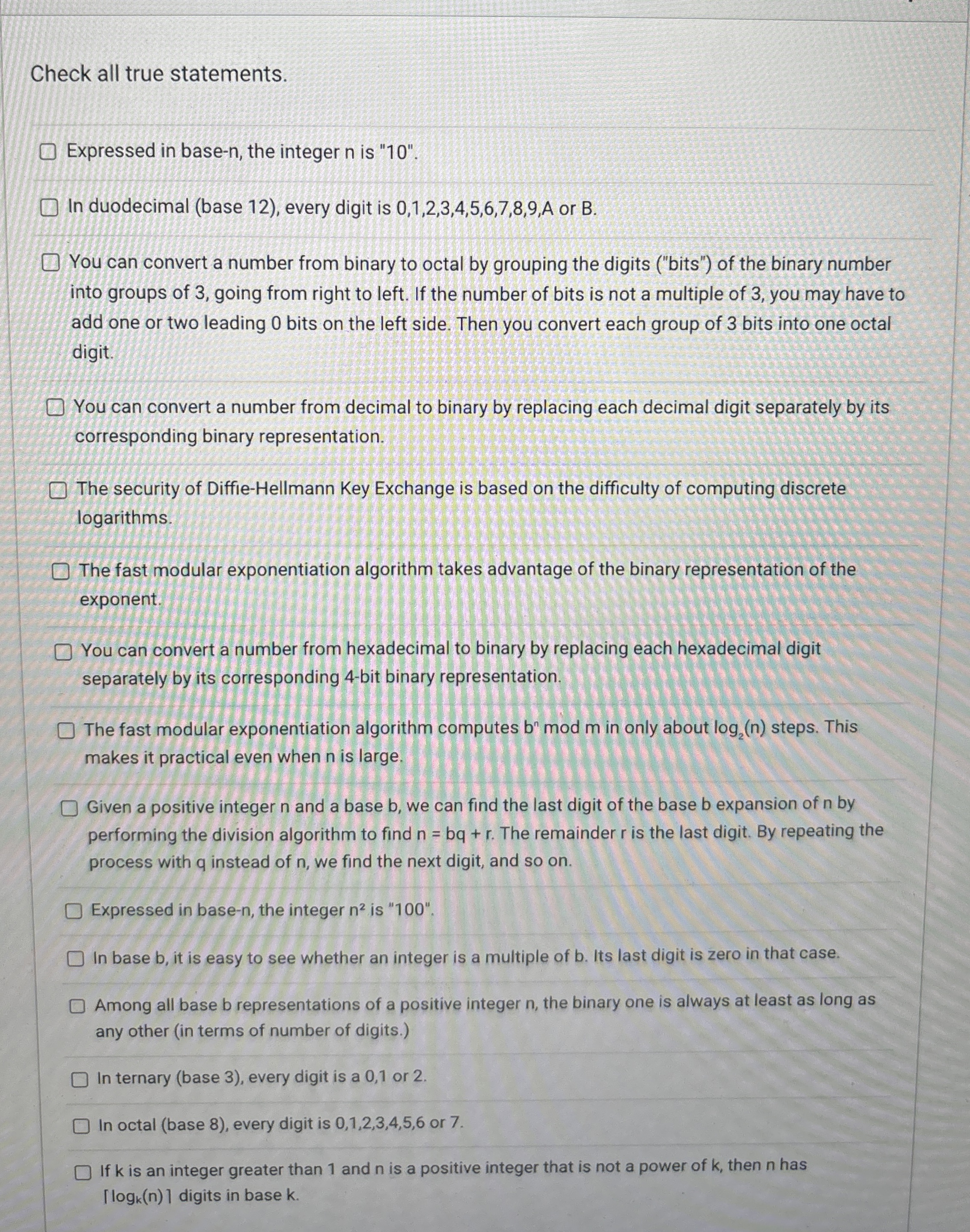
Question: Check all true statements. Expressed in base - n , the integer n is 1 0 . In duodecimal ( base 1 2
Check all true statements.
Expressed in basen the integer n is
In duodecimal base every digit is or B
You can convert a number from binary to octal by grouping the digits bits of the binary number into groups of going from right to left. If the number of bits is not a multiple of you may have to add one or two leading bits on the left side. Then you convert each group of bits into one octal digit.
You can convert a number from decimal to binary by replacing each decimal digit separately by its corresponding binary representation.
The security of DiffieHellmann Key Exchange is based on the difficulty of computing discrete logarithms.
The fast modular exponentiation algorithm takes advantage of the binary representation of the exponent.
You can convert a number from hexadecimal to binary by replacing each hexadecimal digit separately by its corresponding bit binary representation.
The fast modular exponentiation algorithm computes mod in only about steps. This makes it practical even when is large.
Given a positive integer and a base we can find the last digit of the base expansion of by performing the division algorithm to find The remainder is the last digit. By repeating the process with instead of we find the next digit, and so on
Expressed in basen the integer is
In base it is easy to see whether an integer is a multiple of Its last digit is zero in that case.
Among all base representations of a positive integer n the binary one is always at least as long as any other in terms of number of digits.
In ternary base every digit is a or
In octal base every digit is or
If is an integer greater than and is a positive integer that is not a power of then has ~~ digits in base
Step by Step Solution
There are 3 Steps involved in it
1 Expert Approved Answer
Step: 1 Unlock

Question Has Been Solved by an Expert!
Get step-by-step solutions from verified subject matter experts
Step: 2 Unlock
Step: 3 Unlock
 Study Help