







Question: Chem 2 Lab help with all please 1. In a reaction, 90.00mL of 0.90MHCl(aq) and 110.00mL of 1.00MNaOH(aq) were added to a constant pressure calorimeter.
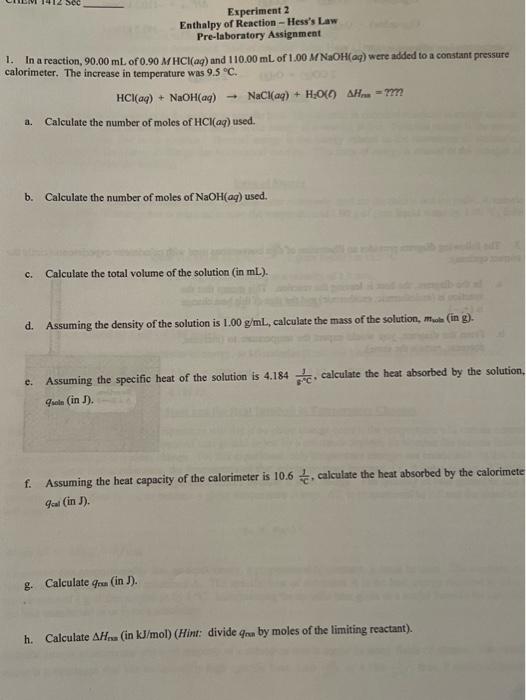
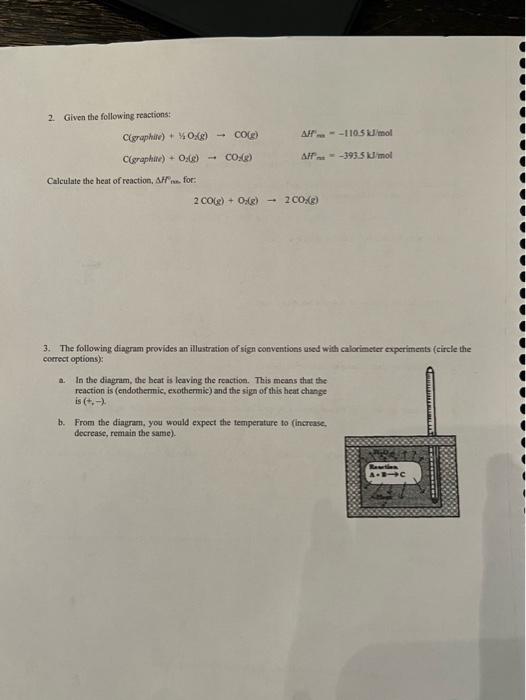
1. In a reaction, 90.00mL of 0.90MHCl(aq) and 110.00mL of 1.00MNaOH(aq) were added to a constant pressure calorimeter. The increase in temperature was 9.5C. HCl(aq)+NaOH(aq)NaCl(aq)+H2O()Hn==2m a. Calculate the number of moles of HCl(aq) used. b. Calculate the number of moles of NaOH(aq) used. c. Calculate the total volume of the solution (in mL ). d. Assuming the density of the solution is 1.00g/mL, calculate the mass of the solution, mhou (in g ). e. Assuming the specific heat of the solution is 4.184sCJ, calculate the heat absorbed by the solution qoiln (in J). f. Assuming the heat capacity of the calorimeter is 10.6c1, calculate the heat absorbed by the calorimett gaal (in J). g. Calculate qras( in J). h. Calculate Hna (in kJ/mol) (Hint: divide qran by moles of the limiting reactant). 2. Given the following reactions: C(gaphire)+12O,(g)CO(g)C(graphine)+O2(g)CO(g)Aff=110.5kl/molSfPn=3935kJmol Calculate the heat of reaction, SHP for: 2CO(g)+O(g)2CO2(g) 3. The following diagram provides an illustration of sign conventions ased with calorimeter experiments (eircle the correct options): a. In the diagram, the heat is leaving the reactioa. This means that the reaction is (endothermic, exatherieic) and the sign of this heat change: is (+,). b. From the diagram, you would expect the temperature to fincrase. decrease, remain the same)
Step by Step Solution
There are 3 Steps involved in it

Get step-by-step solutions from verified subject matter experts
 Study Help