



Question: Chemical engineering thermal dynamic questions PROBLEM 3 Many small airplanes are powered by the turboprop engine (pictured). A simplistic view of a turboprop engine consists
Chemical engineering thermal dynamic questions
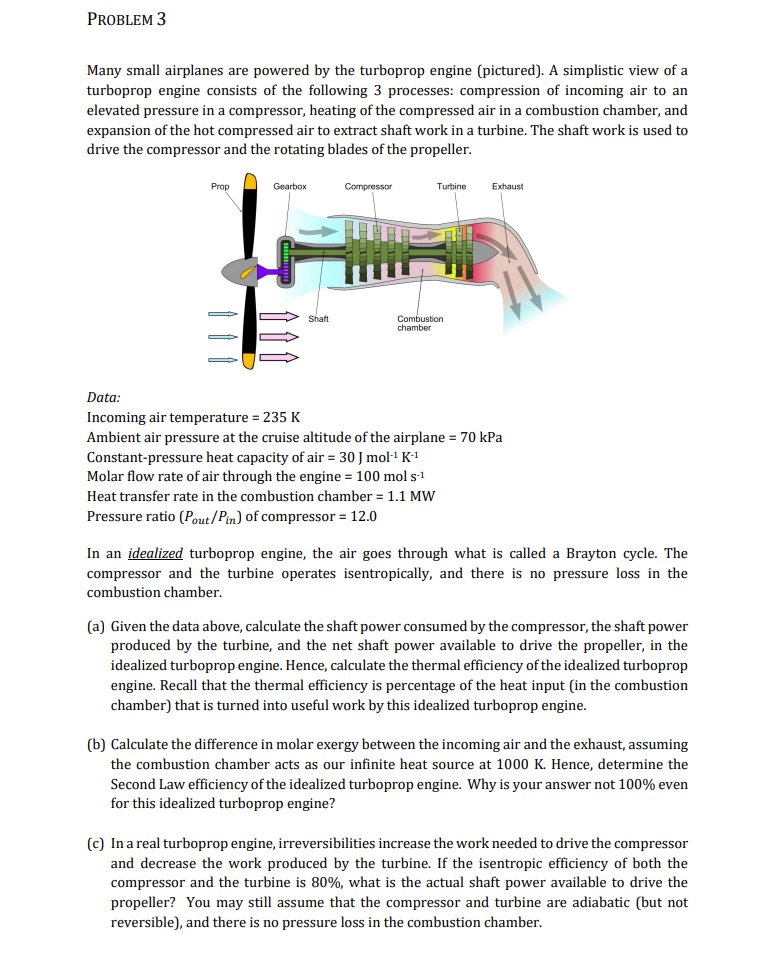
PROBLEM 3 Many small airplanes are powered by the turboprop engine (pictured). A simplistic view of a turboprop engine consists of the following 3 processes: compression of incoming air to an elevated pressure in a compressor, heating of the compressed air in a combustion chamber, and expansion of the hot compressed air to extract shaft work in a turbine. The shaft work is used to drive the compressor and the rotating blades of the propeller. Prop Gearbox Compressor Turbine Exhaust Shaft Combustion chamber Data: Incoming air temperature = 235 K Ambient air pressure at the cruise altitude of the airplane = 70 kPa Constant-pressure heat capacity of air = 30 J mol-? K-1 Molar flow rate of air through the engine = 100 mols-1 Heat transfer rate in the combustion chamber = 1.1 MW Pressure ratio (Pout/Pin) of compressor = 12.0 In an idealized turboprop engine, the air goes through what is called a Brayton cycle. The compressor and the turbine operates isentropically, and there is no pressure loss in the combustion chamber. (a) Given the data above, calculate the shaft power consumed by the compressor, the shaft power produced by the turbine, and the net shaft power available to drive the propeller, in the idealized turboprop engine. Hence, calculate the thermal efficiency of the idealized turboprop engine. Recall that the thermal efficiency is percentage of the heat input (in the combustion chamber) that is turned into useful work by this idealized turboprop engine. (b) Calculate the difference in molar exergy between the incoming air and the exhaust, assuming the combustion chamber acts as our infinite heat source at 1000 K. Hence, determine the Second Law efficiency of the idealized turboprop engine. Why is your answer not 100% even for this idealized turboprop engine? (c) In a real turboprop engine, irreversibilities increase the work needed to drive the compressor and decrease the work produced by the turbine. If the isentropic efficiency of both the compressor and the turbine is 80%, what is the actual shaft power available to drive the propeller? You may still assume that the compressor and turbine are adiabatic (but not reversible), and there is no pressure loss in the combustion chamber
Step by Step Solution
There are 3 Steps involved in it

Get step-by-step solutions from verified subject matter experts