







Question: Choose True if the statement is correct. If the statement is incorrect, choose the correct statement below. In a uniform circular motion, the acceleration and
Choose True if the statement is correct. If the statement is incorrect, choose the correct statement below.
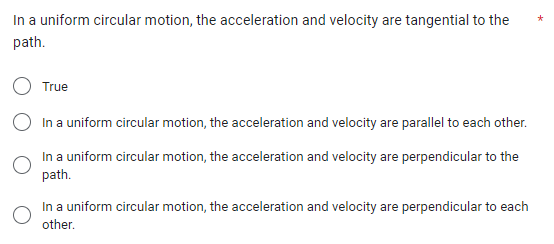
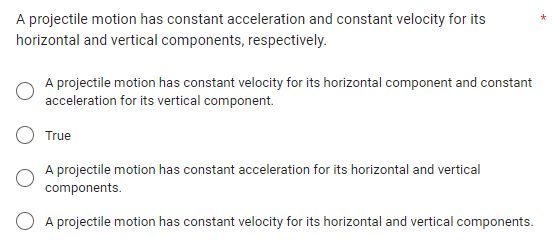
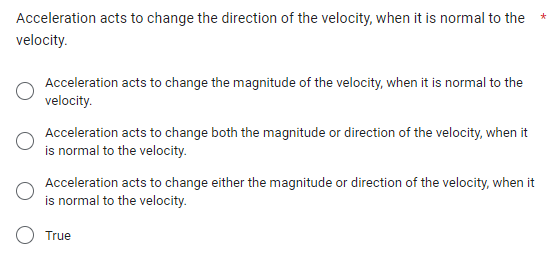
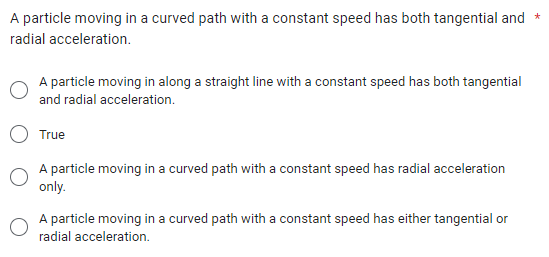
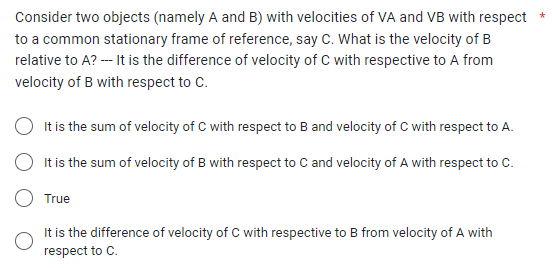
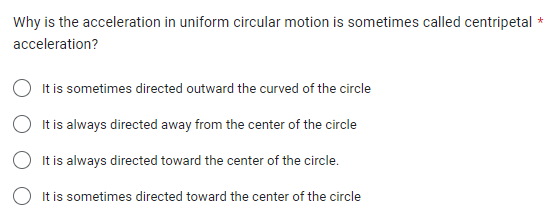
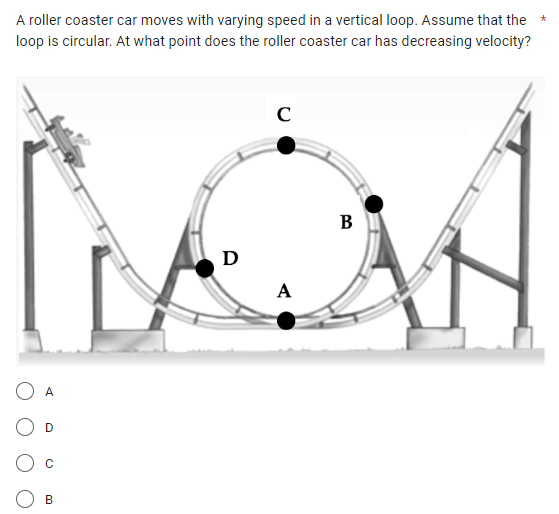
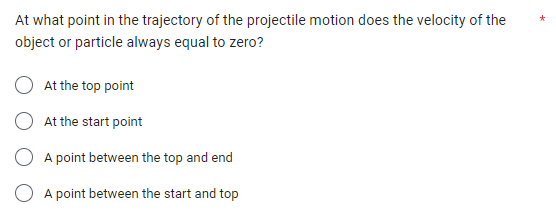

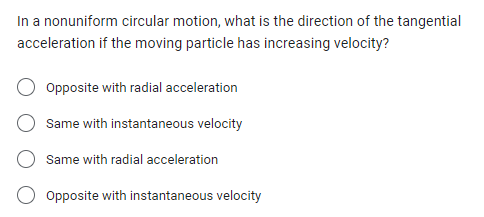
In a uniform circular motion, the acceleration and velocity are tangential to the path. C True In a uniform circular motion, the acceleration and velocity are parallel to each other. C In a uniform circular motion, the acceleration and velocity are perpendicular to the path. C In a uniform circular motion, the acceleration and velocity are perpendicular to each other.A projectile motion has constant acceleration and constant velocity for its horizontal and vertical components, respectively. O A projectile motion has constant velocity for its horizontal component and constant acceleration for its vertical component. O True O A projectile motion has constant acceleration for its horizontal and vertical components. A projectile motion has constant velocity for its horizontal and vertical components.Acceleration acts to change the direction of the velocity, 1.vhen it is normal to the * velocity. 0 acceleration acts to changethe magnitude of the velocity, when it is normal to the velocity. acceleration acts to change both the magnitude or direction of the velocity, when it is normal to the velocity. O acceleration acts to change either the magnitude or direction of the velocity, when it is normal to the velocity. True A particle moving in a curved path with a constant speed has both tangential and * radial acceleration. O A particle moving in along a straight line with a constant speed has both tangential and radial acceleration. True A particle moving in a curved path with a constant speed has radial acceleration only. O A particle moving in a curved path with a constant speed has either tangential or radial acceleration.Consider two objects (namely A and B) with velocities of VA and VB with respect to a common stationary frame of reference, say C. What is the velocity of B relative to A? --- It is the difference of velocity of C with respective to A from velocity of B with respect to C. It is the sum of velocity of C with respect to B and velocity of C with respect to A. It is the sum of velocity of B with respect to C and velocity of A with respect to C. True It is the difference of velocity of C with respective to B from velocity of A with respect to C.Why is the acceleration in uniform circular motion is sometimes called centripetal * acceleration? C It is sometimes directed outward the curved of the circle O It is always directed away from the center of the circle O It is always directed toward the center of the circle. O It is sometimes directed toward the center of the circleA roller coaster car moves with varying speed in a vertical loop. Assume that the * loop is circular. At what point does the roller coaster car has decreasing velocity? B D A O A OD OC OBAt what point in the trajectory of the projectile motion does the velocity of the object or particle always equal to zero? O At the top point O At the start point O A point between the top and end A point between the start and topWhat refers to the total time that took to complete one cycle? O Flight O Period O Revolution O FrequencyIn a nonuniform circular motion, what is the direction of the tangential acceleration if the moving particle has increasing velocity? O Opposite with radial acceleration O Same with instantaneous velocity O Same with radial acceleration O Opposite with instantaneous velocity
Step by Step Solution
There are 3 Steps involved in it

Get step-by-step solutions from verified subject matter experts
 Study Help