







Question: chp5 time value, answer e-k please Excel Online Structured Activity: Time value of money The data has been collected in the Microsoft Excel Online file
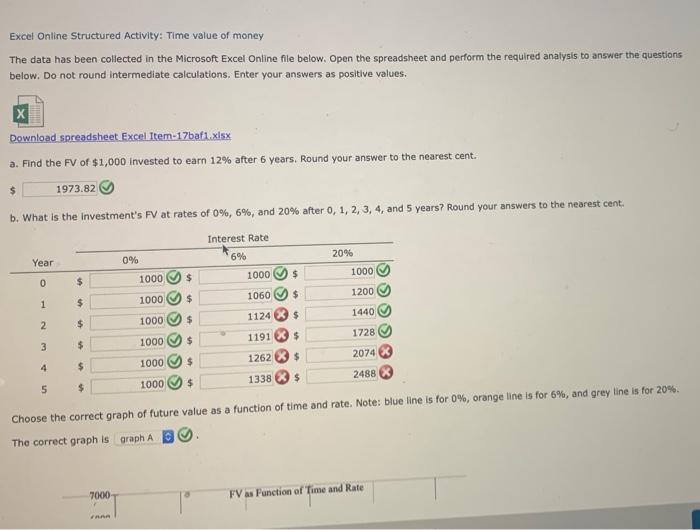
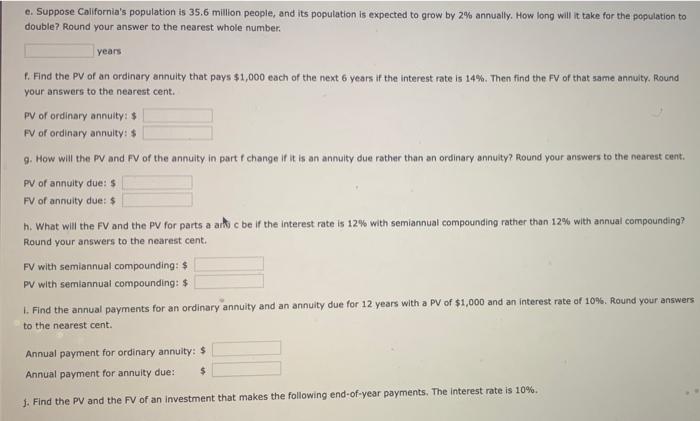
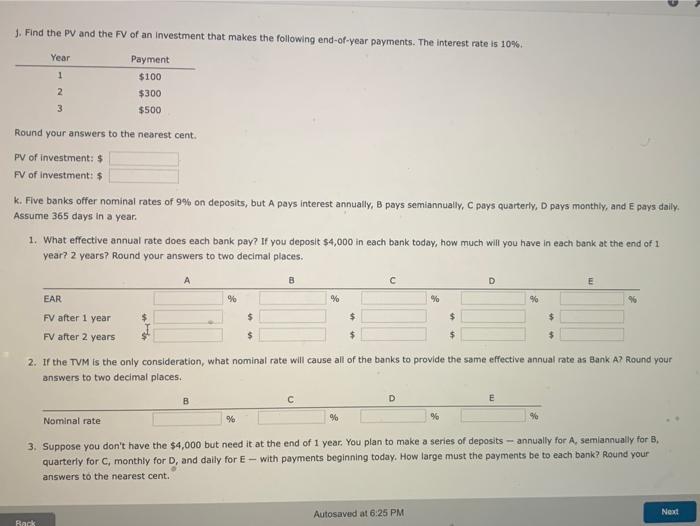
Excel Online Structured Activity: Time value of money The data has been collected in the Microsoft Excel Online file below. Open the spreadsheet and perform the required analysis to answer the questions below. Do not round intermediate calculations. Enter your answers as positive values. Download spreadsheet Excel Item-17batt.xlsx a. Find the FV of $1,000 invested to earn 12% after 6 years. Round your answer to the nearest cent. $ 1973.82 b. What is the investment's FV at rates of 0%, 6%, and 20% after 0, 1, 2, 3, 4, and 5 years? Round your answers to the nearest cent. Interest Rate 6% 20% Year 0% 1000 1000 1000 $ $ $ 0 1200 $ $ 1060 1 $ 1000 1124 $ 1440 $ 2 $ 1000 1728 1191 $ $ 3 $ 1000 1262 $ 2074 $ $ 4 1000 1338 $ 2488 1000 5 $ Choose the correct graph of future value as a function of time and rate. Note: blue line is for 0%, orange line is for 6%, and grey line is for 20%. The correct graph is graph A 7000 FVs Function of Time and Rate e. Suppose Colifornia's population is 35.6 million people, and its population is expected to grow by 2% annually. How long will it take for the population to double? Round your answer to the nearest whole number. years t. Find the PV of an ordinary annuity that pays $1,000 each of the next 6 years if the interest rate is 14%. Then find the FV of that same annuity. Round your answers to the nearest cent. PV of ordinary annuity: $ FV of ordinary annuity: $ 9. How will the PV and FV of the annuity in part f change if it is an annuity due rather than an ordinary annulty? Round your answers to the nearest cent. PV of annuity due: $ FV of annuity due: $ h. What will the FV and the PV for parts a arcbe if the interest rate is 12% with semiannual compounding rather than 12% with annual compounding? Round your answers to the nearest cent. FV with semiannual compounding: $ PV with semiannual compounding: $ I. Find the annual payments for an ordinary annuity and an annuity due for 12 years with a PV of $1,000 and an interest rate of 10%. Round your answers to the nearest cent Annual payment for ordinary annuity: $ Annual payment for annuity due: $ 3. Find the PV and the FV of an investment that makes the following end-of-year payments. The interest rate is 10%. 1. Find the PV and the FV of an investment that makes the following end-of-year payments. The interest rate is 10% Year 1 2 3 Payment $100 $300 $500 Round your answers to the nearest cent. PV of investment: $ FV of investment: $ k. Five banks offer nominal rates of 9% on deposits, but A pays interest annually, B pays semiannually, Cpays quarterly, D pays monthly, and Epays daily, Assume 365 days in a year 1. What effective annual rate does each bank pay? If you deposit $4,000 in each bank today, how much will you have in each bank at the end of 1 year? 2 years? Round your answers to two decimal places. A B D % % % 96 EAR Fv after 1 year FV after 2 years $ $ $ $ 2. If the TVM is the only consideration, what nominal rate will cause all of the banks to provide the same effective annual rate as Bank A? Round your answers to two decimal places. B % % Nominal rate % 3. Suppose you don't have the $4,000 but need it at the end of 1 year. You plan to make a series of deposits - annually for A, semiannually for B, quarterly for C, monthly for D, and daily for E - with payments beginning today. How large must the payments be to each bank? Round your answers to the nearest cent. Autosaved at 6:25 PM Next Rack
Step by Step Solution
There are 3 Steps involved in it

Get step-by-step solutions from verified subject matter experts
 Study Help