







Question: CIT-111 Homework #1: Answer Problem 3 by completing the worksheet YOU MUST COMPLETE THE WORK SHEET AND NOT JUST CODE. Student Name: Class/Section: HW/Assignment: CIT-111
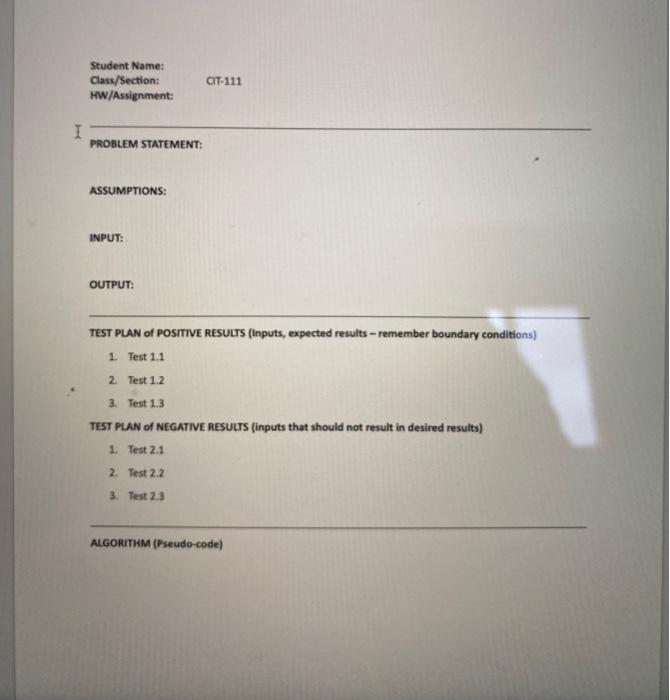
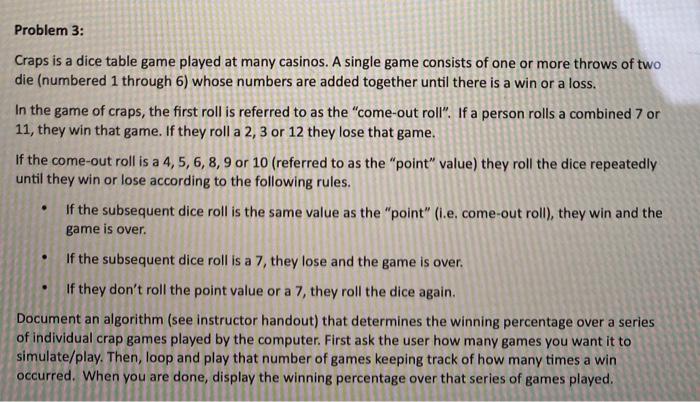
Student Name: Class/Section: HW/Assignment: CIT-111 I PROBLEM STATEMENT: ASSUMPTIONS: INPUT: OUTPUT: TEST PLAN of POSITIVE RESULTS (Inputs, expected results - remember boundary conditions) 1. Test 1.1 2. Test 1.2 3. Test 1.3 TEST PLAN of NEGATIVE RESULTS (inputs that should not result in desired results) 1 Test 21 2 Test 2.2 3. Test 23 ALGORITHM (Pseudo-code) Problem 3: Craps is a dice table game played at many casinos. A single game consists of one or more throws of two die (numbered 1 through 6) whose numbers are added together until there is a win or a loss. In the game of craps, the first roll is referred to as the "come-out roll". If a person rolls a combined 7 or 11, they win that game. If they roll a 2, 3 or 12 they lose that game. If the come-out roll is a 4,5,6,8,9 or 10 (referred to as the "point" value) they roll the dice repeatedly until they win or lose according to the following rules. If the subsequent dice roll is the same value as the "point" (l.e. come-out roll), they win and the game is over. . If the subsequent dice roll is a 7, they lose and the game is over. If they don't roll the point value or a 7, they roll the dice again. Document an algorithm (see instructor handout) that determines the winning percentage over a series of individual crap games played by the computer. First ask the user how many games you want it to simulate/play. Then, loop and play that number of games keeping track of how many times a win occurred. When you are done, display the winning percentage over that series of games played. Student Name: Class/Section: HW/Assignment: CIT-111 I PROBLEM STATEMENT: ASSUMPTIONS: INPUT: OUTPUT: TEST PLAN of POSITIVE RESULTS (Inputs, expected results - remember boundary conditions) 1. Test 1.1 2. Test 1.2 3. Test 1.3 TEST PLAN of NEGATIVE RESULTS (inputs that should not result in desired results) 1 Test 21 2 Test 2.2 3. Test 23 ALGORITHM (Pseudo-code) Problem 3: Craps is a dice table game played at many casinos. A single game consists of one or more throws of two die (numbered 1 through 6) whose numbers are added together until there is a win or a loss. In the game of craps, the first roll is referred to as the "come-out roll". If a person rolls a combined 7 or 11, they win that game. If they roll a 2, 3 or 12 they lose that game. If the come-out roll is a 4,5,6,8,9 or 10 (referred to as the "point" value) they roll the dice repeatedly until they win or lose according to the following rules. If the subsequent dice roll is the same value as the "point" (l.e. come-out roll), they win and the game is over. . If the subsequent dice roll is a 7, they lose and the game is over. If they don't roll the point value or a 7, they roll the dice again. Document an algorithm (see instructor handout) that determines the winning percentage over a series of individual crap games played by the computer. First ask the user how many games you want it to simulate/play. Then, loop and play that number of games keeping track of how many times a win occurred. When you are done, display the winning percentage over that series of games played
Step by Step Solution
There are 3 Steps involved in it

Get step-by-step solutions from verified subject matter experts
 Study Help