







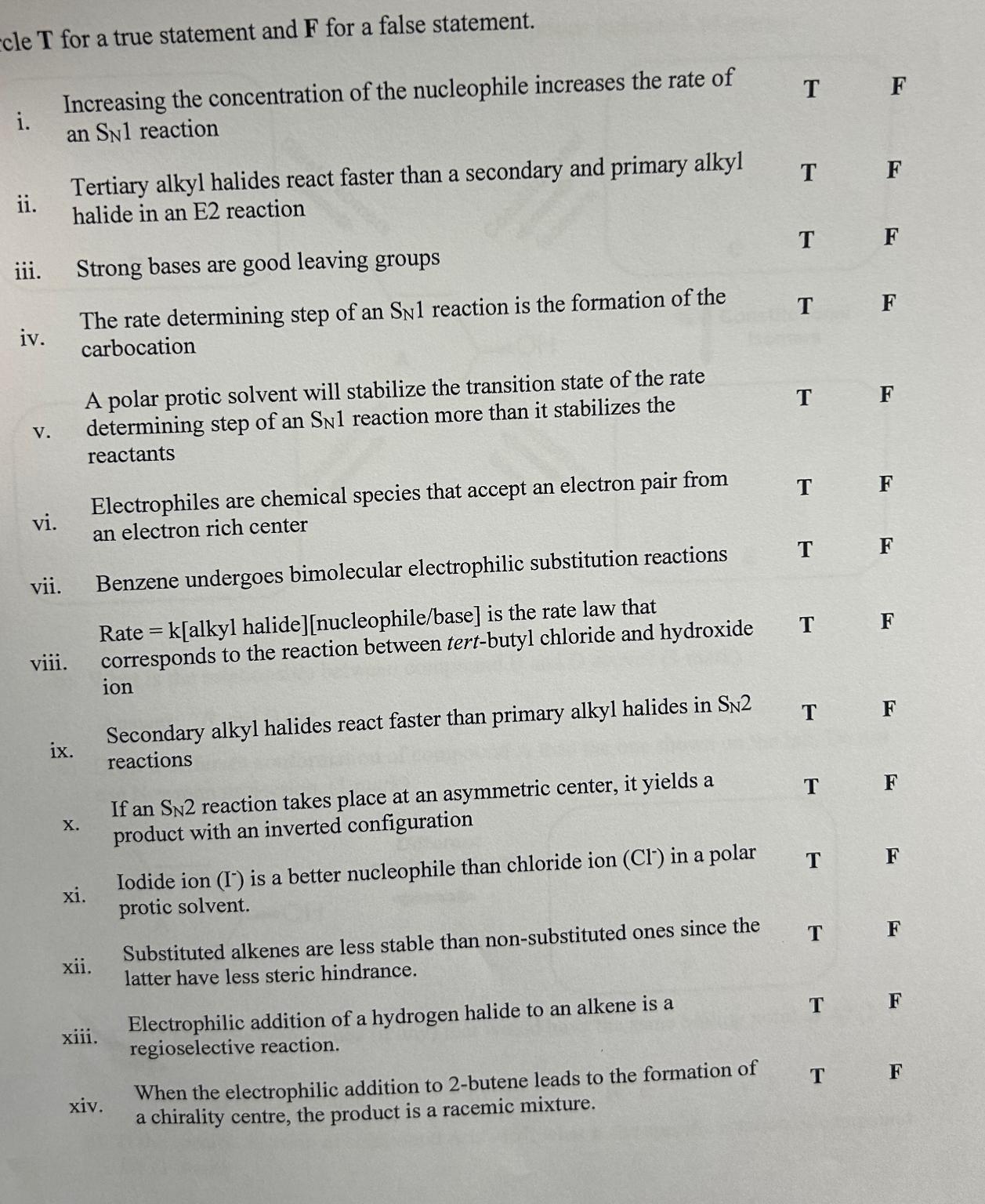
Question: cle T for a true statement and F for a false statement. Increasing the concentration of the nucleophile increases the rate of an S N
cle for a true statement and for a false statement.
Increasing the concentration of the nucleophile increases the rate of an reaction
ii Tertiary alkyl halides react faster than a secondary and primary alkyl halide in an E reaction
iii. Strong bases are good leaving groups
iv The rate determining step of an reaction is the formation of the carbocation
A polar protic solvent will stabilize the transition state of the rate
v determining step of an reaction more than it stabilizes the reactants
vi Electrophiles are chemical species that accept an electron pair from an electron rich center
vii. Benzene undergoes bimolecular electrophilic substitution reactions Rate alkyl halidenucleophilebase is the rate law that
viii. corresponds to the reaction between tertbutyl chloride and hydroxide ion
ix Secondary alkyl halides react faster than primary alkyl halides in reactions
x If an reaction takes place at an asymmetric center, it yields a
T F
xi Iodide ion is a better nucleophile than chloride ion in a polar protic solvent.
xii. Substituted alkenes are less stable than nonsubstituted ones since the latter have less steric hindrance.
xiii. Electrophilic addition of a hydrogen halide to an alkene is a regioselective reaction.
xiv. When the electrophilic addition to butene leads to the formation of a chirality centre, the product is a racemic mixture.
Step by Step Solution
There are 3 Steps involved in it
1 Expert Approved Answer
Step: 1 Unlock

Question Has Been Solved by an Expert!
Get step-by-step solutions from verified subject matter experts
Step: 2 Unlock
Step: 3 Unlock
 Study Help