







Question: Use Matlab command dsolve to determine and plot the step responses of the following systems. (Step response is the system response to a unit
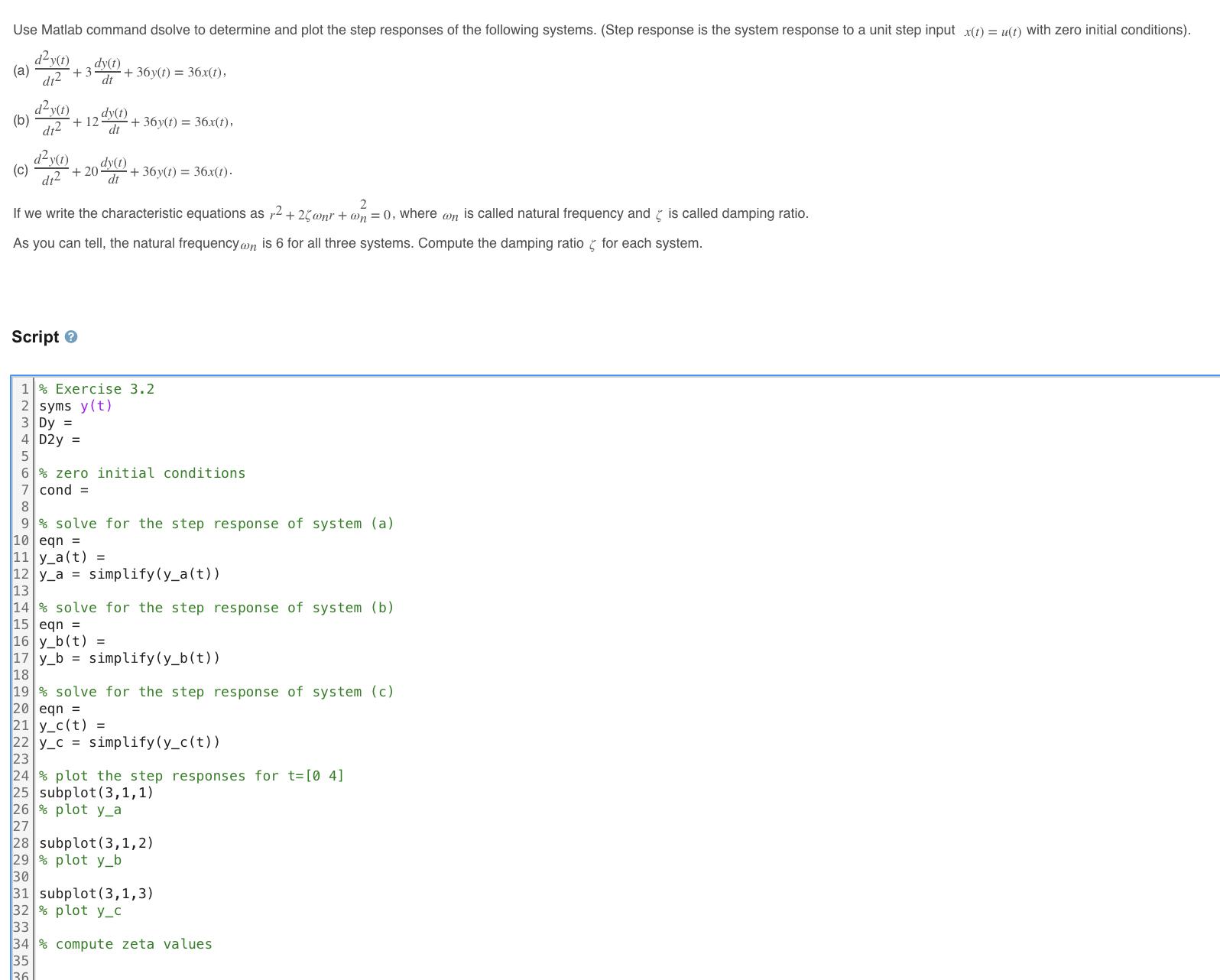
Use Matlab command dsolve to determine and plot the step responses of the following systems. (Step response is the system response to a unit step input x(t) = u(t) with zero initial conditions). dy(t) (a) d1 +3 +36y(t) = 36x(t), dy(t) dt (b) + 12 dy(t) + 36y(t) = 36x(t), dy(t) dt2 d y(t) (c) + 20 dy(t) + 36y(t) = 36x(t). d12 dt 2 If we write the characteristic equations as r +25@nr + n = 0, where an is called natural frequency and is called damping ratio. As you can tell, the natural frequency on is 6 for all three systems. Compute the damping ratio for each system. Script> 1% Exercise 3.2 2 syms y(t) 3 Dy = 4 D2y = 6% zero initial conditions 7 cond= 9% solve for the step response of system (a) 10 eqn = 11 y_a(t) = 12 y_a= simplify (y_a(t)) 13 14 % solve for the step response of system (b) 15 eqn = 16 y_b(t) = 17 y_b = simplify(y_b(t)) 18 19% solve for the step response of system (c) 20 eqn = 21 y_c(t) = 22 y_c= simplify (y_c(t)) 23 24 % plot the step responses for t= [04] 25 subplot (3,1,1) 26% plot y_a 27 28 subplot(3,1,2) 29 % plot y_b 30 31 subplot (3,1,3) 32 % plot y_c 33 34 % compute zeta values 35 36
Step by Step Solution
3.42 Rating (149 Votes )
There are 3 Steps involved in it
To plot the shape of step responses for different damping ratios we can use the following MATLAB code Define the damping ratios zeta 01 05 09 Calculat... View full answer

Get step-by-step solutions from verified subject matter experts
 Study Help