







Question: (CLO1(C3) Solve linear programming problems using graphical and simplex methods; and CLO2 (C3) Solve transportation problems using suitable transportation and network model) A company sells
(CLO1(C3) Solve linear programming problems using graphical and simplex methods; and CLO2 (C3) Solve transportation problems using suitable transportation and network model)
A company sells rice and quinoa noodles that are processed using two difference processors. Processor A can only be operated for 40 hours a week, while processor B can only be operated for 50 hours a week. The rice noodle requires three hours in processor A and three hours in processor B, while the quinoa noodle requires one hour in processor A and four hours in processor B. Profits from rice and quinoa noodles are RM 5 and RM 8 respectively.
i) Use the graphical method to determine the maximum number of these products that needs to be produced weekly for maximum profit (the point of intersection must be shown correctly on a scaled graph paper and verified using solutions from simultaneous equations).
ii) Use the simplex method to find the same solution
iii) The company owns four factories and four restaurants. Table 1a shows the location, monthly supply and demand between the factories and the restaurants. Table 1b provides the transportation cost from the factories to the restaurants. Determine the minimum cost bearable by applying the North-West Corner method. Optimise the solution using the Stepping Stone method.
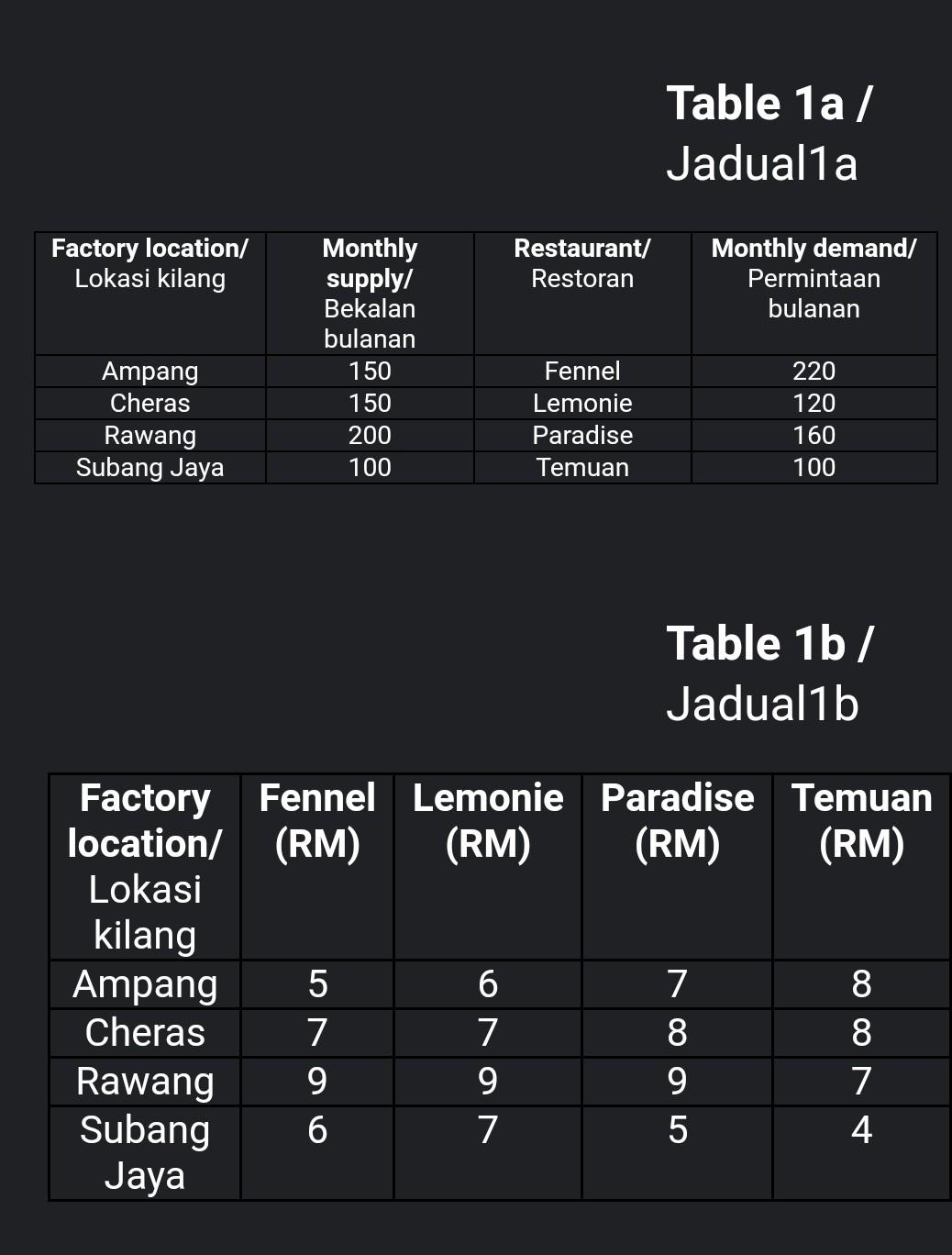
Table 1a / Jadualla Factory location/ Lokasi kilang Restaurant/ Restoran Monthly demand/ Permintaan bulanan Monthly supply/ Bekalan bulanan 150 150 200 100 Ampang Cheras Rawang Subang Jaya Fennel Lemonie Paradise Temuan 220 120 160 100 Table 1b / Jadual1b Factory Fennel Lemonie Fennel Lemonie Paradise Temuan location/ (RM) (RM) (RM) (RM) Lokasi kilang Ampang 5 6 7 8 Cheras 7 7 8 8 Rawang 9 9 9 7 Subang 6 7 5 4 Jaya
Step by Step Solution
There are 3 Steps involved in it

Get step-by-step solutions from verified subject matter experts
 Study Help