







Question: coaching management read the article than answer questions Part 1 (both A and B) Part 1 (both A and B): Read the article entitled, Five
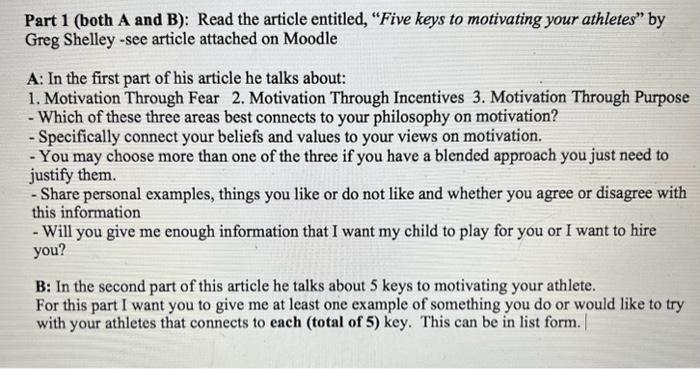
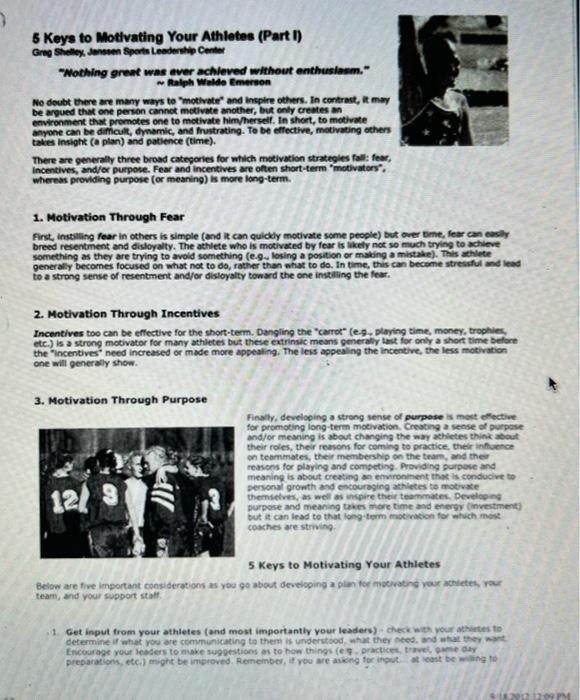
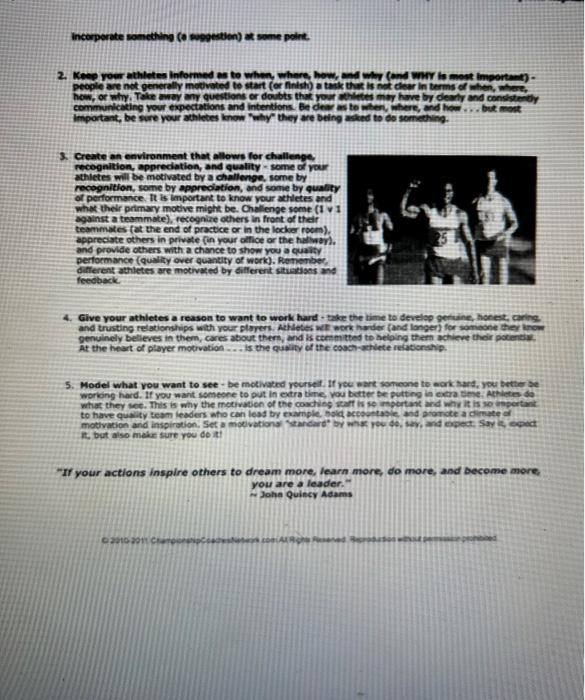
Part 1 (both A and B): Read the article entitled, "Five keys to motivating your athletes" by Greg Shelley -see article attached on Moodle A: In the first part of his article he talks about: 1. Motivation Through Fear 2. Motivation Through Incentives 3. Motivation Through Purpose - Which of these three areas best connects to your philosophy on motivation? - Specifically connect your beliefs and values to your views on motivation. - You may choose more than one of the three if you have a blended approach you just need to justify them. - Share personal examples, things you like or do not like and whether you agree or disagree with this information - Will you give me enough information that I want my child to play for you or I want to hire you? B: In the second part of this article he talks about 5 keys to motivating your athlete. For this part I want you to give me at least one example of something you do or would like to try with your athletes that connects to each (total of 5) key. This can be in list form. 5 Keys to Motlvating Your Athletes (Part D) Greg shellex densen Spots Leedentip Center "Nothing great was ever achleved without enthuslasm." No doubt there are many ways to "motivate' and inspire others. In contrast, it may be arqued that one person cannot motlvate another, but only creates an environment that promotes one to motivate himpherself. In short, to metivate anyone can be diffoill, Amomic, and frustrating. To be effective, motivating ochen takes insight (a plan) and patience (time). There are generally three broad categories for whilh motivation strategies fall: feac, incentives, and/or purpose. Fear and incentives are often short-term "motivators", whereas providing purpose (or meaning) is more long-term. 1. Motivation Through Fear Finct intaling fear in others is simple (and it can quidily motivate some peopie) but over bme, fear can eacly breed resentment and disloyalty. The athlete who is motivated by fear is whely not so much trying to achieve something as they are trving to avold something (e.9- losing a position or making a mistake). This achlete generaly becomes focused on what not to 60 , rather than what to do. In time, this can became stressful and lest to a strong sense of resentment and/or disloyalty toward the one instiling the fear. 2. Motivation Through Incentives Incentives too can be effective for the short-tem. Dangling the "carrok" (e.9. ploying time, moner, trophies, the "incentives" need increased or made more appealing. The less appealing the incentive, the less motivation one will generaly show. 3. Motivation Through Purpose incorporate somsching (s nuggestben) at some point. 2. 3. Create an emvironment that allows for challenge. recognition, appreciation, and quality - some of your athictes will be motivated by a challenge, some by recognition, some by appreciation, and some by quabty of performance. ft is important to know your achictes and whot their primary motive might be. Ohallenge some (I v 1 ) against a teammote), recognize others in front of their teammates (at the end of practice or in the lockor rocm). appreciate others in private (in your office or the hatliar). and provide others with a chance to show you a cualty performance (qualify over quandity of work). Renenber. different athletes are motivated by different situatises and feechack 4. Give your athletes a reason to want to work hard + takc the bime to develop gercine, honest, caring: and trusting relationships with your plorer. Aehletes act nork haver fand longeri for sombone ther anom genuinely believes in them, cares about there, and is cteremithed to helping them achieve their potertik. At the heart of player motivation ... is the quaity of the coach-achiete refationship. 5. Model what you want to see - be motivatiod roursel. If yoe ware someone to acrk thard, you better be Wodeing hard. If you want someone to put in extra tine, you butter be putting in exkra time, Amhictes do. what they sec. This is why the motivabon of the couchiog sart is se important ard why it is ro mepertank it, but aiso mehix sure rou de it! "If your actions inspire others to dream more, learn more, to more, and become aore. you are a leader, " if Joha Quincy Adams
Step by Step Solution
There are 3 Steps involved in it

Get step-by-step solutions from verified subject matter experts
 Study Help