







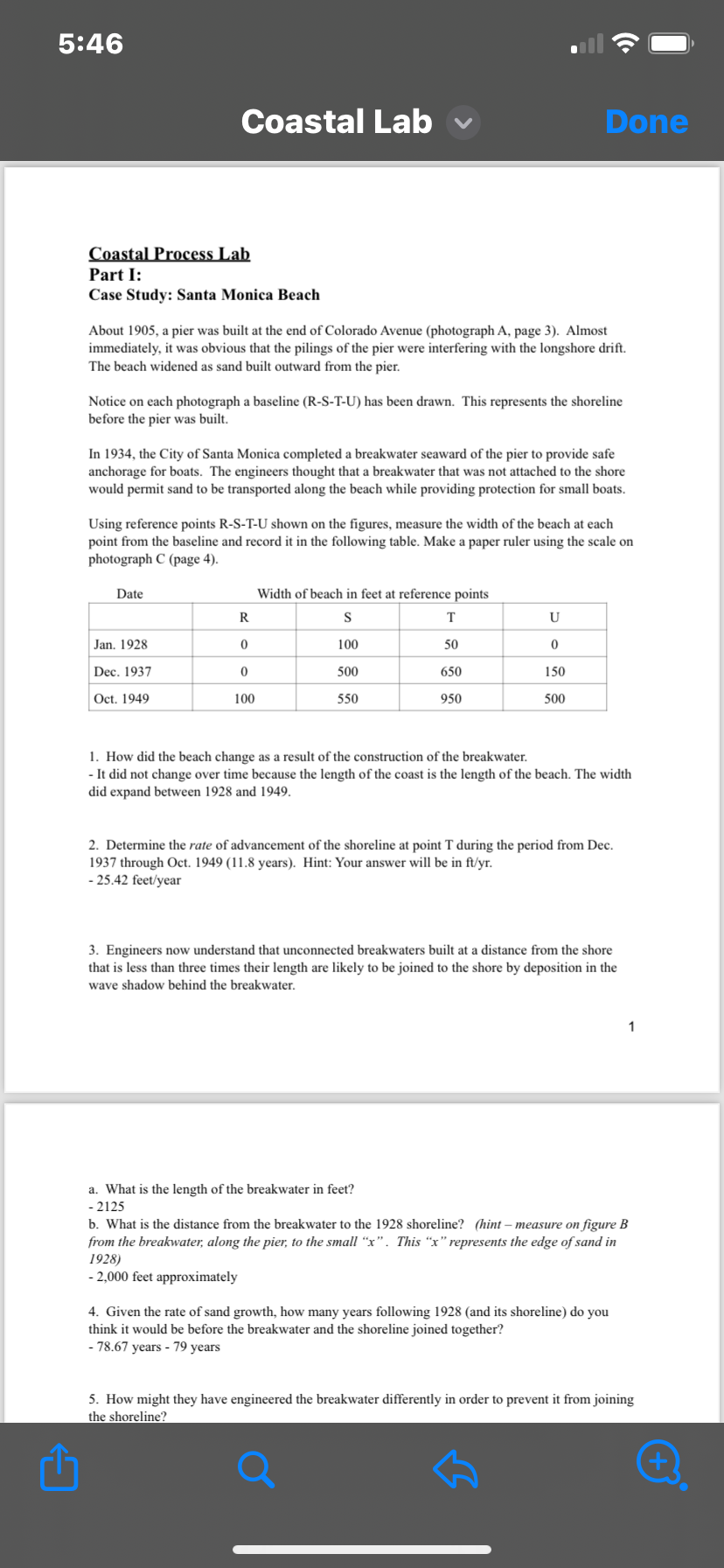
Question: Coastal Process Lab Part I: Case Study: Santa Monica Beach About 1 9 0 5 , a pier was built at the end of Colorado
Coastal Process Lab
Part I:
Case Study: Santa Monica Beach
About a pier was built at the end of Colorado Avenue photograph A page Almost
immediately, it was obvious that the pilings of the pier were interfering with the longshore drift.
The beach widened as sand built outward from the pier.
Notice on each photograph a baseline RSTU has been drawn. This represents the shoreline
before the pier was built.
In the City of Santa Monica completed a breakwater seaward of the pier to provide safe
anchorage for boats. The engineers thought that a breakwater that was not attached to the shore
would permit sand to be transported along the beach while providing protection for small boats.
Using reference points RSTU shown on the figures, measure the width of the beach at each
point from the baseline and record it in the following table. Make a paper ruler using the scale on
photograph C page
How did the beach change as a result of the construction of the breakwater.
It did not change over time because the length of the coast is the length of the beach. The width
did expand between and
Determine the rate of advancement of the shoreline at point during the period from Dec.
through Oct. years Hint: Your answer will be in
feetyear
Engineers now understand that unconnected breakwaters built at a distance from the shore
that is less than three times their length are likely to be joined to the shore by deposition in the
wave shadow behind the breakwater.
a What is the length of the breakwater in feet?
b What is the distance from the breakwater to the shoreline? hint measure on figure B
from the breakwater, along the pier, to the small This represents the edge of sand in
feet approximately
Given the rate of sand growth, how many years following and its shoreline do you
think it would be before the breakwater and the shoreline joined together?
years years
How might they have engineered the breakwater differently in order to prevent it from joining
the shoreline?
Step by Step Solution
There are 3 Steps involved in it
1 Expert Approved Answer
Step: 1 Unlock

Question Has Been Solved by an Expert!
Get step-by-step solutions from verified subject matter experts
Step: 2 Unlock
Step: 3 Unlock
 Study Help