







Question: Code as mentioned in problem: public class TrashAndTakeOut { public static void trash (int x) { int m, n; m = 0; if (x >
Code as mentioned in problem:
public class TrashAndTakeOut
{
public static void trash (int x)
{
int m, n;
m = 0;
if (x > 0)
m = 4;
if (x > 5)
n = 3*m;
else
n = 4*m;
int o = takeOut (m, n);
System.out.println ("o is: " + o);
}
public static int takeOut (int a, int b)
{
int d, e;
d = 42*a;
if (a > 0)
e = 2*b+d;
else
e = b+d;
return (e);
}
public static void main (String []argv)
{ // Driver method for trashAndTakeOut
// Read an integer from standard input, call trashAndTakeOut()
if (argv.length != 1)
{
System.out.println ("Usage: java TrashAndTakeOut v1");
return;
}
int x = 0;
try
{
x = Integer.parseInt (argv[0]);
}
catch (NumberFormatException e)
{
System.out.println ("Entry must be an integer, using 1.");
x = 1;
}
trash (x);
}
}
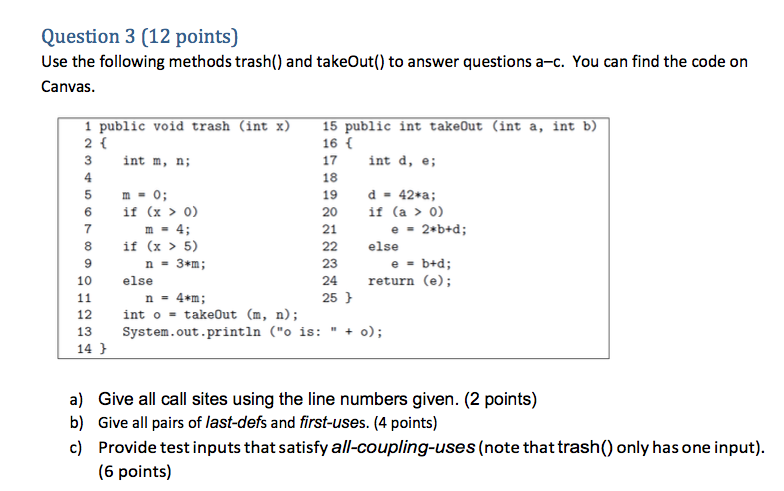
Question 3 (12 points) Use the following methods trash() and takeout() to answer questions a-c. You can find the code on Canvas. 1 public void trash (int x) 15 public int takeout int a, int b) 2 16 int m n; 17 int d, e 18 m 0; 19 d 42 a 6 if (x 0) 20 if (a 0) m 4 e 2 b+d 21 if (x 5) 22 else e b+d 23 n 3*m; 24 return (e) 10 else 25 4 m 12 int o takeouts (m n) 13 System.out.println ("o is: o) 14 a) Give all call sites using the line numbers given. (2 points) b) Give all pairs of last-defs and first-uses. (4 points) c) Provide test inputs thatsatisfy all-coupling-uses (note that trash() only has one input). (6 points)
Step by Step Solution
There are 3 Steps involved in it

Get step-by-step solutions from verified subject matter experts
 Study Help