







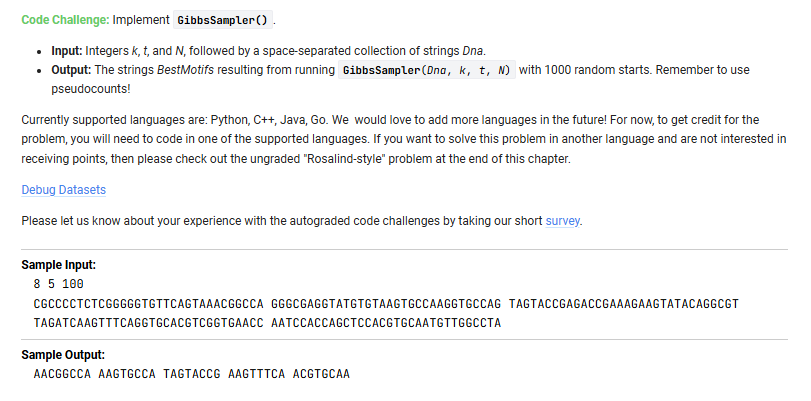
Question: Code Challenge: Implement GibbsSampler ( ) . - Input: Integers ( k , t ) , and ( N ) ,
Code Challenge: Implement GibbsSampler
Input: Integers k t and N followed by a spaceseparated collection of strings Dna.
Output: The strings BestMotifs resulting from running GibbsSampler Dna k t N with random starts. Remember to use pseudocounts!
Currently supported languages are: Python, C Java, Go We would love to add more languages in the future! For now, to get credit for the problem, you will need to code in one of the supported languages. If you want to solve this problem in another language and are not interested in receiving points, then please check out the ungraded "Rosalindstyle" problem at the end of this chapter.
Debug Datasets
Please let us know about your experience with the autograded code challenges by taking our short survey.
Sample Input:
CGCCCCTCTCGGGGGTGTTCAGTAAACGGCCA GGGCGAGGTATGTGTAAGTGCCAAGGTGCCAG TAGTACCGAGACCGAAAGAAGTATACAGGCGT
TAGATCAAGTTTCAGGTGCACGTCGGTGAACC AATCCACCAGCTCCACGTGCAATGTTGGCCTA
Sample Output:
AACGGCCA AAGTGCCA TAGTACCG AAGTTTCA ACGTGCAA
import sys
# Please do not remove package declarations because these are used by the autograder.
# Insert your gibbssampler function here, along with any subroutines you need
def gibbssamplerdna: liststr k: int, t: int, n: int liststr:
Implements the GibbsSampling algorithm for notif finding."""
pass
Step by Step Solution
There are 3 Steps involved in it
1 Expert Approved Answer
Step: 1 Unlock

Question Has Been Solved by an Expert!
Get step-by-step solutions from verified subject matter experts
Step: 2 Unlock
Step: 3 Unlock
 Study Help