







Question: Code language is wolfram Mathematica Here's a new parallelogram with lots of points inside: jump = 0.1: Clear[parallelogramplotter, basepoint, side1, side2, pointcolor]: ranger = 2.5:
Code language is wolfram Mathematica
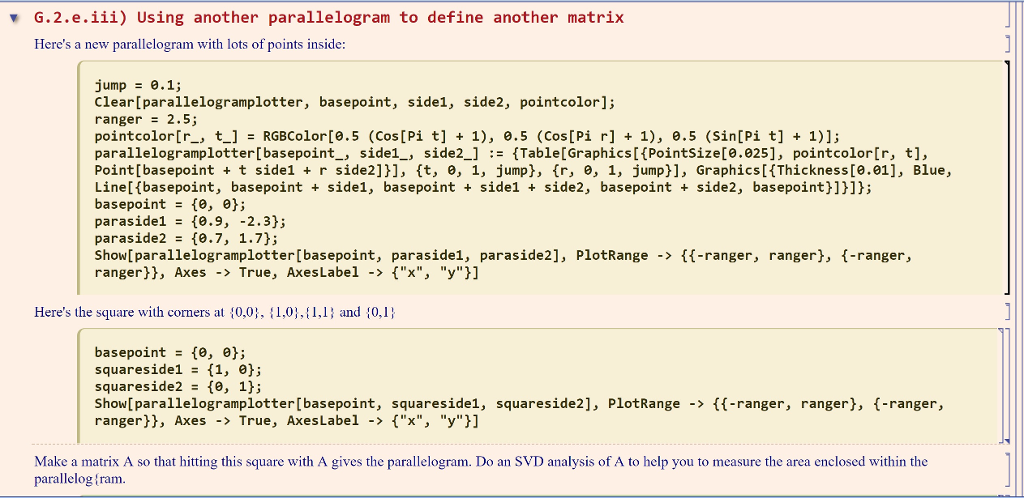
Here's a new parallelogram with lots of points inside: jump = 0.1: Clear[parallelogramplotter, basepoint, side1, side2, pointcolor]: ranger = 2.5: pointcolor[r_, t_] = RGBColor[0.5 (Cos[Pi t] + 1), 0.5 (Cos[Pi r] + 1), 0.5 (Sin [Pi t] + 1)]: parallelogramplotter[basepoint_, side1_, side2_1]: {Table[Graphics[{Pointsize[0.025], pointcolor[r, t], Point[basepoint + t side1 + r side2]}], {t, 0, 1, jump}], Graphics[{Thickness[0.01], Blue, Line[{basepoint, basepoint + side1, basepoint + sidel + side2, basepoint + side2, basepoint)}]}]}: basepoint = {0, 0}: paraside1 = {0.9, -2.3}: paraside2 = {0.7, 1.7}: Show[parallelogramplotter[basepoint, paraside1, paraside2], PlotRange rightarrow {{-ranger, ranger}, {-ranger, ranger}}, Axes rightarrow True, AxesLabel rightarrow {"x", "y"}] Here's the square with corners at { 0, 0}, { 1, 0), {1, 1} and {0, 1} basepoint = {0, 0}: squareside1 = {1, 0}: squareside2 = {0, 1): Show[parallelogramplotter [basepoint, squareside1, squareside2], PlotRange rightarrow {{-ranger, ranger}, {-ranger, ranger}}, Axes rightarrow True, AxesLabel rightarrow {"x", "y"}] Make a matrix A so that hitting this square with A gives the parallelogram. Do an SVD analysis of A to help you to measure the area enclosed within the parallelog {ram
Step by Step Solution
There are 3 Steps involved in it

Get step-by-step solutions from verified subject matter experts
 Study Help