







Question: Code needed in JAVA language Virtual Dice Throwing and Point-Circle-Cylinder Inheritance and Polymorphism a virtual dice throwing program; and The program should emulate virtual dice
Code needed in JAVA language
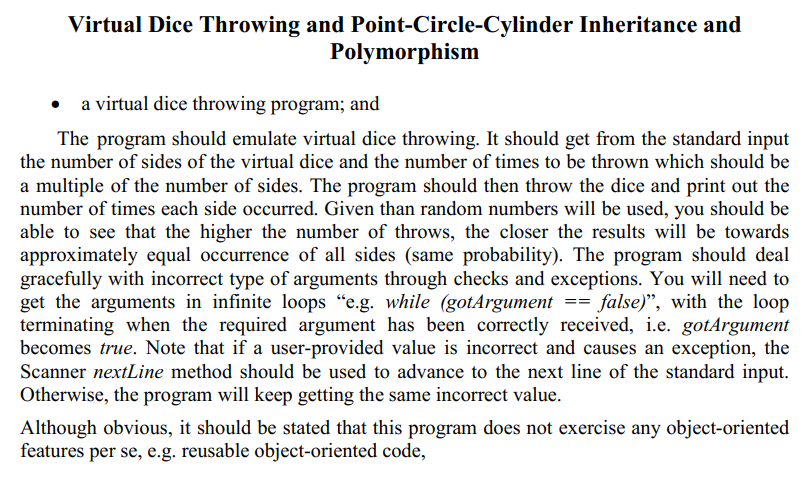
Virtual Dice Throwing and Point-Circle-Cylinder Inheritance and Polymorphism a virtual dice throwing program; and The program should emulate virtual dice throwing. It should get from the standard input the number of sides of the virtual dice and the number of times to be thrown which should be a multiple of the number of sides. The program should then throw the dice and print out the number of times each side occurred. Given than random numbers will be used, you should be able to see that the higher the number of throws, the closer the results will be towards approximately equal occurrence of all sides (same probability). The program should deal gracefully with incorrect type of arguments through checks and exceptions. You will need to get the arguments in infinite loops e.g. while (gotArgument == false)", with the loop terminating when the required argument has been correctly received, i.e. gotArgument becomes true. Note that if a user-provided value is incorrect and causes an exception, the Scanner nextLine method should be used to advance to the next line of the standard input. Otherwise, the program will keep getting the same incorrect value. Although obvious, it should be stated that this program does not exercise any object-oriented features per se, e.g. reusable object-oriented code, Virtual Dice Throwing and Point-Circle-Cylinder Inheritance and Polymorphism a virtual dice throwing program; and The program should emulate virtual dice throwing. It should get from the standard input the number of sides of the virtual dice and the number of times to be thrown which should be a multiple of the number of sides. The program should then throw the dice and print out the number of times each side occurred. Given than random numbers will be used, you should be able to see that the higher the number of throws, the closer the results will be towards approximately equal occurrence of all sides (same probability). The program should deal gracefully with incorrect type of arguments through checks and exceptions. You will need to get the arguments in infinite loops e.g. while (gotArgument == false)", with the loop terminating when the required argument has been correctly received, i.e. gotArgument becomes true. Note that if a user-provided value is incorrect and causes an exception, the Scanner nextLine method should be used to advance to the next line of the standard input. Otherwise, the program will keep getting the same incorrect value. Although obvious, it should be stated that this program does not exercise any object-oriented features per se, e.g. reusable object-oriented code
Step by Step Solution
There are 3 Steps involved in it

Get step-by-step solutions from verified subject matter experts
 Study Help