







Question: //CODE public class HasPrefixSumProblem { public static class Node { private E data; private Node next; public Node(E data, Node next) { this.data = data;
 //CODE
public class HasPrefixSumProblem {
public static class Node
private E data;
private Node
public Node(E data, Node
this.data = data;
this.next = next;
}
public Node(E data) {
this(data, null);
}
public void setData(E data) {
this.data = data;
}
public void setNext(Node
this.next = next;
}
public E getData() {
return data;
}
public Node
return next;
}
}
/**
* TODO EXERCISE 5:
* Implement a method that determines if a Linked List
* has an initial sequence of nodes whose values sum to n.
*
* If so, it returns an integer corresponding to how many elements at the
* beginning of the list add up to n.
*
* The method receives as parameter a Node that represents the head node of a Singly Linked List,
* as well as a integer n denoting a target sum to search for.
*
* It is assumed that the list always has at least one node.
*
* If no sequence of initial elements adds up to n, the method will
* return a negative value, which is specified as follows.
* 1. The negative of the size of the list if the sum
* of all elements in the list is less than n.
* 2. The negative of the minimum number of elements at the
* beginning of the list whose sum exceeds n.
*
* Examples:
* 1) {1,2,3,4,5}, n = 10 -> returns 4
* 2) {2,4,6,8,10}, n = 10 -> returns -3 (since 2 + 4 + 6 = 12, which is larger than n = 10)
* 3) {1,2,3,4}, n = 15 -> returns -4 (since 1 + 2 + 3 + 4 = 10, which is smaller than n = 15)
*
* All the elements in the list are assumed to be non-negative integers.
*
* @param first - Head Node of Singly Linked List
* @param n - Integer denoting target sum
* @return Number of elements needed to sum up to n
*/
public int hasPrefixSum(Node
/*TODO ADD YOUR CODE HERE*/
return -Integer.MAX_VALUE; // Dummy Return
}
}
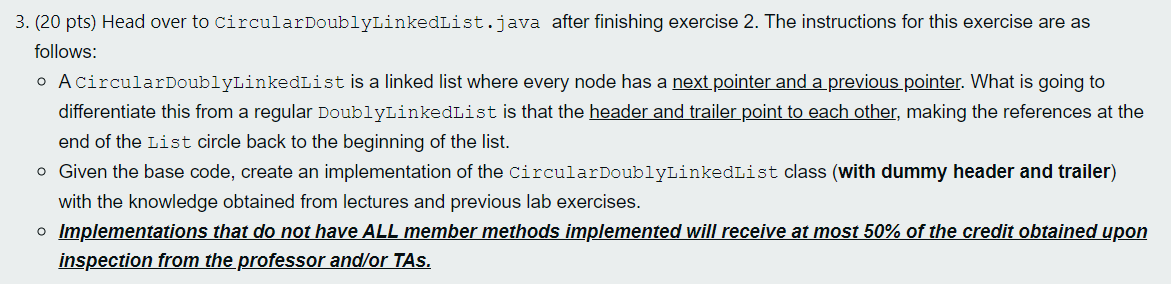
3. (20 pts) Head over to CircularDoublyLinkedList. java after finishing exercise 2. The instructions for this exercise are as follows: - A circulardoublylinkedList is a linked list where every node has a next pointer and a previous pointer. What is going to differentiate this from a regular DoublyLinkedList is that the header and trailer point to each other, making the references at the end of the List circle back to the beginning of the list. - Given the base code, create an implementation of the CirculardoublyLinkedList class (with dummy header and trailer) with the knowledge obtained from lectures and previous lab exercises. - Implementations that do not have ALL member methods implemented will receive at most 50% of the credit obtained upon inspection from the professor and/or TAs
Step by Step Solution
There are 3 Steps involved in it

Get step-by-step solutions from verified subject matter experts
 Study Help