







Question: package lab4.problems; public class HasPrefixSumProblem { public static class Node { private E data; private Node next; public Node(E data, Node next) { this.data =
package lab4.problems;
public class HasPrefixSumProblem {
public static class Node
private E data;
private Node
public Node(E data, Node
this.data = data;
this.next = next;
}
public Node(E data) {
this(data, null);
}
public void setData(E data) {
this.data = data;
}
public void setNext(Node
this.next = next;
}
public E getData() {
return data;
}
public Node
return next;
}
}
/**
* TODO EXERCISE 5:
* Implement a method that determines if a Linked List
* has an initial sequence of nodes whose values sum to n.
*
* If so, it returns an integer corresponding to how many elements at the
* beginning of the list add up to n.
*
* The method receives as parameter a Node that represents the head node of a Singly Linked List,
* as well as a integer n denoting a target sum to search for.
*
* It is assumed that the list always has at least one node.
*
* If no sequence of initial elements adds up to n, the method will
* return a negative value, which is specified as follows.
* 1. The negative of the size of the list if the sum
* of all elements in the list is less than n.
* 2. The negative of the minimum number of elements at the
* beginning of the list whose sum exceeds n.
*
* Examples:
* 1) {1,2,3,4,5}, n = 10 -> returns 4
* 2) {2,4,6,8,10}, n = 10 -> returns -3 (since 2 + 4 + 6 = 12, which is larger than n = 10)
* 3) {1,2,3,4}, n = 15 -> returns -4 (since 1 + 2 + 3 + 4 = 10, which is smaller than n = 15)
*
* All the elements in the list are assumed to be non-negative integers.
*
* @param first - Head Node of Singly Linked List
* @param n - Integer denoting target sum
* @return Number of elements needed to sum up to n
*/
public int hasPrefixSum(Node
/*TODO ADD YOUR CODE HERE*/
return -Integer.MAX_VALUE; // Dummy Return
}
}
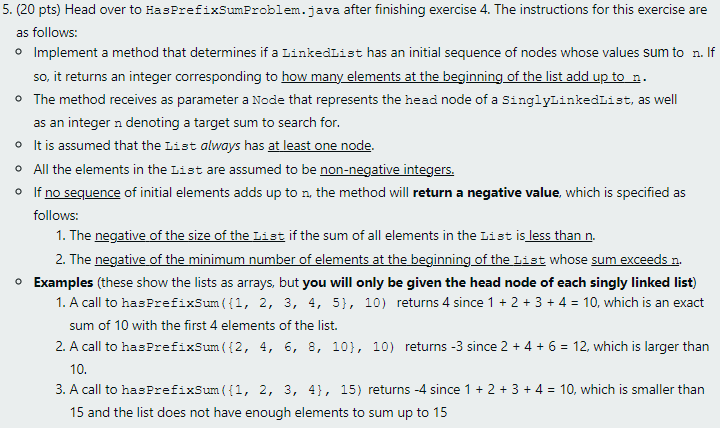
5. (20 pts) Head over to HasPrefixSumProblem. java after finishing exercise 4 . The instructions for this exercise are as follows: - Implement a method that determines if a Linkediist has an initial sequence of nodes whose values sum to n. I so, it returns an integer corresponding to how many elements at the beginning of the list add up to n. - The method receives as parameter a Node that represents the head node of a SinglyLinkedList, as well as an integer n denoting a target sum to search for. - It is assumed that the Iist always has at least one node. - All the elements in the List are assumed to be non-negative integers. - If no sequence of initial elements adds up to n, the method will return a negative value, which is specified as follows: 1. The negative of the size of the List if the sum of all elements in the List is less than n. 2. The negative of the minimum number of elements at the beginning of the List whose sum exceeds n. Examples (these show the lists as arrays, but you will only be given the head node of each singly linked list) 1. A call to hasprefixSum ({1,2,3,4,5},10) returns 4 since 1+2+3+4=10, which is an exact sum of 10 with the first 4 elements of the list. 2. A call to hasPrefixsum ({2,4,6,8,10},10) returns 3 since 2+4+6=12, which is larger than 10. 3. A call to hasPrefixsum ({1,2,3,4},15) returns 4 since 1+2+3+4=10, which is smaller than 15 and the list does not have enough elements to sum up to 15
Step by Step Solution
There are 3 Steps involved in it

Get step-by-step solutions from verified subject matter experts
 Study Help