







Question: //CODE public class RemoveAfterProblem { private static int countClears = 0; private static int countSetNext = 0; public static class Node { private E data;
 //CODE
public class RemoveAfterProblem {
private static int countClears = 0;
private static int countSetNext = 0;
public static class Node
private E data;
private Node
public Node(E data, Node
this.data = data;
this.next = next;
}
public Node(E data) {
this(data, null);
}
public E getData() {
return data;
}
public Node
return next;
}
public void setNext(Node
countSetNext++; // for grading purposes
this.next = next;
}
public void clear() {
countClears++; // for grading purposes
data = null;
next = null;
}
}
public int getCountClears() {
return countClears;
}
public int getCountSetNext() {
return countSetNext;
}
public void setCountClears(int count) {
countClears = count;
}
public void setCountSetNext(int count) {
countSetNext = count;
}
/**
* TODO EXERCISE 4:
*
* Implement a method that removes from the list all elements, if any,
* that are immediately after one occurrence of a given
* element and which are not equal to the given element.
*
* The method receives as a parameter a Node that represents the head of a linked list,
* as well as a target which will be used to find nodes containing that element such that
* we can remove the subsequent nodes that one (if they subsequent node does not contain an
* element that is equal to target).
*
* For example, assume that the specified element is 5.
*
* 1. If the list is (4, 5, 5, 6, 8, 5, 9, 5), then
* the list remaining would be (4, 5, 5, 8, 5, 5).
* The method would return value 2 (number of removals).
*
* 2. If the list is (4, 3, 6, 7, 8), the the list is
* not altered because it has no occurrence of 5. And
* the method would return 0.
*
* Your solution must be as efficient as possible and must
* properly apply the clear() method (of class Node) to each
* deleted node.
*
* @param
* @param first - Head Node of the Linked List
* @param target - Target element in a node to find that will
* remove nodes after it that are not equal to target
* @return The number of copies the method removed
*/
public
/*TODO ADD YOUR CODE HERE*/
return -Integer.MAX_VALUE; //Dummy Return
}
}
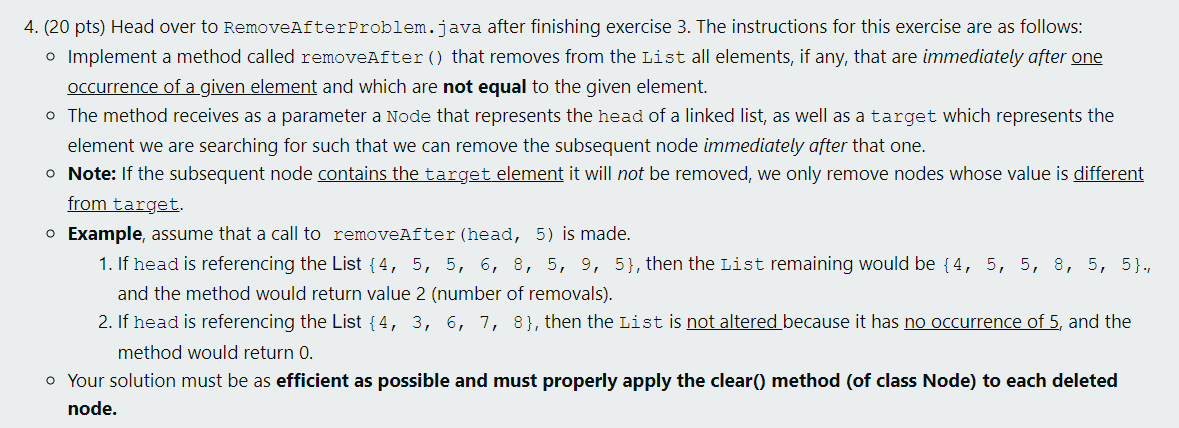
4. (20 pts) Head over to RemoveAfterproblem. java after finishing exercise 3. The instructions for this exercise are as follows: - Implement a method called removeafter () that removes from the List all elements, if any, that are immediately after one occurrence of a given element and which are not equal to the given element. - The method receives as a parameter a Node that represents the head of a linked list, as well as a target which represents the element we are searching for such that we can remove the subsequent node immediately after that one. - Note: If the subsequent node contains the target element it will not be removed, we only remove nodes whose value is different from target. - Example, assume that a call to removeafter (head, 5) is made. 1. If head is referencing the List {4,5,5,6,8,5,9,5}, then the List remaining would be {4,5,5,8,5,5}. and the method would return value 2 (number of removals). 2. If head is referencing the List {4,3,6,7,8}, then the List is not altered because it has no occurrence of 5 , and the method would return 0. - Your solution must be as efficient as possible and must properly apply the clear() method (of class Node) to each deleted node
Step by Step Solution
There are 3 Steps involved in it

Get step-by-step solutions from verified subject matter experts
 Study Help