







Question: CODE TO IMPORT list_node.py Contains a simple ListNode class, which simply has 'val' and 'next' fields. class ListNode: Models a single node
CODE TO IMPORT
""" list_node.py
Contains a simple ListNode class, which simply has 'val' and 'next' fields. """
class ListNode: """ Models a single node in a singly-linked list. Has no methods, other than the constructor. """
def __init__(self, val): """ Constructs the object; caller must pass a value, which will be stored in the 'val' field. """
self.val = val self.next = None
def __str__(self): vals = [] objs = set() curr = self while curr is not None: curr_str = str(curr.val) if curr in objs: vals.append("{} -> ... (to infinity and beyond)".format(curr_str)) break else: vals.append(curr_str) objs.add(curr) curr = curr.next
return " -> ".join(vals)
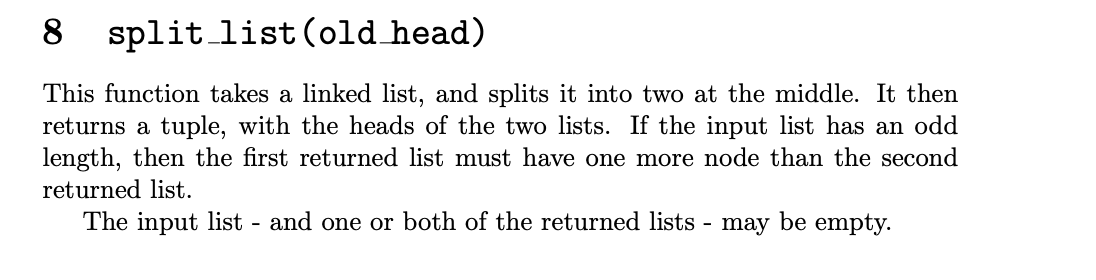
8 split list(old head) This function takes a linked list, and splits it into two at the middle. It then returns a tuple, with the heads of the two lists. If the input list has an odd length, then the first returned list must have one more node than the second returned list. The input list - and one or both of the returned lists - may be empty. 8 split list(old head) This function takes a linked list, and splits it into two at the middle. It then returns a tuple, with the heads of the two lists. If the input list has an odd length, then the first returned list must have one more node than the second returned list. The input list - and one or both of the returned lists - may be empty
Step by Step Solution
There are 3 Steps involved in it

Get step-by-step solutions from verified subject matter experts
 Study Help