







Question: CODING IN C: Enhance the code to handle any # of words as parameters and output them in a fancy pattern as shown below -
CODING IN C: Enhance the code to handle any # of words as parameters and output them in a fancy pattern as shown below - use a block of 16x16 characters for each word. Note that 16*16 = 256 (decimal) = 400 (octal).
Code given for copy and paste:
#include
#include
#include
#include
#include
#include
#define LINESIZE 16
//use one command line argument
int main(int argc, char *argv[]) {
if (argc != 2) {
printf("Usage: diagonal
return -1;
}
//create a file so that 16 rows of empty will appear with od -c command
int fd = open("diagonal.out", O_CREAT | O_WRONLY | O_TRUNC, S_IRUSR | S_IWUSR);
char space = ' ';
for(int line=0; line for(int column=0; column write(fd, &space, 1); //Each line of od outputs 16 characters //So, to make the output diagonal, we will use 0, 17, 34, .... int n = strlen(argv[1]); for(int i=0; i lseek(fd, (LINESIZE+1)*i, SEEK_SET); write(fd, &argv[1][i], 1); } close(fd); puts("diagonal.out has been created. Use od -c diagonal.out to see the contents."); }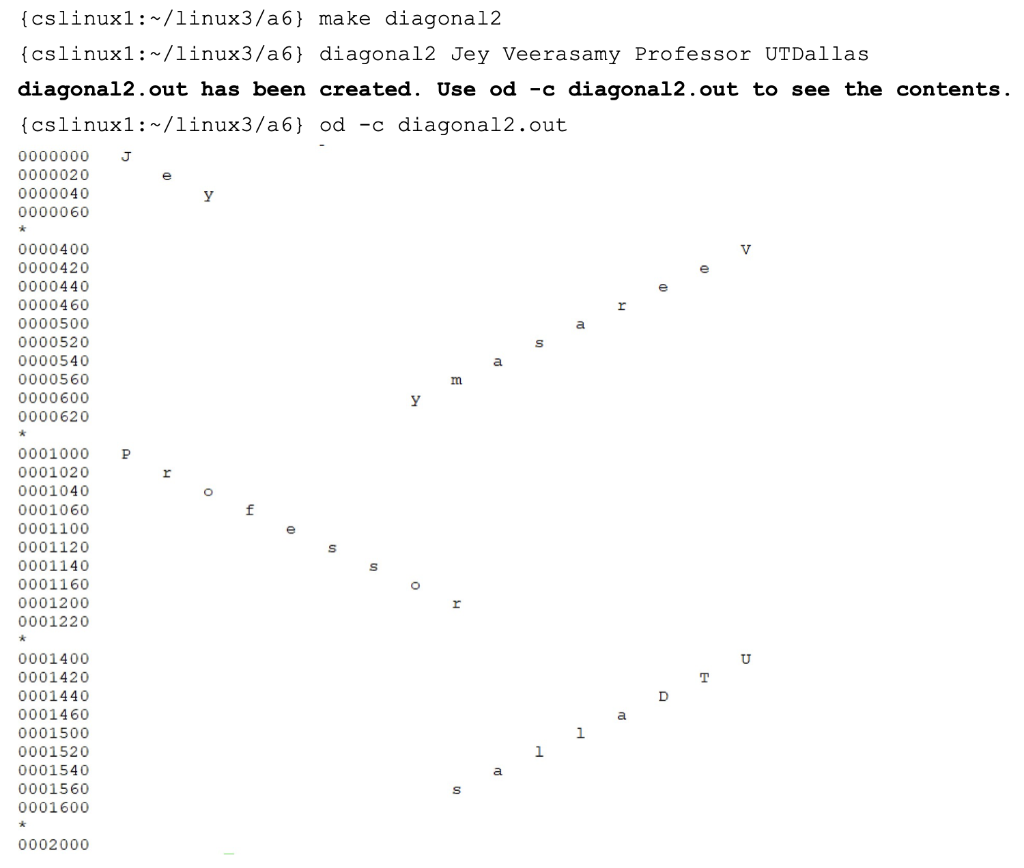
Step by Step Solution
There are 3 Steps involved in it

Get step-by-step solutions from verified subject matter experts
 Study Help