Question: COLLECTIVE BARGAINING SIMULATION Background The Help Agency Inc. is a publicly funded organization located in a large wrancenter provides an array of services to its
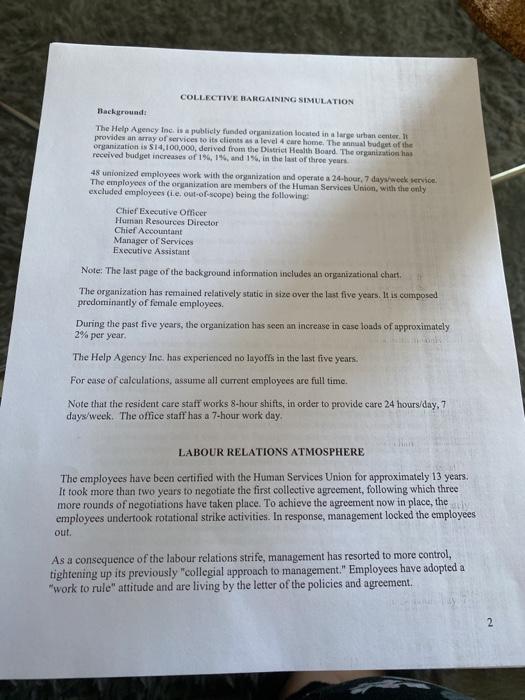
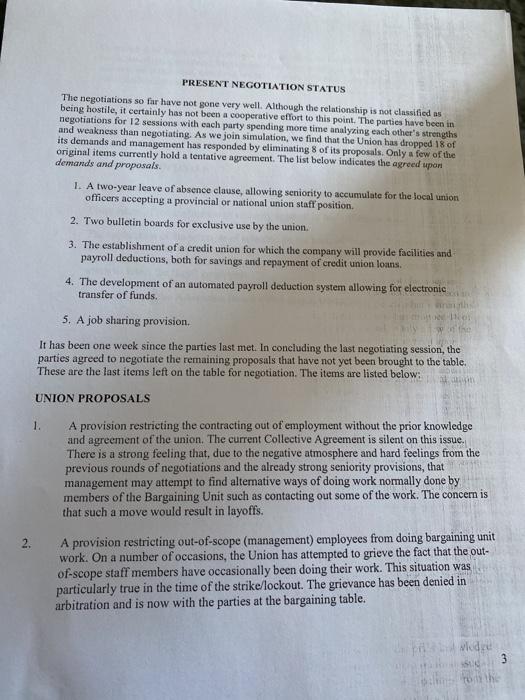
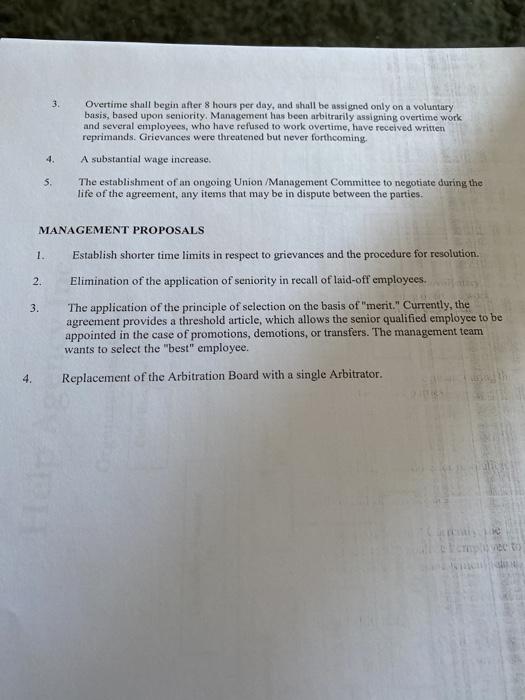
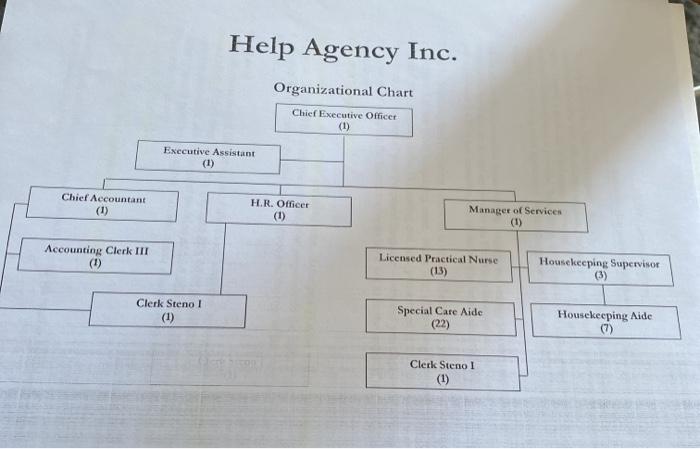
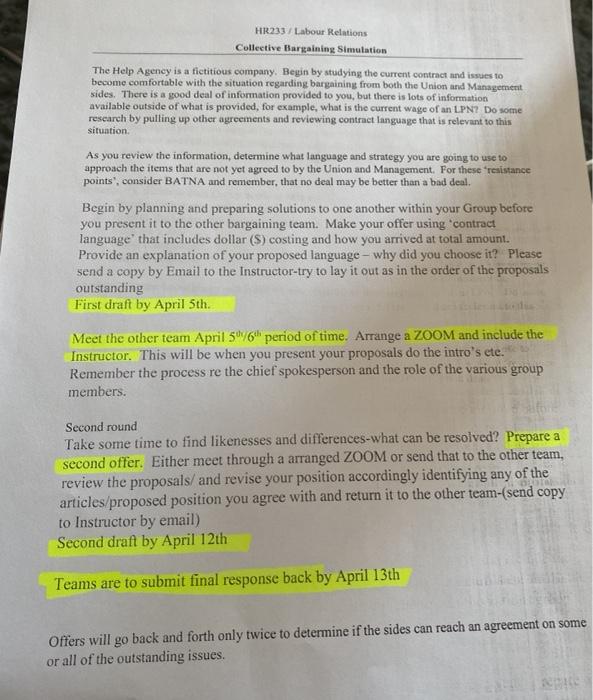
COLLECTIVE BARGAINING SIMULATION Background The Help Agency Inc. is a publicly funded organization located in a large wrancenter provides an array of services to its clients as a level 4 care home. The annual budget of the organization in S14,100,000, derived from the District Health Board. The organization has received budget increases of 194, 1%, and 1%, in the last of three years 48 unionized employees work with the organization and operate a 24-hour, 7 daysweek service The employees of the organization are members of the Human Services Union, with the only excluded employees (ie. out-of-scope) being the following Chief Executive Officer Human Resources Director Chief Accountant Manager of Services Executive Assistant Note: The last page of the background information includes an organizational chatt. The organization has remained relatively static in size over the last five years. It is composed predominantly of female employees. During the past five years, the organization has seen an increase in case loads of approximately 2% per year. The Help Agency Inc. has experienced no layoffs in the last five years. For ease of calculations, assume all current employees are full time. Note that the resident care staff works 8-hour shifts, in order to provide care 24 hours/day, 7 days/week. The office staff has a 7-hour work day. LABOUR RELATIONS ATMOSPHERE The employees have been certified with the Human Services Union for approximately 13 years. It took more than two years to negotiate the first collective agreement, following which three more rounds of negotiations have taken place. To achieve the agreement now in place, the employees undertook rotational strike activities. In response, management locked the employees out. As a consequence of the labour relations strife, management has resorted to more control, tightening up its previously "collegial approach to management." Employees have adopted a "work to rule" attitude and are living by the letter of the policies and agreement. 2 PRESENT NEGOTIATION STATUS The negotiations so far have not gone very well. Although the relationship is not classified as being hostile, it certainly has not been a cooperative effort to this point. The parties have been in negotiations for 12 sessions with each party spending more time analyzing cach other's strengths and weakness than negotiating. As we join simulation, we find that the Union has dropped 18 of its demands and management has responded by eliminating 8 of its proposals. Only a few of the original items currently hold a tentative agreement. The list below indicates the agreed upon demands and proposals. 1. A two-year leave of absence clause, allowing seniority to accumulate for the local union officers accepting a provincial or national union staff position. 2. Two bulletin boards for exclusive use by the union 3. The establishment of a credit union for which the company will provide facilities and payroll deductions, both for savings and repayment of credit union loans. 4. The development of an automated payroll deduction system allowing for electronic transfer of funds. 5. A job sharing provision. It has been one week since the parties last met. In concluding the last negotiating session, the parties agreed to negotiate the remaining proposals that have not yet been brought to the table. These are the last items left on the table for negotiation. The items are listed below: UNION PROPOSALS 1. A provision restricting the contracting out of employment without the prior knowledge and agreement of the union. The current Collective Agreement is silent on this issue. There is a strong feeling that, due to the negative atmosphere and hard feelings from the previous rounds of negotiations and the already strong seniority provisions, that management may attempt to find alternative ways of doing work normally done by members of the Bargaining Unit such as contacting out some of the work. The concern is that such a move would result in layoffs. 2 A provision restricting out-of-scope (management) employees from doing bargaining unit work. On a number of occasions, the Union has attempted to grieve the fact that the out- of-scope staff members have occasionally been doing their work. This situation was particularly true in the time of the strike/lockout. The grievance has been denied in arbitration and is now with the parties at the bargaining table. lidre TO 3. Overtime shall begin after 8 hours per day, and shall be assigned only on a voluntary basis, based upon seniority. Management has been arbitrarily assigning overtime work and several employees, who have refused to work overtime, have received written reprimands. Grievances were threatened but never forthcoming. 4. A substantial wage increase 5. The establishment of an ongoing Union/Management Committee to negotiate during the life of the agreement, any items that may be in dispute between the parties. MANAGEMENT PROPOSALS 1. 2. 3. Establish shorter time limits in respect to grievances and the procedure for resolution. Elimination of the application of seniority in recall of laid-off employees. The application of the principle of selection on the basis of "merit." Currently, the agreement provides a threshold article, which allows the senior qualified employee to be appointed in the case of promotions, demotions, or transfers. The management team wants to select the "best" employee. 4. Replacement of the Arbitration Board with a single Arbitrator. Help Agency Inc. Organizational Chart Chief Executive Officer (1) Executive Assistant (1) Chief Accountant H.R. Officer (1) Manager of Services (1) Accounting Clerk III (1) Licensed Practical Nurse (13) Housekeeping Supervisor (3) Clerk Steno 1 (1) Special Care Aide (22) Housekeeping Aide Clerk Steno ! HR233/Labour Relations Collective Bargaining Simulation The Help Agency is a fictitious company. Begin by studying the current contract and issues to become comfortable with the situation regarding bargaining from both the Union and Management sides. There is a good deal of information provided to you, but there is lots of information available outside of what is provided, for example, what is the current wage of an LPN? Do some research by pulling up other agreements and reviewing contract language that is relevant to this situation. As you review the information, determine what language and strategy you are going to use to approach the items that are not yet agreed to by the Union and Management. For these resistance points", consider BATNA and remember, that no deal may be better than a bad deal. Begin by planning and preparing solutions to one another within your Group before you present it to the other bargaining team. Make your offer using contract language that includes dollar (S) costing and how you arrived at total amount. Provide an explanation of your proposed language - why did you choose it? Please send a copy by Email to the Instructor-try to lay it out as in the order of the proposals outstanding First draft by April 5th. Meet the other team April 50/6h period of time. Arrange a ZOOM and include the Instructor. This will be when you present your proposals do the intro's ete. Remember the process re the chief spokesperson and the role of the various group members. Second round Take some time to find likenesses and differences-what can be resolved? Prepare a second offer. Either meet through a arranged ZOOM or send that to the other team, review the proposals and revise your position accordingly identifying any of the articles/proposed position you agree with and return it to the other team-(send copy to Instructor by email) Second draft by April 12th Teams are to submit final response back by April 13th Offers will go back and forth only twice to determine if the sides can reach an agreement on some or all of the outstanding issues









 Study Help