





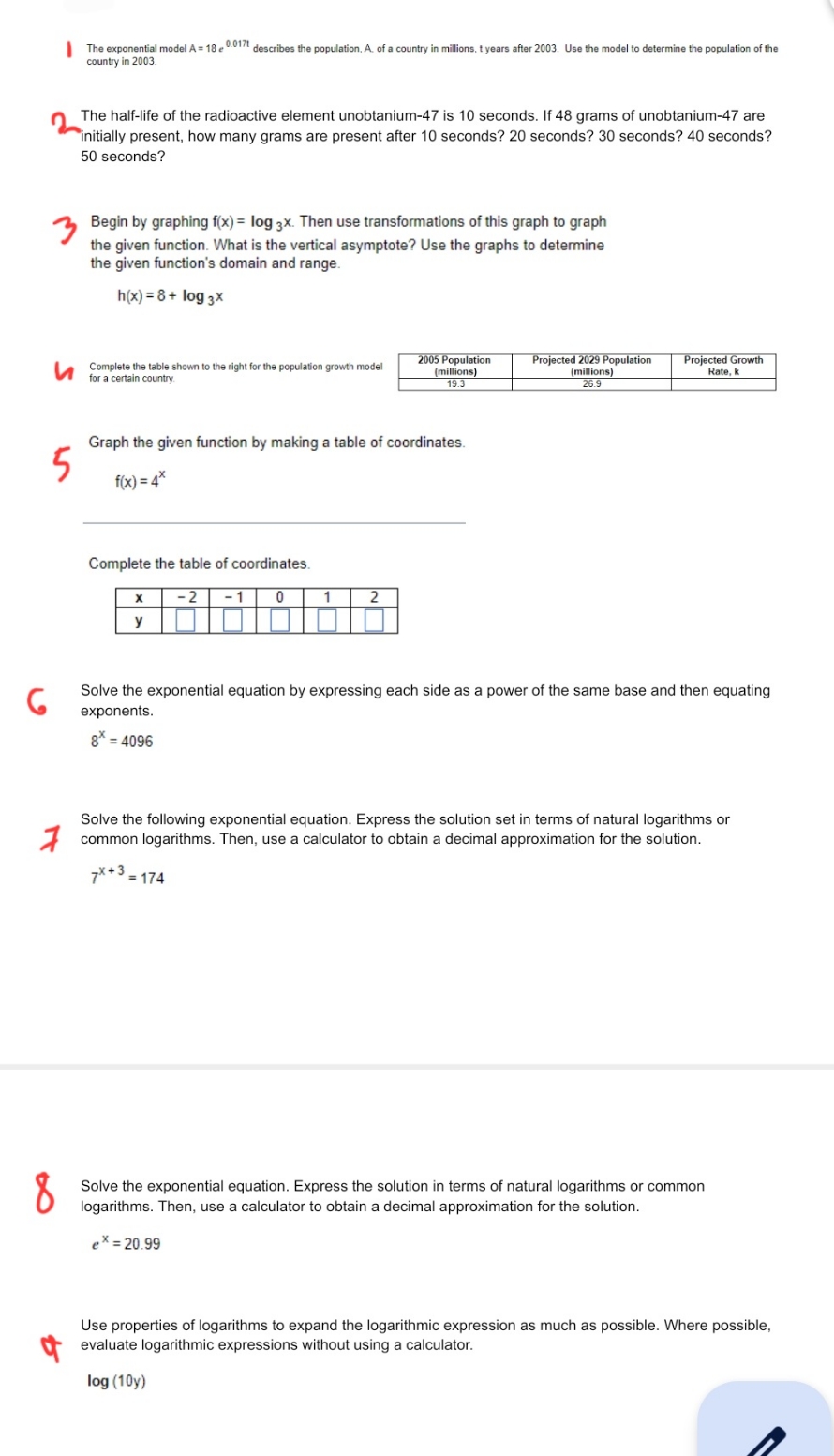
Question: College Algebra The exponential model A = 18 e .describes the population, A, of a country in millions, t years after 2003. Use the model

College Algebra
College Algebra The exponential model A = 18 e
The exponential model A = 18 e .describes the population, A, of a country in millions, t years after 2003. Use the model to determine the population of the country in 2003. 2 The half-life of the radioactive element unobtanium-47 is 10 seconds. If 48 grams of unobtanium-47 are initially present, how many grams are present after 10 seconds? 20 seconds? 30 seconds? 40 seconds? 50 seconds? 3 Begin by graphing f(x) = log 3x. Then use transformations of this graph to graph the given function. What is the vertical asymptote? Use the graphs to determine the given function's domain and range. h(x) =8+ log 3X Complete the table shown to the right for the population growth model 2005 Population Projected 2029 Population Projected Growth (millions) (millions) Rate, k for a certain country. 19.3 26.9 Graph the given function by making a table of coordinates. f(x) = 4* Complete the table of coordinates. X 1-2 -1 0 1 2 y Solve the exponential equation by expressing each side as a power of the same base and then equating exponents. 8* = 4096 Solve the following exponential equation. Express the solution set in terms of natural logarithms or 7 common logarithms. Then, use a calculator to obtain a decimal approximation for the solution. 7X+3 = 174 Solve the exponential equation. Express the solution in terms of natural logarithms or common logarithms. Then, use a calculator to obtain a decimal approximation for the solution. e * = 20.99 Use properties of logarithms to expand the logarithmic expression as much as possible. Where possible, evaluate logarithmic expressions without using a calculator. log (10y)

Step by Step Solution

There are 3 Steps involved in it

1 Expert Approved Answer
Step: 1 Unlock blur-text-image

Question Has Been Solved by an Expert!

Get step-by-step solutions from verified subject matter experts

Step: 2 Unlock
Step: 3 Unlock

Students Have Also Explored These Related Mathematics Questions!