







Question: colours so that for every pair ( u , v ) of adjacent vertices, ( u ) and ( v
colours so that for every pair u v of adjacent vertices, u and v are assigned different colours.
The quad of a graph G denoted by chiG is the smallest integer k for which graph G is k colorable. To show that chiGk you must show that the graph is k colourable and that the graph is not kcolourable.
Q
Points
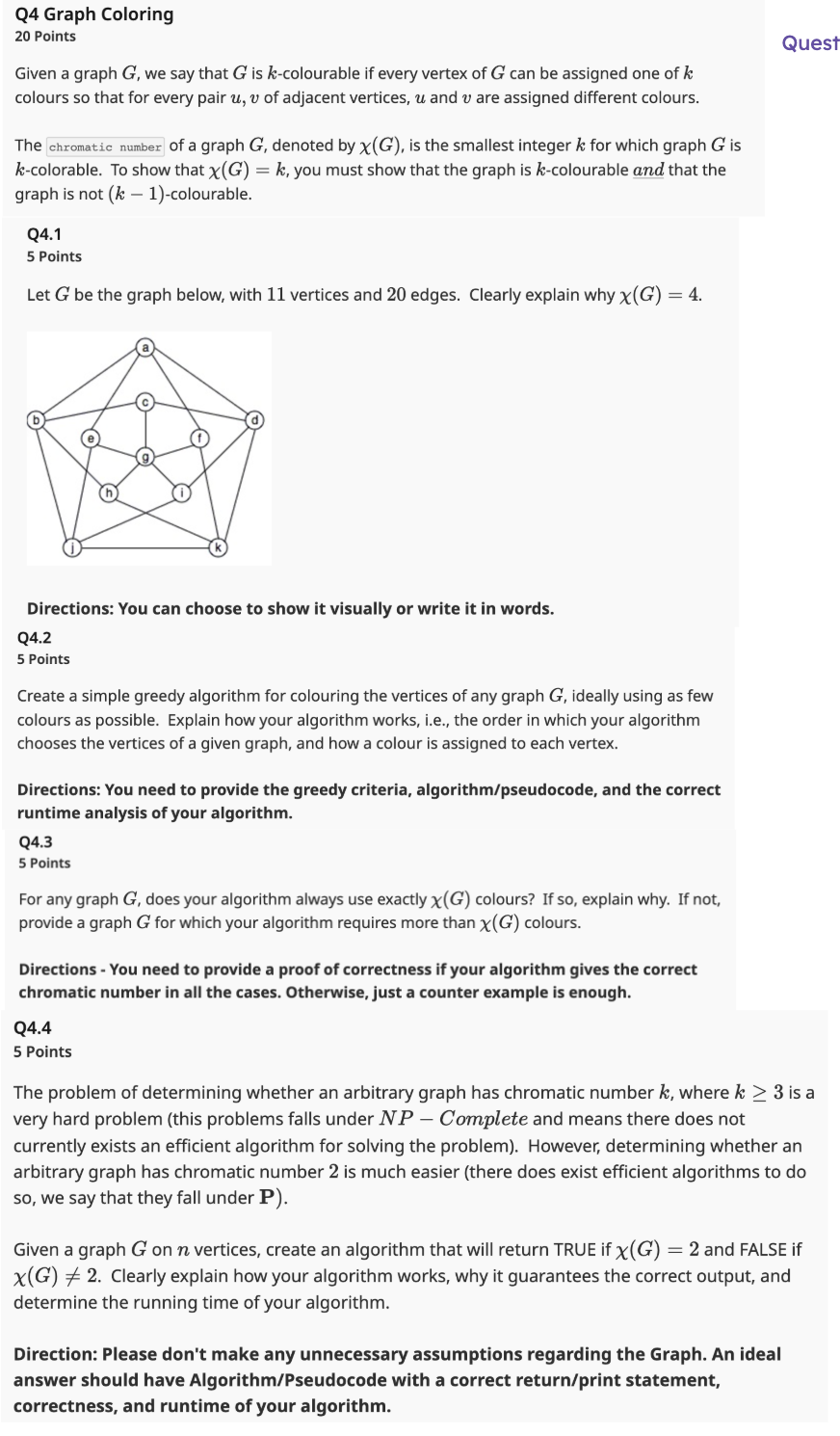
Let G be the graph below, with vertices and edges. Clearly explain why chiG
Directions: You can choose to show it visually or write it in words.
Q
Points
Create a simple greedy algorithm for colouring the vertices of any graph G ideally using as few colours as possible. Explain how your algorithm works, ie the order in which your algorithm chooses the vertices of a given graph, and how a colour is assigned to each vertex.
Directions: You need to provide the greedy criteria, algorithmpseudocode and the correct runtime analysis of your algorithm.
Q
Points
For any graph G does your algorithm always use exactly chiG colours? If so explain why. If not, provide a graph G for which your algorithm requires more than chiG colours.
Directions You need to provide a proof of correctness if your algorithm gives the correct chromatic number in all the cases. Otherwise, just a counter example is enough.
Q
Points
The problem of determining whether an arbitrary graph has chromatic number k where k geq is a very hard problem this problems falls under N P Complete and means there does not currently exists an efficient algorithm for solving the problem However, determining whether an arbitrary graph has chromatic number mathbf is much easier there does exist efficient algorithms to do so we say that they fall under mathbfP
Given a graph G on n vertices, create an algorithm that will return TRUE if chiG and FALSE if chiG
eq Clearly explain how your algorithm works, why it guarantees the correct output, and determine the running time of your algorithm.
Direction: Please don't make any unnecessary assumptions regarding the Graph. An ideal answer should have AlgorithmPseudocode with a correct returnprint statement, correctness, and runtime of your algorithm.
Step by Step Solution
There are 3 Steps involved in it
1 Expert Approved Answer
Step: 1 Unlock

Question Has Been Solved by an Expert!
Get step-by-step solutions from verified subject matter experts
Step: 2 Unlock
Step: 3 Unlock
 Study Help