







Question: Comcasts Influence Went Only So Far Comcast is the largest cable provider in the United States. This activity is important because despite its impressive power,
Comcasts Influence Went Only So Far
Comcast is the largest cable provider in the United States. This activity is important because despite its impressive power, influence, and politics, Comcast failed to effectively influence stakeholders including customers, employees, regulators, networks, and other content providers.
The goal of this activity is to apply the knowledge of OB in order to understand why Comcast failed in its bid to acquire Time Warner, and allow you to provide realistic solutions for future acquisition attempts.
Read the case about Comcasts failure to influence key stakeholders. Then, using the 3-step problem-solving approach, answer the questions that follow.
Like many companies in the telecom industry, Comcast has chosen to grow by buying competitors. After acquiring AT&Ts Internet business in 2001, the company has remained on the acquisition train ever since. Its largest purchase to date was NBC Universal in 2011 for $18 billion, but its most notable was its thwarted 2015 attempt to buy Time Warner for $45 billion. Despite its impressive power, influence, and politics, Comcast failed to effectively influence stakeholders including customers, employees, regulators, networks, and other content providers. More than 300,000 comments were filed with the Federal Communication Commission (FCC) by customers who opposed the merger. For perspective, the merger between AT&T and T-Mobile drew just over 40,000 comments.1
Why Bother in the First Place?
Comcast is the largest cable provider in the United States despite having the worst customer satisfaction ratings in its industry. It has twice earned the dubious distinction of being the Worst Company in America, according to Consumer Reports customer satisfaction arm. Comcasts customer service was so poor as to be considered legendary. And its reputation with various networks and cable channels such as Discovery, Disney, 20th Century Fox, and the NFL Network had been declining for years.2 These partners are in effect customers, and Comcast has pressured them to pay higher fees to distribute their content through its cables.3
Industry trends were affecting Comcasts current performance and its future prospects. Consumers have been cutting the cable and instead accessing their content via streaming alternatives such as Netflix and Amazon Prime. Netflix alone accounts for one-third of all Internet traffic. But apparently believing that being No. 1 was not enough, Comcasts leaders decided that acquiring Time Warner would enable them to better serve existing and new customers, as well as to defend against increasingly diverse competition from Google, Dish Network, and others.4
Attempts to Influence the Players
Comcast was determined and resourceful in its attempt to make things go its way. A major part of its efforts focused on Washington, D.C., since no merger of that size goes through without regulatory approval. Comcast employs a force of more than 100 lobbyists, and its $17 million annual lobbying budget is second only to Googles.5 Lobbying efforts were largely intended to influence officials in the FCC and Department of Justice (DOJ), the regulators who would ultimately decide how the merger would affect competition and consumer choice, and who would either block it or allow it to proceed. Members of these government departments were buried in data, wined and dined, and presented with dazzling arguments highlighting the potential benefits of the merger. But Comcast did not stop there. CEO Brian Roberts courted President Obama, golfing with him on Marthas Vineyard. And Comcast Executive Vice President David Cohen hosted three fund-raisers for the president at his home, raising more than $10 million for the Democratic party.6 Roberts and Cohen presumably thought that associating with key players in the government would win them favor with regulators and members of Congress who might influence the merger and other policies favorable to Comcast.
For its part, the company argued that a merger of the two largest players wouldnt stifle competition but instead allow them to provide more services to more customers. For instance, it currently provides Internet services to low-income and rural residents. Combining with Time Warner, the company claimed, would enable it to serve even more of these customers.7
The Other Side and Ultimate Outcome
Ultimately, the money, the relationships, the lobbyists arguments, and the pressure failed to work. Its opponents used many of the same bases of power, influence, and political tactics to argue against the merger that Comcast used to promote it, and the company withdrew its bid for Time Warner. It didnt help that Comcast already had such a poor reputation with many of the parties from whom it needed support. It is noteworthy that in mid-2016 Charter Communications successfully acquired Time Warner in a merger worth $79 billion.8
Assume you are CEO Roberts, and you want to successfully acquire a large competitor in the future. Drawing on what you learned from the Time Warner experience, what would you do now to improve your chances?
Apply the 3-Step Problem-Solving Approach to OB
Use the Organizing Framework in Figure 12.9 and the 3-Step Problem-Solving Approach to help identify inputs, processes, and outcomes relative to this case.
Step 1: Define the problem.
- Look first at the Outcomes box of the Organizing Framework to help identify the important problem(s) in this case. Remember that a problem is a gap between a desired and current state. State your problem as a gap, and be sure to consider problems at all three levels. If more than one desired outcome is not being accomplished, decide which one is most important and focus on it for steps 2 and 3.
- Cases have protagonists (key players), and problems are generally viewed from a particular protagonists perspective. In this case youre asked to assume the role of CEO Brian Roberts.
- Use details in the case to determine the key problem. Dont assume, infer, or create problems that are not included in the case.
- To refine your choice, ask yourself, Why is this a problem? Focus on topics in the current chapter, because we generally select cases that illustrate concepts in the current chapter.
Step 2: Identify causes of the problem by using material from this chapter, which has been summarized in the Organizing Framework for Chapter 12 and is shown in Figure 12.9. Causes will tend to show up in either the Inputs box or the Processes box.
- Start by looking at the Organizing Framework (Figure 12.9) and decide which person factors, if any, are most likely causes of the defined problem. For each cause, explain why this is a cause of the problem. Asking why multiple times is more likely to lead you to root causes of the problem. For example, do employee characteristics help explain the problem you defined in Step 1?
- Follow the same process for the situation factors. For each ask yourself, Why is this a cause? By asking why multiple times you are likely to arrive at a more complete and accurate list of causes. Again, look to the Organizing Framework for this chapter for guidance.
- Now consider the Processes box in the Organizing Framework. Are any processes at the individual, group/team, or organizational level potential causes of your defined problem? For any process you consider, ask yourself, Why is this a cause? Again, do this for several iterations to arrive at the root causes.
- To check the accuracy or appropriateness of the causes, map them onto the defined problem.
Step 3: Make your recommendations for solving the problem. Consider whether you want to resolve it, solve it, or dissolve it (see Section 1.5). Which recommendation is desirable and feasible?
- Given the causes you identified in Step 2, what are your best recommendations? Use the material in the current chapter that best suits the cause. Consider the OB in Action and Applying OB boxes, because these contain insights into what others have done that might be especially useful for this case.
- Be sure to consider the Organizing Frameworkboth person and situation factorsas well as processes at different levels.
- Create an action plan for implementing your recommendations.
What is the main problem in this case?
Multiple Choice
-
Comcasts inability to influence stakeholders
-
Poor government oversight of the telecommunications industry
-
The gap between Comcasts current financial performance and desired financial performance
-
CEOs and government officials having dinners and golf outings
-
The performance management tactics at Comcast
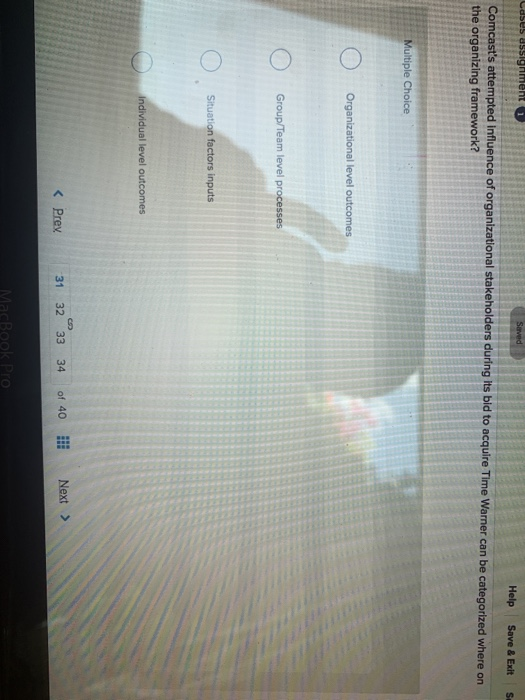
Comcasts attempted influence of organizational stakeholders during its bid to acquire Time Warner can be categorized where on the organizing framework?
Multiple Choice
-
Organizational level outcomes
-
Group/Team level processes
-
Situation factors inputs
-
Individual level outcomes
-
Person factors inputs
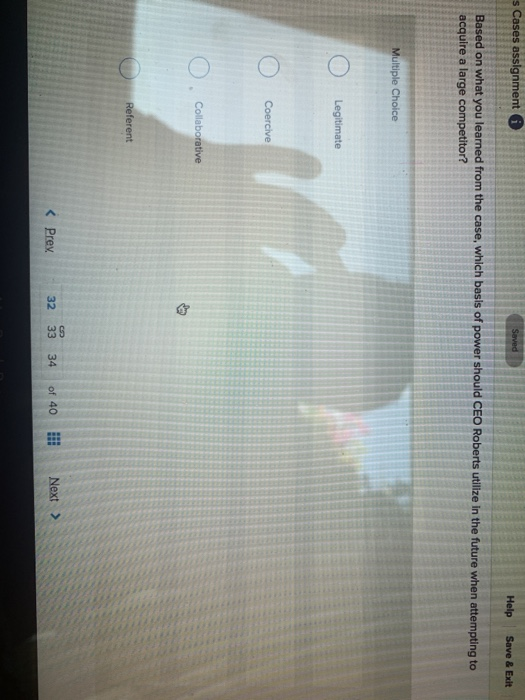
Based on what you learned from the case, which basis of power should CEO Roberts utilize in the future when attempting to acquire a large competitor?
Multiple Choice
-
Legitimate
-
Coercive
-
Collaborative
-
Referent
-
Reward
Comcast seems to have failed at which of the following principles of persuasion?
Multiple Choice
-
Authority
-
Pressure
-
Exchange
-
Liking
-
Reward
Which of the following political tactics proved to be problematic for Comcast?
Multiple Choice
-
Ingratiation
-
Making friends with power brokers
-
Using information
-
Diversity management
-
Impression management
Step by Step Solution
There are 3 Steps involved in it

Get step-by-step solutions from verified subject matter experts
 Study Help