







Question: Commercial Law L PART 1 (TOTAL: 45 MARKS) INSTRUCTIONS: a. There are 15 questions in Part 1. Students must answer ALL QUESTIONS b. State whether
Commercial Law
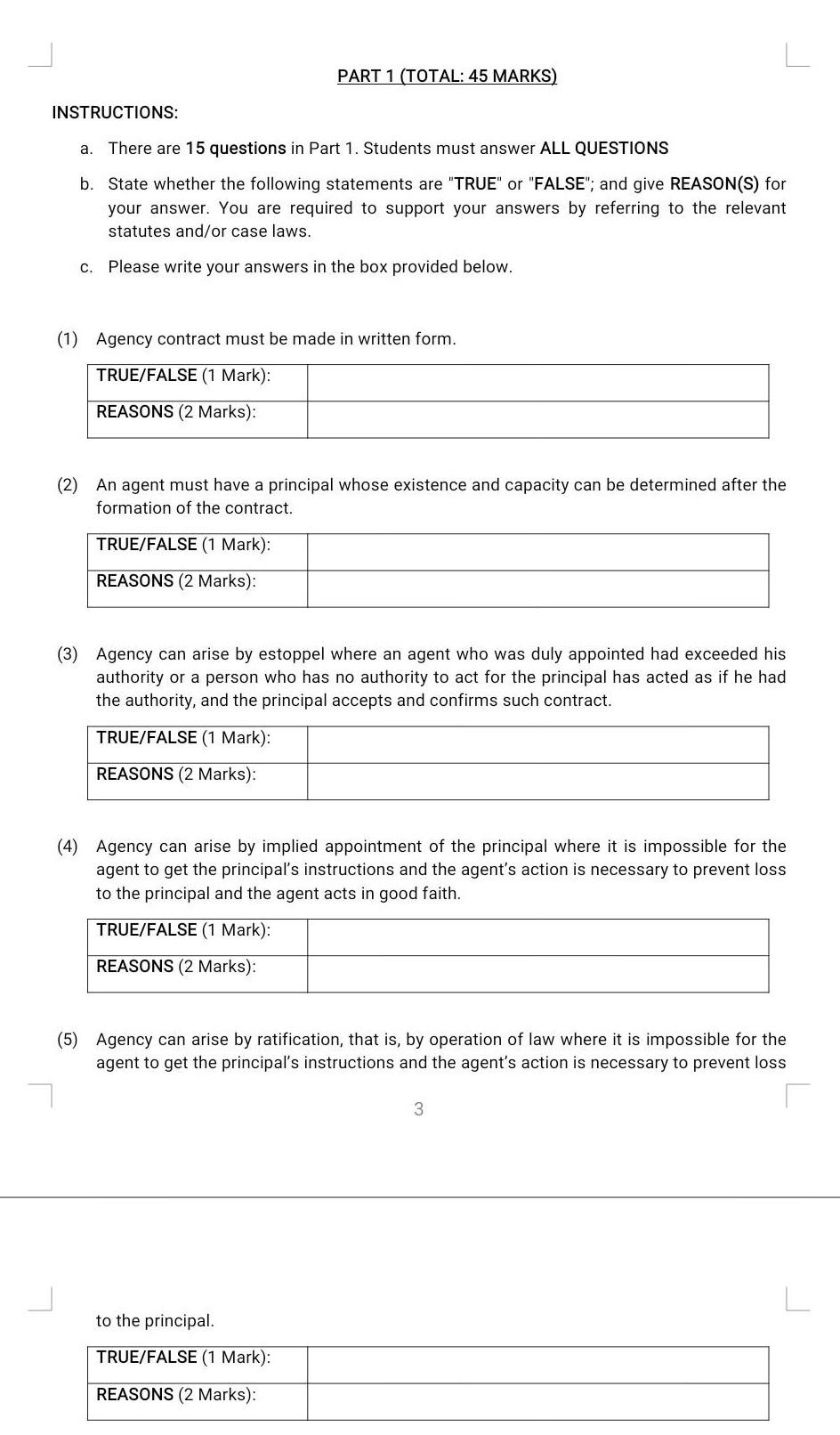
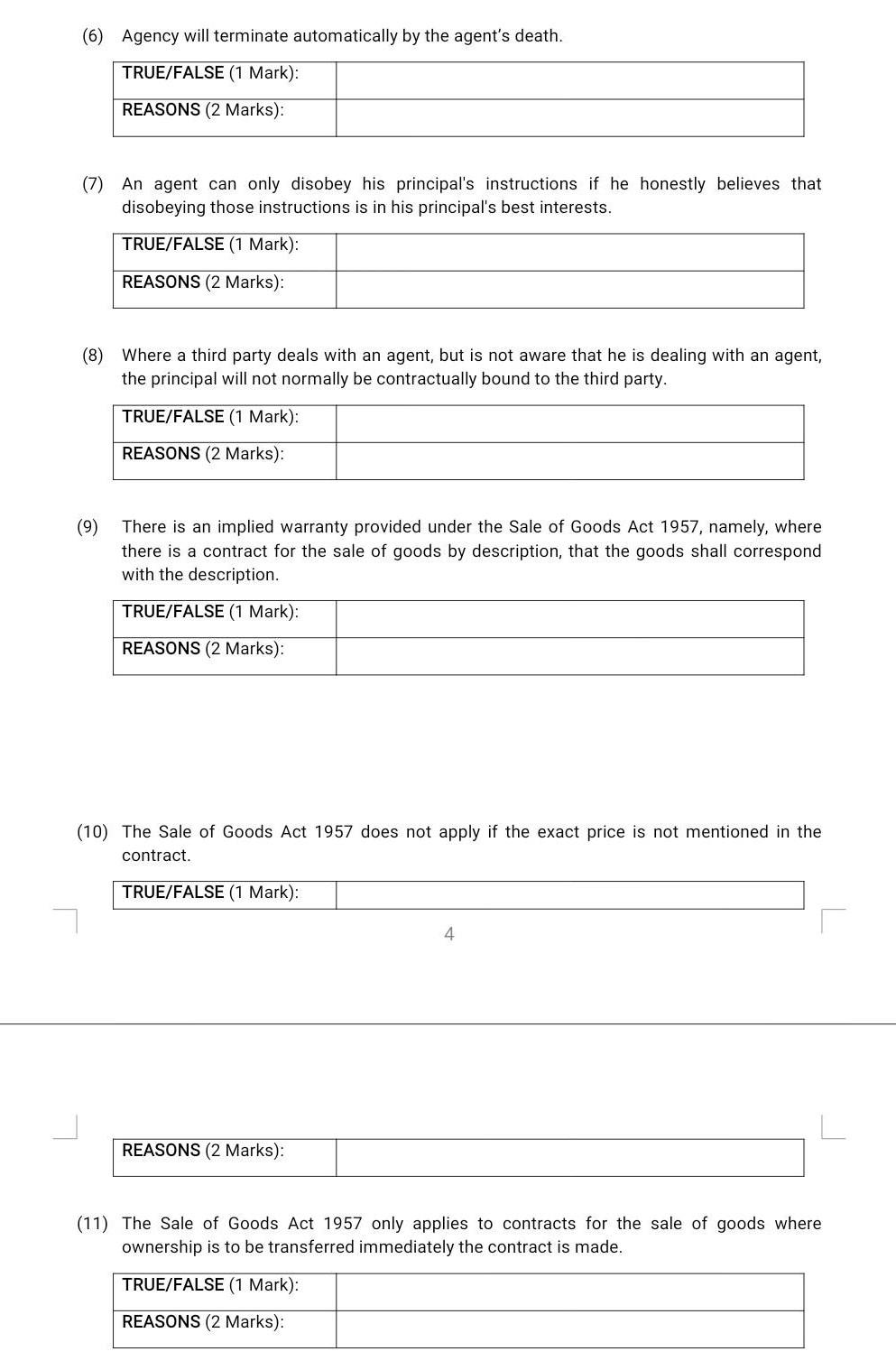
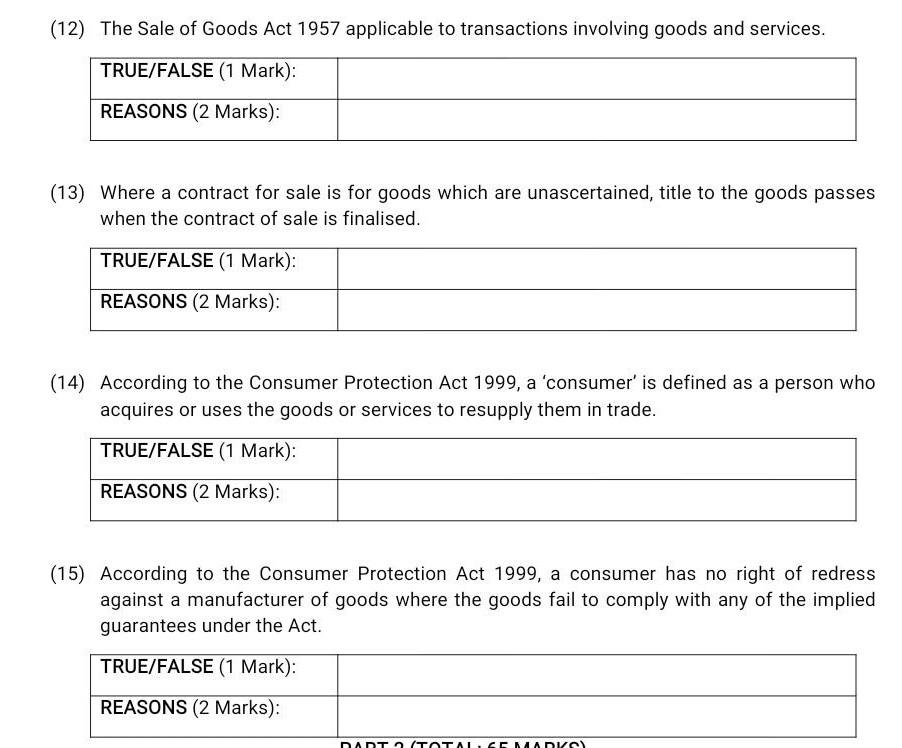
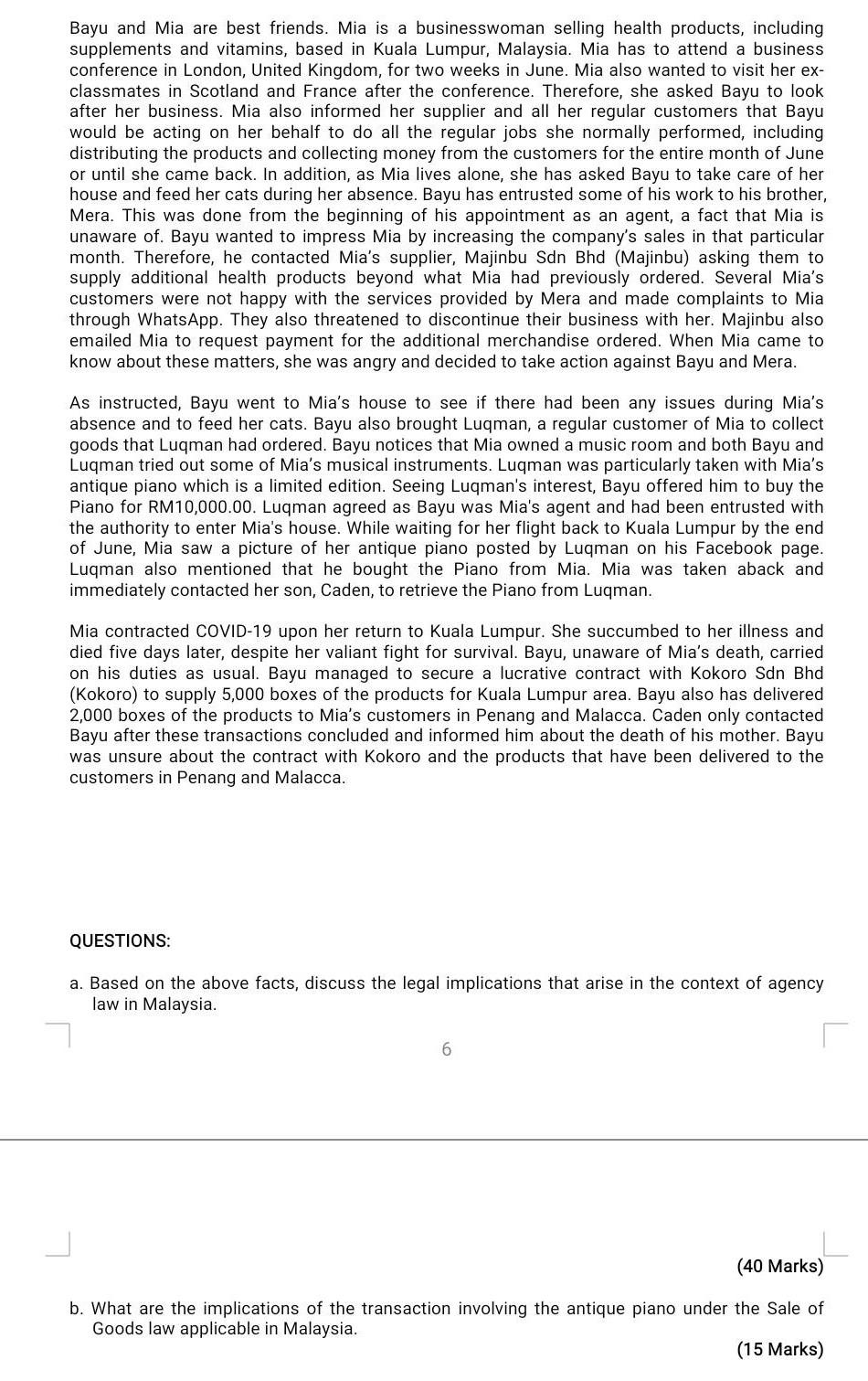
L PART 1 (TOTAL: 45 MARKS) INSTRUCTIONS: a. There are 15 questions in Part 1. Students must answer ALL QUESTIONS b. State whether the following statements are "TRUE" or "FALSE"; and give REASON(S) for your answer. You are required to support your answers by referring to the relevant statutes and/or case laws. C. Please write your answers in the box provided below. (1) Agency contract must be made in written form. TRUE/FALSE (1 Mark): REASONS (2 Marks): (2) An agent must have a principal whose existence and capacity can be determined after the formation of the contract. TRUE/FALSE (1 Mark): REASONS (2 Marks): (3) Agency can arise by estoppel where an agent who was duly appointed had exceeded his authority or a person who has no authority to act for the principal has acted as if he had the authority, and the principal accepts and confirms such contract. TRUE/FALSE (1 Mark): REASONS (2 Marks): (4) Agency can arise by implied appointment of the principal where it is impossible for the agent to get the principal's instructions and the agent's action is necessary to prevent loss to the principal and the agent acts in good faith. TRUE/FALSE (1 Mark): REASONS (2 Marks): (5) Agency can arise by ratification, that is, by operation of law where it is impossible for the agent to get the principal's instructions and the agent's action is necessary to prevent loss 3 to the principal. TRUE/FALSE (1 Mark): REASONS (2 Marks): (6) Agency will terminate automatically by the agent's death. TRUE/FALSE (1 Mark): REASONS (2 Marks): (7) An agent can only disobey his principal's instructions if he honestly believes that disobeying those instructions is in his principal's best interests. TRUE/FALSE (1 Mark): REASONS (2 Marks): (8) Where a third party deals with an agent, but is not aware that he is dealing with an agent, the principal will not normally be contractually bound to the third party. TRUE/FALSE (1 Mark): REASONS (2 Marks): (9) There is an implied warranty provided under the Sale of Goods Act 1957, namely, where there is a contract for the sale of goods by description, that the goods shall correspond with the description. TRUE/FALSE (1 Mark): REASONS (2 Marks): (10) The Sale of Goods Act 1957 does not apply if the exact price is not mentioned in the contract. TRUE/FALSE (1 Mark): 4. REASONS (2 Marks): (11) The Sale of Goods Act 1957 only applies to contracts for the sale of goods where ownership is to be transferred immediately the contract is made. TRUE/FALSE (1 Mark): REASONS (2 Marks): (12) The Sale of Goods Act 1957 applicable to transactions involving goods and services. TRUE/FALSE (1 Mark): REASONS (2 Marks): (13) Where a contract for sale is for goods which are unascertained, title to the goods passes when the contract of sale is finalised. TRUE/FALSE (1 Mark): REASONS (2 Marks): (14) According to the Consumer Protection Act 1999, a 'consumer' is defined as a person who acquires or uses the goods or services to resupply them in trade. TRUE/FALSE (1 Mark): REASONS (2 Marks): (15) According to the Consumer Protection Act 1999, a consumer has no right of redress against a manufacturer of goods where the goods fail to comply with any of the implied guarantees under the Act. TRUE/FALSE (1 Mark): REASONS (2 Marks): DADTTOTAL.CENA DVA Bayu and Mia are best friends. Mia is a businesswoman selling health products, including supplements and vitamins, based in Kuala Lumpur, Malaysia. Mia has to attend a business conference in London, United Kingdom, for two weeks in June. Mia also wanted to visit her ex- classmates in Scotland and France after the conference. Therefore, she asked Bayu to look after her business. Mia also informed her supplier and all her regular customers that Bayu would be acting on her behalf to do all the regular jobs she normally performed, including distributing the products and collecting money from the customers for the entire month of June or until she came back. In addition, as Mia lives alone, she has asked Bayu to take care of her house and feed her cats during her absence. Bayu has entrusted some of his work to his brother, Mera. This was done from the beginning of his appointment as an agent, a fact that Mia is unaware of. Bayu wanted to impress Mia by increasing the company's sales in that particular month. Therefore, he contacted Mia's supplier, Majinbu Sdn Bhd (Majinbu) asking them to supply additional health products beyond what Mia had previously ordered. Several Mia's customers were not happy with the services provided by Mera and made complaints to Mia through WhatsApp. They also threatened to discontinue their business with her. Majinbu also emailed Mia to request payment for the additional merchandise ordered. When Mia came to know about these matters, she was angry and decided to take action against Bayu and Mera. As instructed, Bayu went to Mia's house to see if there had been any issues during Mia's absence and to feed her cats. Bayu also brought Luqman, a regular customer Mia to collect goods that Luqman had ordered. Bayu notices that Mia owned a music room and both Bayu and Luqman tried out some of Mia's musical instruments. Luqman was particularly taken with Mia's antique piano which is a limited edition. Seeing Luqman's interest, Bayu offered him to buy the Piano for RM10,000.00. Luqman agreed as Bayu was Mia's agent and had been entrusted with the authority to enter Mia's house. While waiting for her flight back to Kuala Lumpur by the end of June, Mia saw a picture of her antique piano posted by Luqman on his Facebook page. Luqman also mentioned that he bought the Piano from Mia. Mia was taken aback and immediately contacted her son, Caden, to retrieve the Piano from Luqman. Mia contracted COVID-19 upon her return to Kuala Lumpur. She succumbed to her illness and died five days later, despite her valiant fight for survival. Bayu, unaware of Mia's death, carried on his duties as usual. Bayu managed to secure a lucrative contract with Kokoro Sdn Bhd (Kokoro) to supply 5,000 boxes of the products for Kuala Lumpur area. Bayu also has delivered 2,000 boxes of the products to Mia's customers in Penang and Malacca. Caden only contacted Bayu after these transactions concluded and informed him about the death of his mother. Bayu was unsure about the contract with Kokoro and the products that have been delivered to the customers in Penang and Malacca. QUESTIONS: a. Based on the above facts, discuss the legal implications that arise in the context of agency law in Malaysia. 6 (40 Marks) b. What are the implications of the transaction involving the antique piano under the sale of Goods law applicable in Malaysia. (15 Marks)Step by Step Solution
There are 3 Steps involved in it
1 Expert Approved Answer
Step: 1 Unlock

Question Has Been Solved by an Expert!
Get step-by-step solutions from verified subject matter experts
Step: 2 Unlock
Step: 3 Unlock
 Study Help