Question: communciation question ! Required information Identifying Noise in Interpersonal Communication This activity is important because in most professional situations, noise will get in the way
 communciation question
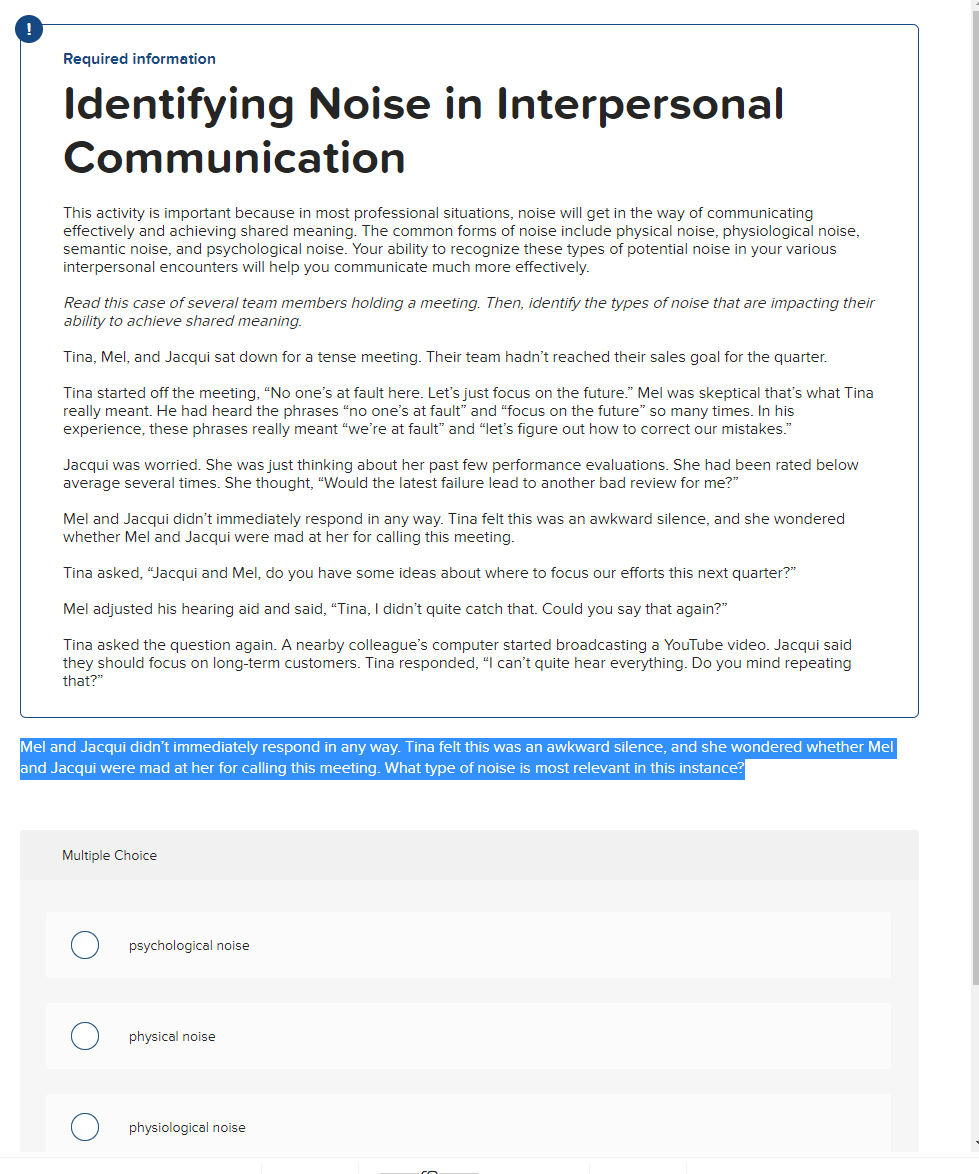
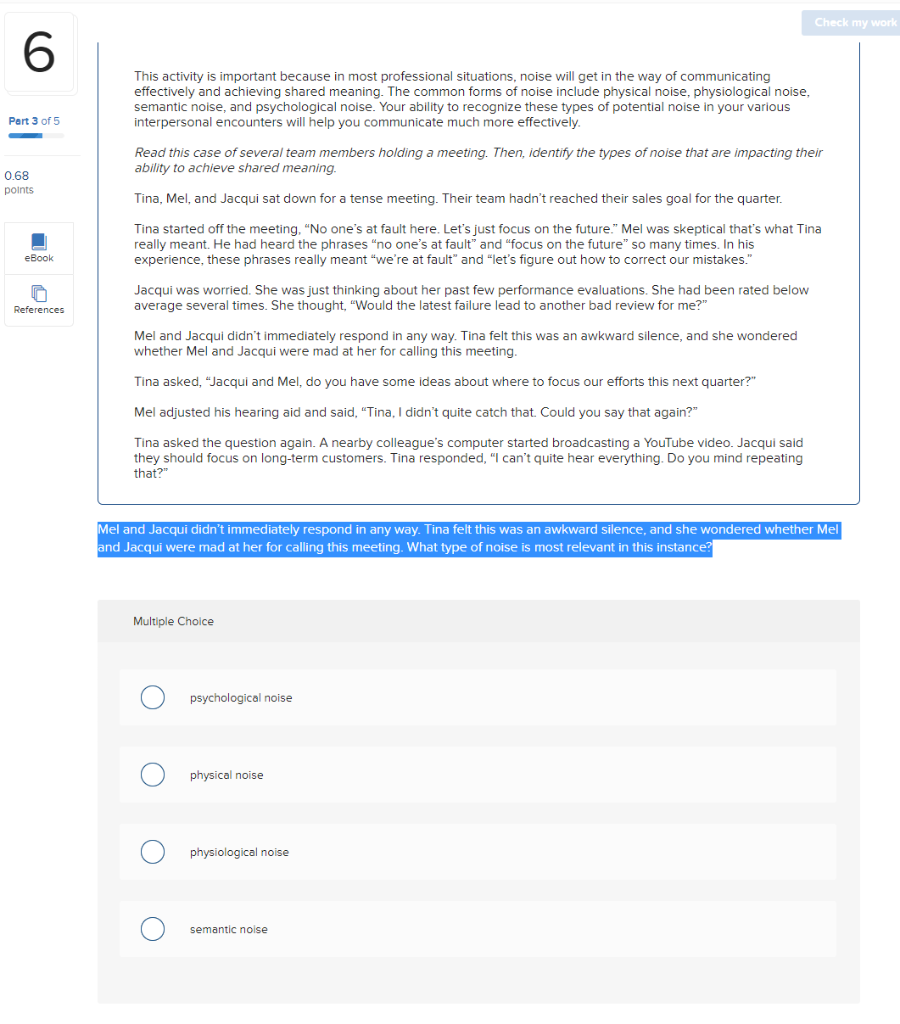
! Required information Identifying Noise in Interpersonal Communication This activity is important because in most professional situations, noise will get in the way of communicating effectively and achieving shared meaning. The common forms of noise include physical noise, physiological noise, semantic noise, and psychological noise. Your ability to recognize these types of potential noise in your various interpersonal encounters will help you communicate much more effectively. Read this case of several team members holding a meeting. Then, identify the types of noise that are impacting their ability to achieve shared meaning. Tina, Mel, and Jacqui sat down for a tense meeting. Their team hadn't reached their sales goal for the quarter. Tina started off the meeting, "No one's at fault here. Let's just focus on the future." Mel was skeptical that's what Tina really meant. He had heard the phrases "no one's at fault and focus on the future so many times. In his experience, these phrases really meant "we're at fault" and "let's figure out how to correct our mistakes." Jacqui was worried. She was just thinking about her past few performance evaluations. She had been rated below average several times. She thought, "Would the latest failure lead to another bad review for me?" Mel and Jacqui didn't immediately respond in any way. Tina felt this was an awkward silence, and she wondered whether Mel and Jacqui were mad at her for calling this meeting. Tina asked, Jacqui and Mel, do you have some ideas about where to focus our efforts this next quarter?" Mel adjusted his hearing aid and said, Tina, I didn't quite catch that. Could you say that again?" Tina asked the question again. A nearby colleague's computer started broadcasting a YouTube video. Jacqui said they should focus on long-term customers. Tina responded, "I can't quite hear everything. Do you mind repeating that?" Mel and Jacqui didn't immediately respond in any way. Tina felt this was an awkward silence, and she wondered whether Mel and Jacqui were mad at her for calling this meeting. What type of noise is most relevant in this instance? Multiple Choice psychological noise physical noise physiological noise Check my work 6 This activity is important because in most professional situations, noise will get in the way of communicating effectively and achieving shared meaning. The common forms of noise include physical noise, physiological noise, semantic noise, and psychological noise. Your ability to recognize these types of potential noise in your various interpersonal encounters will help you communicate much more effectively. Part 3 of 5 0.68 points Read this case of several team members holding a meeting. Then, identify the types of noise that are impacting their ability to achieve shared meaning. Tina, Mel, and Jacqui sat down for a tense meeting. Their team hadn't reached their sales goal for the quarter. Tina started off the meeting, "No one's at fault here. Let's just focus on the future." Mel was skeptical that's what Tina really meant. He had heard the phrases "no one's at fault" and "focus on the future so many times. In his experience, these phrases really meant "we're at fault" and "let's figure out how to correct our mistakes." eBook r References Jacqui was worried. She was just thinking about her past few performance evaluations. She had been rated below average several times. She thought, "Would the latest failure lead to another bad review for me?" Mel and Jacqui didn't immediately respond in any way. Tina felt this was an awkward silence, and she wondered whether Mel and Jacqui were mad at her for calling this meeting. Tina asked, "Jacqui and Mel, do you have some ideas about where to focus our efforts this next quarter?" Mel adjusted his hearing aid and said, "Tina, I didn't quite catch that Could you say that again?" Tina asked the question again. A nearby colleague's computer started broadcasting a YouTube video. Jacqui said they should focus on long-term customers. Tina responded, "I can't quite hear everything. Do you mind repeating that?" Mel and Jacqui didn't immediately respond in any way. Tina felt this was an awkward silence, and she wondered whether Mel and Jacqui were mad at her for calling this meeting. What type of noise is most relevant in this instance? Multiple Choice psychological noise O physical noise O O physiological noise semantic noise









 Study Help