





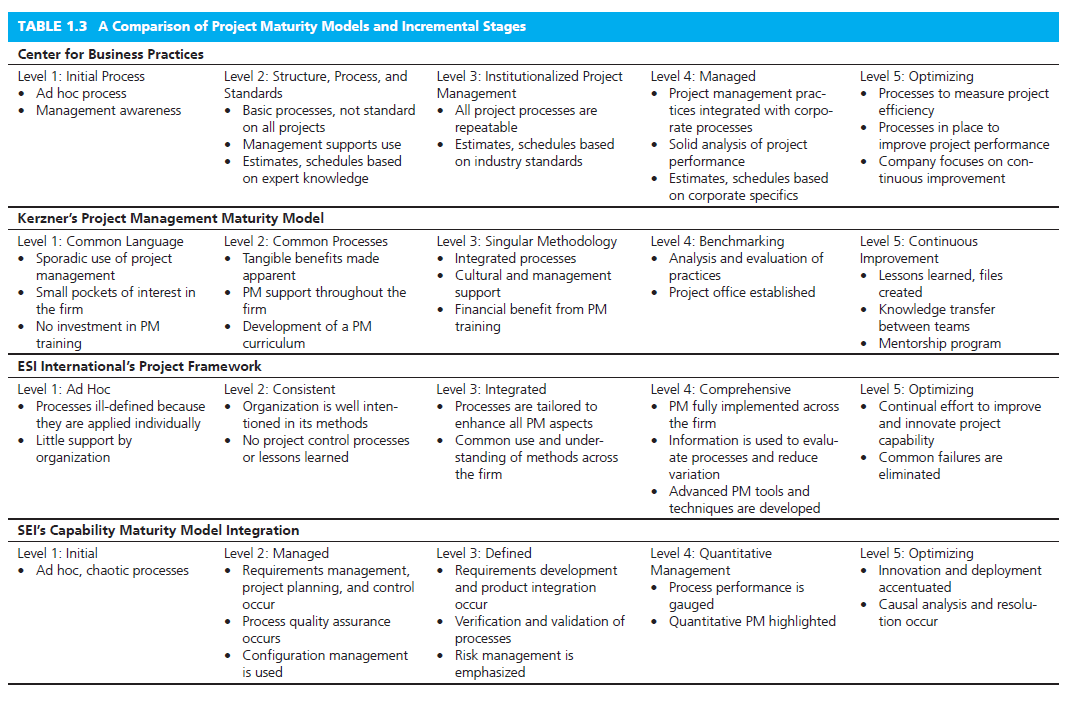
Question: Compare and contrast the four project management maturity models shown in Table 1.3. What strengths and weaknesses do you perceive in each of the models?
Compare and contrast the four project management maturity

models shown in Table 1.3. What strengths and weaknesses

do you perceive in each of the models?

Compare and contrast the four project management

TABLE 1.3 A Comparison of Project Maturity Models and Incremental Stages Center for Business Practices Level 1: Initial Process Level 2: Structure, Process, and Level 3: Institutionalized Project Ad hoc process Standards Management Management awareness Basic processes, not standard project processes are on all projects repeatable Management supports use Estimates, schedules based Estimates, schedules based on industry standards on expert knowledge Level 4: Managed Project management prac- tices integrated with corpo- rate processes Solid analysis of project performance Estimates, schedules based on corporate specifics Level 5: Optimizing Processes to measure project efficiency Processes in place to improve project performance Company focuses on con- tinuous improvement Level 3: Singular Methodology Integrated processes Cultural and management support Financial benefit from PM training Level 4: Benchmarking Analysis and evaluation of practices Project office established Kerzner's Project Management Maturity Model Level 1: Common Language Level 2: Common Processes Sporadic use of project Tangible benefits made management apparent Small pockets of interest in PM support throughout the the firm firm No investment in PM Development of a PM training curriculum ESI International's Project Framework Level 1: Ad Hoc Level 2: Consistent Processes ill-defined because Organization is well inten- they are applied individually tioned in its methods Little support by No project control processes organization or lessons learned Level 5: Continuous Improvement Lessons learned, files created Knowledge transfer between teams Mentorship program Level 3: Integrated Processes are tailored to enhance all PM aspects Common use and under- standing of methods across the firm Level 4: Comprehensive PM fully implemented across the firm Information is used to evalu- ate processes and reduce variation Advanced PM tools and techniques are developed Level 5: Optimizing Continual effort to improve and innovate project capability Common failures are eliminated SEI's Capability Maturity Model Integration Level 1: Initial Level 2: Managed Ad hoc, chaotic processes Requirements management, project planning, and control occur Process quality assurance occurs Configuration management is used Level 3: Defined Requirements development and product integration occur Verification and validation of processes Risk management is emphasized Level 4: Quantitative Management Process performance is gauged Quantitative PM highlighted Level 5: Optimizing Innovation and deployment accentuated Causal analysis and resolu- tion occur

Step by Step Solution

There are 3 Steps involved in it

1 Expert Approved Answer
Step: 1 Unlock blur-text-image

Question Has Been Solved by an Expert!

Get step-by-step solutions from verified subject matter experts

Step: 2 Unlock
Step: 3 Unlock

Students Have Also Explored These Related General Management Questions!