





Question: comparing In this problem, we consider the performance of non-persistent HTTP with persistent HTTP. Suppose the page your browser wants to download is 300K bits
comparing In this problem, we consider the
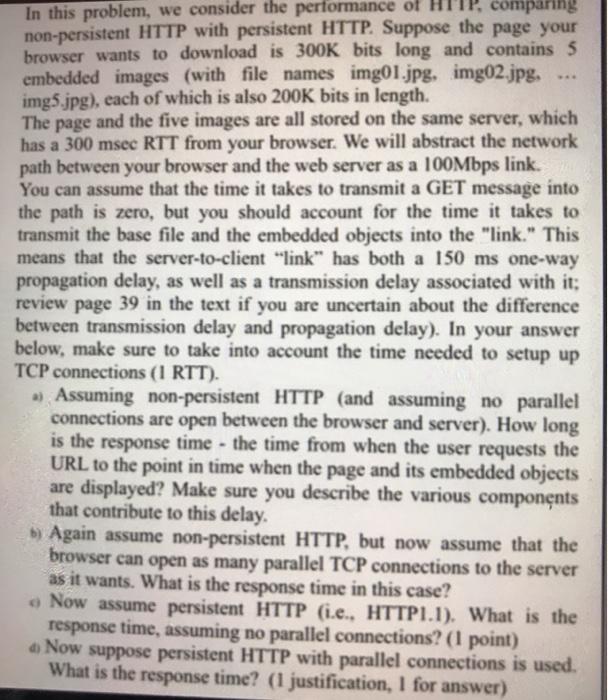
comparing In this problem, we consider the performance of non-persistent HTTP with persistent HTTP. Suppose the page your browser wants to download is 300K bits long and contains 5 embedded images (with file names img01.jpg, img02.jpg img5.jpg), each of which is also 200K bits in length. The page and the five images are all stored on the same server, which has a 300 msec RTT from your browser. We will abstract the network path between your browser and the web server as a 100Mbps link. You can assume that the time it takes to transmit a GET message into the path is zero, but you should account for the time it takes to transmit the base file and the embedded objects into the "link." This means that the server-to-client "link" has both a 150 ms one-way propagation delay, as well as a transmission delay associated with it; review page 39 in the text if you are uncertain about the difference between transmission delay and propagation delay). In your answer below, make sure to take into account the time needed to setup up TCP connections (1 RTT). - Assuming non-persistent HTTP (and assuming no parallel connections are open between the browser and server). How long is the response time - the time from when the user requests the URL to the point in time when the page and its embedded objects are displayed? Make sure you describe the various components that contribute to this delay. ) Again assume non-persistent HTTP, but now assume that the browser can open as many parallel TCP connections to the server as it wants. What is the response time in this case? Now assume persistent HTTP (i.e., HTTP1.1). What is the response time, assuming no parallel connections? (1 point) . Now suppose persistent HTTP with parallel connections is used. What is the response time? (1 justification, I for answer)

Step by Step Solution

There are 3 Steps involved in it

1 Expert Approved Answer
Step: 1 Unlock blur-text-image

Question Has Been Solved by an Expert!

Get step-by-step solutions from verified subject matter experts

Step: 2 Unlock
Step: 3 Unlock

Students Have Also Explored These Related General Management Questions!