







Question: competing on quality ARTICLE ANALYSIS For each article in the text that is assigned, you are to prepare an outline of the key concepts of
competing on quality 
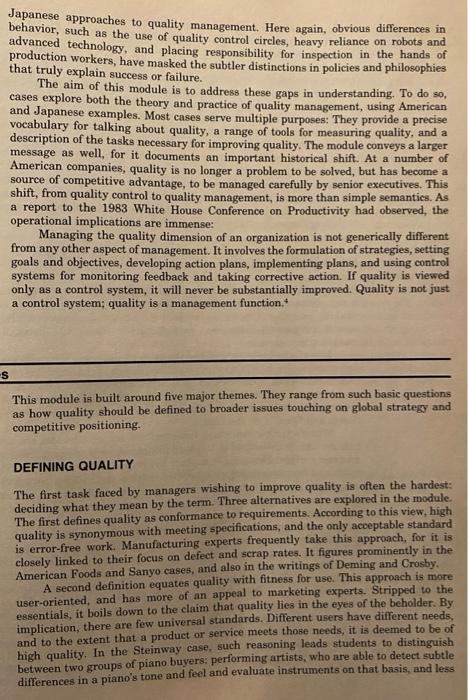
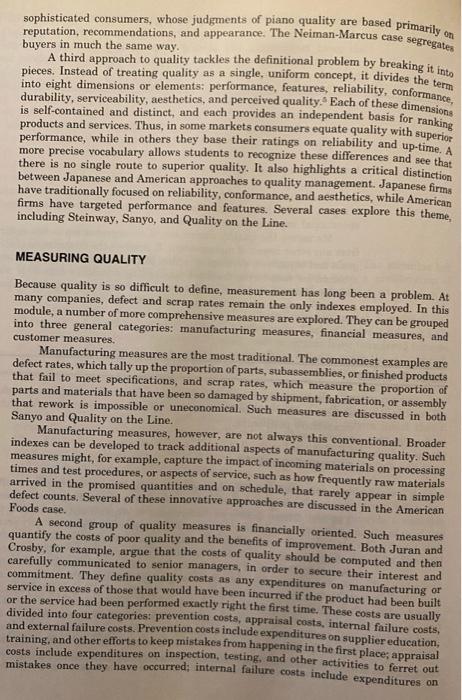
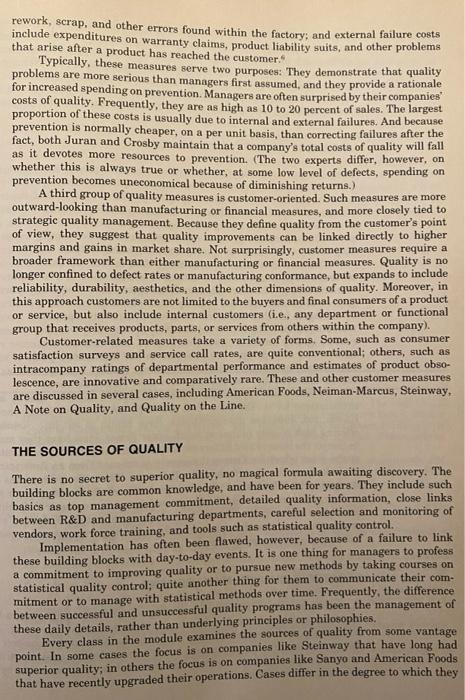
proliferation of Quality has suddenly become a hot topic in management circles. The stimulus has frequently been Japanese competition, and the result has been a programs and techniques. Today an impressive array of companies cite quality as their chief competitive priority. have achieved dramatic breakthroughs in performance. Lack of interest has not been Surprisingly, many of these programs have been limited in impact. Few companies the problem, not a lack of resources. Instead, most programs have foundered because of a lack of understanding. All too often, managers have failed to grasp three essentials of quality management: the meaning of quality; its measurement, and its sources in design, purchasing, and production. Terminology is partly to blame. Quality is an unusually slippery concept, easy to visualize and yet exasperatingly difficult to define. Conflicting definitions are common. Some experts claim that quality is "fitness for use"; others insist that it means "conformance to requirements." Faced with these conflicts, managers have often finessed the issue by saying, I know it when I see it." While such language offers room for maneuvering, it is of little help to those who must design, manufacture, and market products to exacting specifications. Measurement has been equally problematic. Traditional quality control depart- ments have normally confined themselves to tracking defect rates, scrap rates, and related measures of manufacturing conformance. These indexes provide a valuable guide to in-plant quality, but they say little or nothing about the quality of products that have reached customers' hands. Moreover, top managers have often found such measures difficult to interpret, because they have seldom been stated in financial terms. For their purposes, more comprehensive indexes are required. Improvement programs have also suffered from managers' inability to pinpoint the sources of quality. In the absence of such knowledge, generalizations have been the rule. Unfortunately, the suggested behaviors-conservative engineering, demon strating top management commitment, buying on quality rather than price , and building quality into designs-have seldom been very concrete. One result has been flawed implementation. Similar problems have plagued most attempts to mimic *Excerpt from Operations Strategy: Module Overview: Competing on Quality, Harvard Business School a Teaching Note 5-688-044. Copyright 1987 by the President and Fellows of Harvard College. Japanese approaches to quality management. Here again, obvious differences in behavior, such as the use of quality control circles, heavy reliance on robots and advanced technology, and placing responsibility for inspection in the hands of production workers, have masked the subtler distinctions in policies and philosophies that truly explain success or failure. The aim of this module is to address these gaps in understanding. To do so, cases explore both the theory and practice of quality management, using American and Japanese examples. Most cases serve multiple purposes: They provide a precise vocabulary for talking about quality, a range of tools for measuring quality, and a description of the tasks necessary for improving quality. The module conveys a larger message as well, for it documents an important historical shift. At a number of American companies, quality is no longer a problem to be solved, but has become a source of competitive advantage, to be managed carefully by senior executives. This shift, from quality control to quality management, is more than simple semantics. As a report to the 1983 White House Conference on Productivity had observed, the operational implications are immense: Managing the quality dimension of an organization is not generically different from any other aspect of management. It involves the formulation of strategies, setting goals and objectives, developing action plans, implementing plans, and using control systems for monitoring feedback and taking corrective action. If quality is viewed only as a control system, it will never be substantially improved. Quality is not just a control system: quality is a management function. S This module is built around five major themes. They range from such basic questions as how quality should be defined to broader issues touching on global strategy and competitive positioning. DEFINING QUALITY The first task faced by managers wishing to improve quality is often the hardest: deciding what they mean by the term. Three alternatives are explored in the module. The first defines quality as conformance to requirements. According to this view, high quality is synonymous with meeting specifications, and the only acceptable standard is error-free work. Manufacturing experts frequently take this approach, for it is closely linked to their focus on defect and scrap rates. It figures prominently in the American Foods and Sanyo cases, and also in the writings of Deming and Crosby A second definition equates quality with fitness for use. This approach is more user-oriented, and has more of an appeal to marketing experts. Stripped to the essentials, it boils down to the claim that quality lies in the eyes of the beholder. By implication, there are few universal standards. Different users have different needs, and to the extent that a product or service meets those needs, it is deemed to be of high quality. In the Steinway case, such reasoning leads students to distinguish between two groups of piano buyers: performing artists, who are able to detect subtle differences in a piano's tone and feel and evaluate instruments on that basis, and less sophisticated consumers, whose judgments of piano quality are based primarily reputation, recommendations, and appearance. The Neiman Marcus case segregates buyers in much the same way. A third approach to quality tackles the definitional problem by breaking it into pieces. Instead of treating quality as a single, uniform concept, it divides the ter into eight dimensions or elements: performance, features, reliability, conformance, durability, serviceability, aesthetics, and perceived quality. Each of these dimensions is self-contained and distinct, and each provides an independent basis for ranking products and services. Thus, in some markets consumers equate quality with superior performance, while in others they base their ratings on reliability and up-time. A more precise vocabulary allows students to recognize these differences and see that there is no single route to superior quality. It also highlights a critical distinction between Japanese and American approaches to quality management. Japanese firme have traditionally focused on reliability, conformance, and aesthetics, while American firms have targeted performance and features. Several cases explore this theme, including Steinway, Sanyo, and Quality on the Line. MEASURING QUALITY Because quality is so difficult to define, measurement has long been a problem. At many companies, defect and scrap rates remain the only indexes employed. In this module, a number of more comprehensive measures are explored. They can be grouped into three general categories: manufacturing measures, financial measures, and customer measures Manufacturing measures are the most traditional. The commonest examples are defect rates, which tally up the proportion of parts, subassemblies, or finished products that fail to meet specifications, and scrap rates, which measure the proportion of parts and materials that have been so damaged by shipment, fabrication, or assembly that rework is impossible or uneconomical. Such measures are discussed in both Sanyo and Quality on the Line. Manufacturing measures, however, are not always this conventional. Broader indexes can be developed to track additional aspects of manufacturing quality. Such measures might, for example, capture the impact of incoming materials on processing times and test procedures, or aspects of service, such as how frequently raw materials arrived in the promised quantities and on schedule, that rarely appear in simple defect counts. Several of these innovative approaches are discussed in the American Foods case. A second group of quality measures is financially oriented. Such measures quantify the costs of poor quality and the benefits of improvement. Both Juran and Crosby, for example, argue that the costs of quality should be computed and then carefully communicated to senior managers, in order to secure their interest and commitment. They define quality costs as any expenditures on manufacturing or service in excess of those that would have been incurred if the product had been built or the service had been performed exactly right the first time. These costs are usually divided into four categories: prevention costs, appraisal costs, internal failure costs, and external failure costs. Prevention costs include expenditures on supplier education, training, and other efforts to keep mistakes from happening in the first place, appraisal costs include expenditures on inspection, testing, and other activities to ferret out mistakes once they have occurred; internal failure costs include expenditures on rework, scrap, and other errors found within the factory, and external failure costs include expenditures on warranty claims, product liability suits, and other problems that arise after a product has reached the customer Typically, these measures serve two purposes: They demonstrate that quality problems are more serious than managers first assumed, and they provide a rationale for increased spending on prevention Managers are often surprised by their companies costs of quality. Frequently, they are as high as 10 to 20 percent of sales. The largest proportion of these costs is usually due to internal and external failures. And because prevention is normally cheaper, on a per unit basis, than correcting failures after the fact, both Juran and Crosby maintain that a company's total costs of quality will fall as it devotes more resources to prevention. (The two experts differ, however, on whether this is always true or whether, at some low level of defects, spending on prevention becomes uneconomical because of diminishing returns.) A third group of quality measures is customer-oriented. Such measures are more outward-looking than manufacturing or financial measures, and more closely tied to strategic quality management. Because they define quality from the customer's point of view, they suggest that quality improvements can be linked directly to higher margins and gains in market share. Not surprisingly, customer measures require a broader framework than either manufacturing or financial measures. Quality is no longer confined to defect rates or manufacturing conformance, but expands to include reliability, durability, aesthetics, and the other dimensions of quality. Moreover, in this approach customers are not limited to the buyers and final consumers of a product or service, but also include internal customers (ie, any department or functional group that receives products, parts, or services from others within the company). Customer-related measures take a variety of forms. Some, such as consumer satisfaction surveys and service call rates, are quite conventional; others, such as intracompany ratings of departmental performance and estimates of product obso- lescence, are innovative and comparatively rare. These and other customer measures are discussed in several cases, including American Foods, Neiman Marcus, Steinway, A Note on Quality, and Quality on the Line. THE SOURCES OF QUALITY There is no secret to superior quality, no magical formula awaiting discovery. The building blocks are common knowledge, and have been for years. They include such basics as top management commitment, detailed quality information, close links between R&D and manufacturing departments, careful selection and monitoring of vendors, work force training, and tools such as statistical quality control. Implementation has often been flawed, however, because of a failure to link these building blocks with day-to-day events. It is one thing for managers to profess a commitment to improving quality or to pursue new methods by taking courses on statistical quality control; quite another thing for them to communicate their com mitment or to manage with statistical methods over time. Frequently, the difference between successful and unsuccessful quality programs has been the management of these daily details, rather than underlying principles or philosophies, Every class in the module examines the sources of quality from some vantage point. In some cases the focus is on companies like Steinway that have long had superior quality; in others the focus is on companies like Sanyo and American Foods that have recently upgraded their operations. Cases differ in the degree to which they emphasize particular tools or approaches American Foods focuses on data collect and quality information items, Steway focuses on raw material selection, skills, and product testing Sanyo focus on supplier management, desi manufacturability, and top management commitments and Neiman Marcus focus on customer contact, buyer behavior, and responsive sales force. In every however, the sources of quality are explored at the micro-level and in fine details order to identify the specific practices that support successful programs JAPANESE QUALITY MANAGEMENT Surprisingly, a great mythology still surrounds Japanese manufacturers, despite the publicity they have received. Few analysts question the Japanese success in global markets or their superior product quality. The source of that superiority, however, remains a subject of heated debate. Is the explanation culture and national character A distinctive manufacturing philosophy? A particular set of design, purchasing and production practices? Or have the Japanese succeeded simply because they adopted long-established American quality control techniques that U.S. firms ignored? There are partisans in each camp. And in fact, all four views contain elements of truth. Japanese culture is indeed distinctive; so is the Japanese approach to manufacturing. Morever, Japanese managers have frequently pursued continuous improvement and enforced "quality first" philosophies with a dedication unmatched by managers in other countries. A variety of innovative practices have also been used including foolproofing to prevent assembly errors, early warning systems to distinguish routine quality problems from emergencies, and internal consumer review boards to ensure that new designs are sensitive to the consumer's point of view. Yet at the same time, such fundamentals of Japanese quality management as process control charts and reliability engineering have clear American roots. Several cases explore the sources of Japan's superior quality and the possible explanations for it. The issue first arises in the Steinway case, where Yamaha and Kawai, two Japanese manufacturers, have begun to cut into Steinway's market by offering high quality pianos at much lower prices. How have they managed to do so? In Sanyo, the issue is a bit different. Sanyo has managed to cut defect rates substantially at the color television factory it recently purchased from an American manufacturer, while keeping the work force virtually intact. What, if anything, was Japanese about its approach? Which steps were innovative, and which were simply sound manufae turing practices that had been ignored by prior managers? Quality on the Line completes the Japanese story by reviewing a range of design, purchasing, and production practices that have contributed to superior Japanese quality in a single industry, room air conditioning. STRATEGIC QUALITY MANAGEMENT In recent years, countless American companies have sought to upgrade their quality, adopting such traditional methods as statistical quality control, cost of quality calculations, and zero defects. Few, however, have learned to compete on quality. For the most part, their approaches have been defensive and reactive. Quality has remained a problem to be solved, and success has been measured by the absence of defects or product failures. Module 2 Competing on Qually Such approaches are quite different from the strategic quality management practiced by Japanese manufacturers and a small number of leading U.S. firms. To them, quality is an opportunity to please customers, not simply the avoidance of problems. Quality improvement is therefore linked to basic business objectives, rather than being pursued in a vacuum. This approach, which goes by the name of company- wide quality control or strategic quality management, has five basic tenets: (1) quality is defined from the customer's point of view. (2) quality is linked with profitability on both the market and cost sides, (3) quality is viewed as a competitive weapon, (4) quality is built into the strategic planning process, and (5) quality requires an organization-wide commitment. Strategic quality management thus involves a sharp change in philosophy, a shift from the traditional production and cost-based view of quality to a marketing and customer-based view. It is also more comprehensive than its predecessors, which assigned responsibility for quality to engineering and manufacturing personnel. In the strategic approach, the entire organization all levels and all functional groups is active in quality improvement. Senior managers provide the leadership and are personally iny in program design and implementation. These distinctions between strategic quality management and its predecessors, quality control and quality assurance, are discussed in the final two classes of the module. They provide a fitting conclusion to the unit, for they show how far quality management has come in the sixty years that it has been a distinct discipline. 1. See, for example, Jeffrey Miller, Jinchiro Nakane, and Thomas Vollman, The 1983 Global Manufacturing Futures Survey: Summary of Survey Responses & Preliminary Report (Boston: School of Management, Boston University, April 1983), pp. 7-8, and Kasra Ferdows et al, Evolving Manufacturing Strategies in Europe, Japan, and North America (Fontainebleau, France: INSEAD, 1985), pp. 2-4, 9. 2. The first definition is Joseph Juran's; the second is Philip Crosby's. See, respectively, J.M. Juran, Quality Control Handbook, Third Edition (New York: McGraw-Hill, 1974), pp. 2-2- 2-11, and Philip B. Crosby, Quality Is Free (New York: New American Library, 1979), pp. 14-15. 3. For a splendid discussion of the pitfalls of this approach, see John Guaspari, I Know It When 1 See Ii (New York: AMACOM, 1985). 4. Final Report of the American Productivity Center Conference on Quality and Productivity (Washington, D.C.: September 22-23, 1983, mimeographed), p. 10. 5. For more on the dimensions of quality, see David A. Garvin, "Product Quality: An Important Strategic Weapon" Business Horizons, March April 1984, pp. 40-43; David A. Garvin, "What Does 'Product Quality Really Mean?." Sloan Management Review. Fall 1984, pp 25-43; David A. Garvin, "Competing on the Eight Dimensions of Quality." Harvard Busines Revicu, November-December 1987, pp. 101109; and David A. Garvin, Managing Quality (New York: Free Press, 1987), ch. 4. 6. See Jack Campanella and Frank J. Corcoran, "Principles of Quality Costs,"Quality Progress April 1983, pp. 16-22, for a more detailed discussion of quality costs. 7. For descriptions of a number of these practices, see David A. Garvin, Japanese Quality Management," Columbia Journal of World Business, Fall 1984, pp. 3-12, and Richard J. Schonberger, Japanese Manufacturing Techniques (New York: Free Press, 1982). ch. 3 ARTICLE ANALYSIS
For each article in the text that is assigned, you are to prepare an outline of the key
concepts of the article, This can be in outline format, but should be typed and look
professional. read fhe atrical below.
Step by Step Solution
There are 3 Steps involved in it
1 Expert Approved Answer
Step: 1 Unlock

Question Has Been Solved by an Expert!
Get step-by-step solutions from verified subject matter experts
Step: 2 Unlock
Step: 3 Unlock
 Study Help